Choose the bike your child fits today, not the one they might fit in two years. If a 16-inch bike is clearly too small and a 20-inch looks big, the answer is decided by two checks you can do in ten minutes: the inseam measurement and a standover test with the child actually on the bike. Wheel size labels and age ranges only get you to the right shelf.
Why the sizes overlap
A “16-inch” or “20-inch” bike is named for its wheel diameter. Manufacturers pair each diameter with an age and height band, but children of the same age vary a lot in height and leg length. Trek’s kids’ guide says plainly that its size ranges are wide and tend to overlap, and that individual bikes differ even when the wheel diameter is the same.
Trek’s own chart shows the overlap. It lists 16-inch bikes for ages 4 to 6 (height 104 to 122 cm, inseam 40.6 to 55.9 cm) and 20-inch bikes for ages 5 to 8 (height 114 to 137 cm, inseam 48 to 63.5 cm). A child of 115 to 122 cm, or with an inseam between 48 and 55.9 cm, sits in both bands. That is the “in between” situation, and the chart alone cannot settle it. Other brands draw their lines differently, so treat any one chart as a starting point.
| Wheel size | Age (Trek chart) | Height | Inseam |
|---|---|---|---|
| 16 in | 4 to 6 | 104 to 122 cm (41 to 48 in) | 40.6 to 55.9 cm (16 to 22 in) |
| 20 in | 5 to 8 | 114 to 137 cm (45 to 54 in) | 48 to 63.5 cm (19 to 25 in) |
Measure the inseam first
Inseam is the distance from the floor to the crotch. A common way to take it is to have the child stand barefoot against a wall with a book snug between the legs and measure to the top of the book. Trek recommends picking an approximate wheel diameter from height and age, then measuring the inseam to find the most comfortable bike, one the child can sit on with both feet down and mount and dismount without struggle.
If the inseam falls in the overlap zone, the number alone will not decide it. Move to a hands-on test.
The fit test that settles it
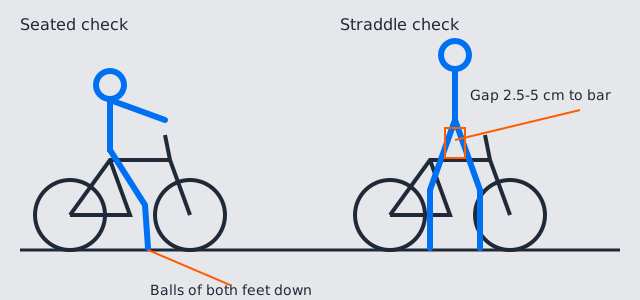
The American Academy of Pediatrics suggests bringing the child to the shop so they can try the bike. Two checks apply to any style of bike:
- Seated: with hands on the handlebar, the child should be able to put the balls of both feet on the ground.
- Straddling: standing over the center bar, both feet should be flat on the ground with about 1 inch (2.5 cm) of space between the crotch and the bar. Trek gives a slightly wider window of 2.5 to 5 cm (1 to 2 in) between the child and the top tube.
The two sources differ a little here, but both point the same way: feet reach the ground, and there is a real gap above the bar rather than contact. If the child cannot meet both checks on the 20-inch, it is too big for now.
Why not buy big and wait
It is tempting to buy the larger bike so it lasts longer. Both sources advise against it. The AAP says to buy the right size rather than one a child has to “grow into,” and adds that oversized bikes are especially dangerous. Trek warns that an oversized bike can slow learning and hurt confidence.
The reason is mechanical. A child who cannot reach the ground or the brakes has less ability to stop and steady the bike, which is the kind of lost control the AAP warns about: a bike that is too big or too small can cause a child to lose control and get hurt, so “too small” is a risk too.
How to choose when it is still close
- Younger or newer rider (around 4 to 5): favor the 16-inch. Beginners need to put a foot down quickly. The AAP also suggests not pushing a two-wheeler before the child is ready, at about age 5 or 6.
- Taller, confident rider who passes both fit checks on the 20-inch: the 20-inch is reasonable.
- Passes on neither: try a different model. Frames of the same wheel size differ, so a lower top tube or shorter reach on another bike can change the result.
- Older child with hand brakes: confirm they can comfortably grip the levers and squeeze hard enough to stop. If they cannot, treat that bike as the wrong fit for now and have a shop look at it.
Once a bike fits, a little saddle adjustment is normal. Trek notes that when the child is comfortable you can raise the saddle so the legs extend better for pedaling. Our guide to saddle height explains the principle for adults, and the broader bike fit guide covers reach.
When to see a shop rather than guess
Ask a bike shop to check the fit if your child cannot reach the brake levers, if neither size passes the standover check, or if the child seems nervous and wobbly on a bike that technically fits. If you are weighing other ways to ride with a younger child, see cycling with kids, and remember a properly fitted helmet matters as much as the bike; see how helmets work.
Sources
- Trek Bicycle: Kids’ buyer’s guide
- HealthyChildren.org (AAP): How to Choose the Right Size Bike & Helmet
Last reviewed: October 2026.