The short answer: a bright jacket may help, but the evidence is split, and it is weakest for the situation most commuters worry about, riding after dark. Some evidence suggests that reflective material placed on parts of you that move works better, and it belongs alongside proper lights rather than instead of them.
What the one randomized trial found
A Danish team ran what they describe as the first randomized controlled trial (RCT) of high-visibility bicycle clothing. An RCT assigns people to groups by chance, which makes the comparison fairer than simply asking who already wears hi-vis. It covered 6793 volunteers: 3402 were given a yellow jacket and 3391 rode as the control group. It appeared in Safety Science in October 2018.
The headline result looks large. The jacket group’s rate of personal injury accidents was 47% lower, and accidents involving a motor vehicle were 55% lower. Both figures come from the same self-reported data, so the caveats in the next section apply to the 55% as much as to the 47%.
Why the headline needs a discount
Participants reported their own accidents, and they knew whether they had the jacket, which is what “non-blinded” means. The authors noticed that jacket wearers also reported fewer single-rider accidents, something a jacket should not influence. They read this as probable response bias, meaning people who know they are in the test group may report differently. After a correction for that bias, the effect fell from 47% to 38%. That is still a meaningful reduction, but it is a self-reported figure from volunteers, not a count of verified crashes.
What the lighting researchers say
The University of Sheffield Lighting Research Group summarizes the wider literature more skeptically. Its position is that fluorescent or reflective jackets are not very good at making cyclists stand out to drivers, in particular after dark. It also points out that two studies using crash records reached opposing conclusions, one of them being the Danish trial above, and that both counted crashes in daylight as well as after dark. Because daylight and darkness are lumped together in both, a reader cannot tell from those results alone whether a jacket helps more at one time of day than the other.
Sheffield suggests the disagreement between those two crash studies may come from method: the Danish one relied on self-reported crashes in a non-blinded trial, so response bias could have shaped the answers.
| Question | Danish RCT | Sheffield summary |
|---|---|---|
| Does a hi-vis jacket reduce accidents? | Yes: 47% lower injury rate, 38% after bias correction | Jackets are not very good at raising visibility, especially after dark |
| Main limitation | Non-blinded, self-reported accidents | Crash studies disagree and mix daylight with darkness |
Why reflectors on joints work differently
Reflective tape only lights up when a vehicle’s headlights hit it, but placed on the wrists and ankles it moves with every pedal stroke. A moving cluster of reflective points is a different shape from a big, still jacket. A 2020 paper in Sheffield’s reference list is titled “Highlighting bicyclist biological motion enhances their conspicuity in daylight”, which points toward motion being part of the explanation, though the summary page does not detail the mechanism. This approach is called bio-marking, and Sheffield says there is some evidence that reflectors on the wrists and ankles greatly improve conspicuity (how readily you are noticed). The research also mentions reflective strips on pedals.
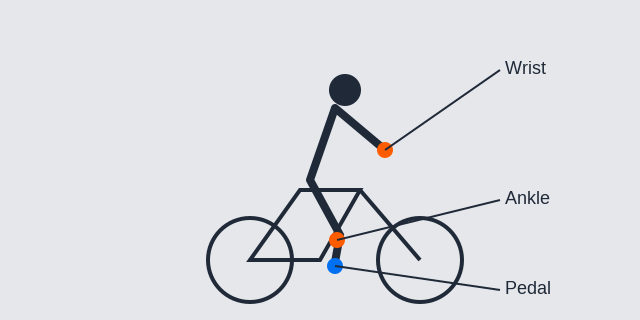
There is a related trap: cyclists tend to overestimate how visible they are to drivers. Sheffield notes that this makes them less likely to appreciate the need to take precautions, so a bright vest can create more confidence than it has earned.
Limits of the reflector evidence
- Cyclists in those tests were always seen from behind, so how well it works head-on is unknown.
- Bio-marking studies used reflective strips only. Sheffield notes that no studies looked at active lights worn the same way, which in principle should stand out more because they do not depend on a car’s headlights.
What to do with this
- Lights first. This is practical advice rather than a finding from the studies above: a working front and rear set is the baseline, and the Sheffield summary itself raises active lights as an untested but promising option. See our guide to commuter bike lights.
- Add reflective material on moving parts, such as reflective bands on wrists and ankles, or reflective strips on pedals, rather than relying on a vest alone. If any band or tape gets in the way of your hands, brakes or pedaling, take it off.
- Wear bright clothing by day if you like it. The trial suggests possible benefit and it costs little, but do not treat it as a substitute for riding position and awareness.
- Ride as if you may not be seen. Our basic road rules and advice on choosing a safe route are better investments than any single garment, in the author’s judgment.
Sheffield’s broader suggestion is that conspicuity features should be built into bikes and cycling clothing from the start, so safety does not depend on a rider’s choices. If you are planning a regular ride, our commuting guide covers the rest of the setup.
Sources
- Aalborg University: The effect of a yellow bicycle jacket on cyclist accidents
- University of Sheffield Lighting Research Group: Past studies about cyclist conspicuity
Last reviewed: October 2026.