The number in “1x,” “2x” or “3x” is how many chainrings are on the crank. A 1x drivetrain has one chainring and no front derailleur. A 2x has two chainrings and a front derailleur. A 3x has three. Everything else follows from that: how many gears you can reach, how wide the range is, how much the chain angles sideways, and how many parts need adjusting.
How the numbers work
The rear cassette holds the sprockets; the front chainrings are the other half of every gear. Sheldon Brown’s gearing introduction counts gears by multiplying chainrings by rear sprockets: two chainrings and five sprockets give 10 theoretical combinations, and a “27-speed” bike is three chainrings times nine sprockets. A 1x bike simply has one front ring, so its speed count equals the number of cassette sprockets.
Two terms help when comparing setups:
- Gear ratio is chainring teeth divided by sprocket teeth. A bigger ratio is a harder gear.
- Range is the hardest gear compared with the easiest. For a single chainring it is simply the largest sprocket divided by the smallest.
Comparing the three layouts
| 1x | 2x | 3x | |
|---|---|---|---|
| Chainrings | 1 | 2 | 3 |
| Front derailleur | None | Yes | Yes |
| Where the range comes from | A wide rear cassette | Cassette plus a choice of two rings | Cassette plus a choice of three rings |
| Step between neighboring gears | Set by the cassette only | Small steps within a ring, plus a larger jump when changing rings | Same, with two ring jumps |
| Shifting controls | One shifter | Two shifters | Two shifters |
1x: simple, with a very wide cassette
With no front derailleur, the cassette has to supply the whole range. SRAM’s Eagle XG-1275 cassette is a published example: 12 speeds, 10-50 teeth, with cogs of 10, 12, 14, 16, 18, 21, 24, 28, 32, 36, 42 and 50 teeth, listed on the page as a 1x cassette on an XD driver body. Its largest cog is five times its smallest, so one chainring covers a wide spread.
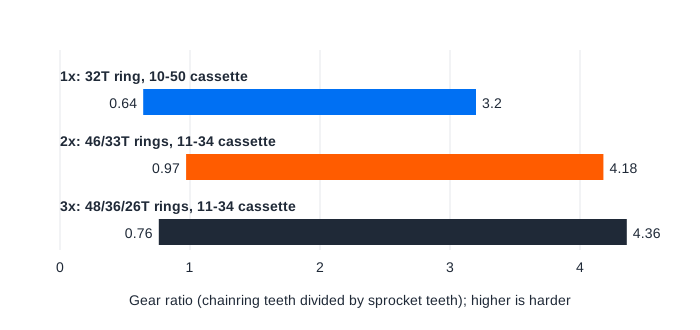
As an illustration only, a 32-tooth chainring with that cassette gives a hardest ratio of 3.2 (32 ÷ 10) and an easiest of 0.64 (32 ÷ 50). Chainring size is the lever you use to shift that whole window up or down.
The trade-off is the size of the steps. A 12-speed cassette spanning 10 to 50 must cover that gap in 11 jumps. Working from the cog list, each step changes the ratio by roughly 13 to 20 percent (10 to 12 teeth is 20 percent, 42 to 50 is about 19 percent, 16 to 18 is 12.5 percent), so a single ring never gets the very fine spacing a narrow cassette can.
Chain retention is the other 1x issue. With no front derailleur or second ring to guide the chain, 1x systems use chainrings with alternating wide and narrow teeth, which SRAM introduced as X-Sync rings for its single-ring XX1 mountain group in 2012. Rings and chains are matched parts: the trade press report on SRAM’s steel X-Sync ring notes the rings must be used with a SRAM chain to maintain the warranty. Check your component maker’s compatibility documentation before mixing parts.
2x: smaller steps, with a front derailleur to manage
Two chainrings add a second choice at the front: per Sheldon Brown, the smaller front sprocket gives the lower gears and the larger gives the higher ones. SRAM’s Rival eTap AXS front derailleur page, for example, lists 12-speed operation and chainring pairs of 46/33, 48/35 and 50/37 teeth. The same page says its Yaw technology “eliminates the need for shifter trim”, meaning the small front-derailleur adjustment some systems need as the chain moves across the cassette.
Hypothetical illustration (an 11-34 cassette chosen for the arithmetic, not a specific product): 46/33 chainrings with it would give a hardest ratio of about 4.2 (46 ÷ 11) and an easiest of about 0.97 (33 ÷ 34), a range of about 4.3 to 1, against 5 to 1 for the 1x example above, but built from a cassette whose sprockets sit closer together.
3x: the most gears on paper, the most to look after
Rose Bikes lists Shimano’s Deore FC-T6010 as a triple/10-speed crankset with 48, 36 and 26 teeth and a 50 mm chainline. Hypothetical illustration with the same 11-34 cassette: 48/11 gives about 4.4 and 26/34 about 0.76, the widest range of the three examples, as the chart shows.
Three chainrings give the highest theoretical count (a 27-speed bike is 3 chainwheels times 9 sprockets in Sheldon Brown’s example). The cost is an extra front shift to manage and more combinations that cross the chain at an extreme angle. Sheldon Brown warns against gears where the chain crosses at an extreme angle, especially the small chainring with the small rear sprocket, which he describes as noisy, inefficient and a cause of premature chain wear. This means the real number of useful gears is lower than the count printed on the shifter.
Which layout fits which rider
- Choose 1x if you want one shifter, no front derailleur and the least to adjust, and a wide cassette gives enough range. SRAM lists its XG-1275 as a 12-speed, 10-50 tooth, 1x cassette. The price is larger steps between gears.
- Choose 2x if you want smaller steps between gears and accept a front derailleur. Sheldon Brown notes that two front and five rear sprockets need two shifting mechanisms, one front and one rear. SRAM pairs its 12-speed Rival eTap AXS front derailleur with 46/33, 48/35 or 50/37 chainrings.
- Choose 3x only on a frame and crankset that already use it, such as the 10-speed triple cranksets Rose Bikes lists. Three rings give the most combinations (27 with nine sprockets) but also the most gears that cross the chain at an extreme angle, which Sheldon Brown calls bad for the chain and sprockets.
What to check when choosing
- Terrain and load. A steep hill is answered by the easiest ratio (small front, large rear). Wide-range cassettes and extra rings both aim at that.
- Chain angle. Sheldon Brown advises: “Try to avoid the gears that make the chain cross over at an extreme angle.” 1x removes front shifting and the front-ring crossovers, but the chain still angles across the cassette at the extremes.
- Maintenance. Front shifting problems are often caused by chainline, meaning the sideways position of the rings, according to Sheldon Brown’s derailer adjustment guide. A 1x removes the front derailleur from that list. For general shifting faults, see why your bike shifts badly.
- Replacement costs. Wide cassettes, chains and chainrings are matched systems. Confirm part compatibility with the manufacturer before buying; see how to maintain your bike chain.
For the basics of ratios, read Understanding Bike Gearing. If you are choosing a bike type first, road, hybrid or mountain is the better starting point, and mountain bike suspension covers the other big trail-bike decision.
Sources
- SRAM: XG-1275 Eagle Cassette (CS-XG-1275-A1)
- SRAM: Rival eTap AXS Front Derailleur
- Sheldon Brown: Gears (introduction)
- Sheldon Brown: Derailer Adjustment
- Rose Bikes: SHIMANO Deore FC-T6010 48/36/26 teeth crankset
- Bicycle Retailer and Industry News: SRAM offers $20 steel X-Sync chainrings
Last reviewed: October 2026.