Shift while the pedals are turning forward, and ease off the pedals for a moment as you do it. That one habit prevents most grinding, clunking and chain wear on a derailleur bike. Everything below explains why it works and how to choose the right gear before you need it.
Why you must keep pedaling to shift
A derailleur (the mechanism that moves the chain between sprockets) does not lift the chain across. It nudges the chain sideways, and the chain can only move sideways while it is also traveling forward. So you can shift only while pedaling forward.
The two derailleurs behave differently, which is why timing matters:
- Rear derailleur. It acts on the bottom of the chain loop, where tension is light. It can usually shift even under full load, but it is better to ease up a bit during the shift.
- Front derailleur. It works on the upper part of the chain, the part that carries your power to the rear wheel. Front shifts go poorly while you are pedaling very hard, slowly, or both.
The practical rule: lighten your push for a second or two, keep the cranks turning, then click the lever once.
Know which lever does what
On a typical multi-speed bike the left control moves the chain among the front chainrings (two or three), and the right control moves it among the rear sprockets (anywhere from 5 to 12). Look at your own bike before you ride, since the number of rings and sprockets varies.
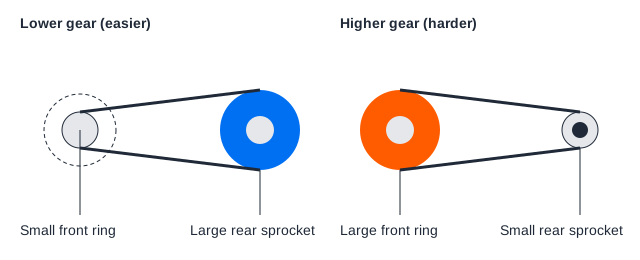
Rather than memorizing lever positions, picture where the chain is. Sprockets toward the middle of the bike, meaning a small front ring and a large rear sprocket, give the lower, easier gears. The outer ones, a large front ring and a small rear sprocket, give the higher, harder gears.
| Chain position | Gear feel | Use it for |
|---|---|---|
| Small front ring, large rear sprocket | Lowest, easiest | Steep climbs, starting from a stop |
| Middle of the range | Moderate | Flat roads, gentle slopes |
| Large front ring, small rear sprocket | Highest, hardest | Descents, tailwinds |
Shift early, before the gear is a problem
The best shift is the one you make before the hill, the stop sign or the headwind arrives. If you wait until the pedals are already heavy, you are shifting under load, which is the situation the technique is meant to avoid.
- See the change coming: a climb ahead, a traffic light, a turn into the wind.
- Shift down one gear at a time as the road tilts up, so your leg speed stays steady.
- Before stopping, shift to an easy gear so you can restart without struggling.
- After a climb, shift up gradually as speed builds.
Shifting one click at a time and listening for the chain to settle is better than dumping several gears at once. If the chain hesitates or skips, the cause is often cable tension or adjustment rather than your technique; see why a bike shifts badly and how to fix it.
Choose the gear by how your legs feel
The point of gears is a steady rhythm. Cadence is how fast your pedals turn, measured in revolutions per minute. Sheldon Brown, the veteran bicycle mechanic whose site is a long-standing reference, calls 75 to 90 RPM a typical easy cadence, while Cycling UK suggests about 70 to 90 RPM. The two sources are close but not identical, which is a reminder that these are comfort ranges, not rules. Count your pedal strokes for 15 seconds and multiply by four if you want a quick check.
Sheldon Brown notes that inexperienced riders often pedal too slowly, which means too high a gear. A gear that is too high for the conditions pushes you into a slower cadence. Shift easier until your legs turn freely without bouncing in the saddle. Our guide to cycling cadence goes deeper, and riding uphill without burning out applies the same idea to climbs.
Avoid the extreme cross-chain gears
Cross-chaining means running the chain at a steep diagonal, such as the small front ring with the small rear sprocket, or the large front ring with the large rear sprocket. Sheldon Brown flags the small front ring paired with the small rear sprocket as especially bad. Running that combination is loud, wastes effort, and makes the chain wear out sooner than it should.
The fix is simple. When you shift the front derailleur, move the rear to a matching region of the cassette. Use the small front ring with the larger rear sprockets, and the large front ring with the smaller ones. A chain kept in good shape lasts longer too; see how to maintain your bike chain.
Hub gears are different
If your bike has an internal gear hub, the rules change. Internal gears sit in the rear hub (or sometimes at the cranks) and can shift at a stop, which is why they suit city riding. Follow the manufacturer’s instructions for the hub on your bike.
When to get it checked
Technique cannot fix a drivetrain that is worn or misadjusted. Stop and have a bike shop look at the bike if the chain skips under pedal pressure, the chain falls off repeatedly, a shift lever feels loose or stuck, or the derailleur looks bent after a fall. If any of these happen, stop riding and have a shop check it before you ride again; Cycling UK advises asking a local bike shop to handle jobs you are not confident about. For background on how the parts relate, read understanding bike gearing.
Sources
- Sheldon Brown: How To Shift Your Bicycle’s Gears
- Cycling UK: Cycling tips: Essential riding advice for beginners
Last reviewed: October 2026.