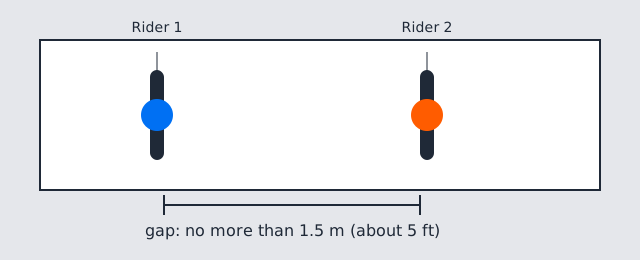
In Queensland, Western Australia and South Australia you may ride two abreast, with no more than 1.5 m (about 5 ft) between the two riders. A third rider beside them is generally not allowed (Queensland permits more than two only when overtaking another rider). The wording differs a little in each state, and the penalties are not spelled out equally, so it helps to know what each official page actually says.
The rule at a glance
“Abreast” simply means side by side, so two abreast is a pair of riders occupying the lane next to each other instead of one behind the other.
| State | Two side by side | Gap between the pair | More than two |
|---|---|---|---|
| Queensland | Permitted | No more than 1.5 m when beside another rider | Not permitted, unless overtaking another rider |
| Western Australia | Permitted on roads | Up to 1.5 m | The page does not state a rule for three or more riders |
| South Australia | Permitted on a carriageway | Not more than 1.5 m | An offence under Australian Road Rules rule 151 |
Queensland
The Queensland Government lists the gap rule under “keeping left”: riders must ride “no more than 1.5m apart, if travelling beside another rider”. Under overtaking, it says you must “not ride with more than 2 riders side by side unless you are overtaking another rider.”
That exception matters for group rides. The exception is tied to overtaking another rider; it is not a general allowance for riding three-wide on a quiet road.
The same page says riders on a single-lane road should stay as close as safely possible to the left side or shoulder, while on a multi-lane road you may take any position within the lane. It adds that bicycle riders are fined at the same rates as motorists but do not collect demerit points.
Western Australia
The Road Safety Commission says cyclists can ride two abreast on the road with up to 1.5 m between riders. It also draws a line between surfaces: single file on paths, two abreast (with 1.5 m between riders) on roads. On footpaths, single file is required.
Western Australia is the one of the three whose official page puts a number on a breach. It lists an infringement of $50 for failing to ride only two abreast with up to 1.5 m between riders. Check the page for the current amount before relying on that figure, since penalties are revised over time.
Two neighboring WA rules affect pairs directly. A marked bicycle lane must be used when one is present, and riding less than 2 m behind a vehicle is illegal. The page says it is illegal to ride less than 2 m behind a vehicle, and that applies to any vehicle, so a pair can respect the 1.5 m gap and still break that separate rule.
South Australia
The Legal Services Commission’s Law Handbook says cyclists can ride two abreast on a carriageway not more than 1.5 meters apart, and that more than two riding abreast is an offence under Australian Road Rules rule 151. This is the only one of the three sources that names the rule number, which is useful if you want to read the statute itself.
The same handbook covers how far drivers must stay from you when passing. A driver must leave a lateral gap of at least 1 meter where the speed limit is 60 km/h or less, and 1.5 meters where it is higher. That 1.5 m is a separate rule about drivers; do not confuse it with the gap between two riders.
On footpaths and shared paths, the handbook says to keep left unless impractical. Two abreast is a road rule, not a path rule.
What the sources agree on, and where they differ
- Agreed: two riders side by side is legal on the road, and the pair must stay within 1.5 m of each other.
- Different phrasing: Queensland states the overtaking exception explicitly. The Western Australian and South Australian pages do not mention one.
- Different detail: only Western Australia gives a fine amount; only South Australia cites the rule number; Queensland says fines match motorists’ without naming an amount for this offence.
- Different tier of source: the Queensland and Western Australian pages are government pages. The South Australian one is a legal-information handbook, so confirm against the Australian Road Rules text if the details matter to you.
These pages cover three states only. Other states and territories have their own road rules and are not covered here.
Riding a pair safely, not just legally
- Keep the gap well inside the limit. A pair at 1 m is easier to hold steady than one drifting toward 1.5 m, and it gives you room to avoid a pothole without clipping a wheel.
- Agree signals before you start. Call or point out hazards, and decide in advance who drops back when a vehicle approaches from behind.
- Merge to single file when it is safer. The rules allow two abreast; they do not require it. On narrow roads, blind corners and busy junctions, single file is simply better judgment.
- Keep your own tire pressure and brakes in order. Close riding punishes a sudden stop or a flat. See our guide to riding safely in a group for spacing and communication habits.
For general road positioning and visibility, the basic rules of cycling on roads covers the habits that apply anywhere, and commuter bike lights are worth fitting before riding side by side at dusk. Local rules can change, so if you lead regular group rides, read the current official page for your state before each season.
Sources
- Queensland Government: Bicycle rules
- Western Australia Road Safety Commission: Bicycle riders
- Legal Services Commission of South Australia: Law Handbook, cyclists
Last reviewed: October 2026.