A cassette fits a freehub body only if its spline pattern and the body’s length both match. Shimano HG (in several lengths), Shimano Micro Spline, SRAM XD and SRAM XDR are the families covered here. Shimano’s own chart lists Micro Spline as taking 12-speed MTB cassettes only, and SRAM’s XD and XDR are separate interfaces again, so check the interface, not just the speed count. This page is a reference for the body families covered by the Shimano and SRAM documents below.
Terms
- Freehub body (driver): the splined cylinder on the rear hub that carries the cassette and houses the ratchet.
- Spline: a ridge or groove that transmits pedaling torque between cassette and body.
- Outer body length: in Shimano’s definition, the length from the cassette contact surface of the free unit to its tip. It decides how many cogs and spacers fit.
The body families at a glance
| Body | Takes | Notes |
|---|---|---|
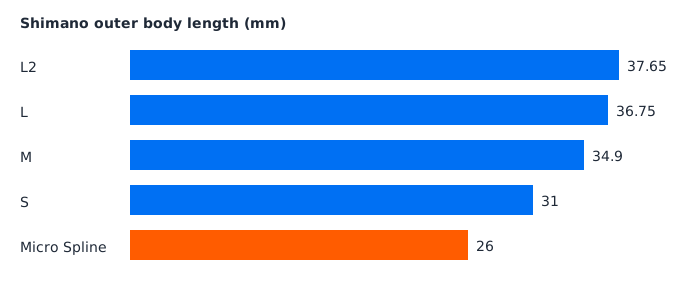
| Shimano HG spline L2 | Road 12-speed | Listed at 37.65 mm outer body length and 18 effective spline teeth |
| Shimano HG spline L | Road 12/11-speed (some 11-speed cassettes need a 1.85 mm spacer); MTB 11-speed with a 1.85 mm spacer | 36.75 mm, 9 effective spline teeth |
| Shimano HG spline M | 10/9/8-speed, MTB 11-speed, and road 11-speed CS-HG800, CS-HG700 and CS-RS400 (note *4); 7-speed only CS-HG210-7 and CS-HG400-7 (note *6) | 34.9 mm, 9 effective spline teeth |
| Shimano HG spline S | 7-speed: only CS-HG41-7, CS-HG200-7 and CS-HG20-7 are listed (note *7) | 31 mm |
| Shimano Micro Spline | Shimano 12-speed MTB | 23 effective spline teeth, 26 mm |
| SRAM XD | XD cassettes, for mountain bikes | Same hub spacing and flange locations as 8-, 9- and 10-speed HG bodies |
| SRAM XDR | XD cassettes with a 1.85 mm spacer, including those in SRAM’s 1x road groups | 1.85 mm longer than XD; same space as an 11-speed road HG body |
Shimano HG: one pattern, several lengths
HG bodies are named by length class, not by a different spline shape. Shimano lists the L, M and S classes at 9 effective spline teeth each, and its chart notes that the MTB 11-speed wheel and freehub have the same spline shape as 10-, 9- and 8-speed freehubs. The length class then decides which cassettes sit correctly. BikeRadar counts the HG interface as 13 splines, so the two sources count differently; use Shimano’s classes when you compare lengths.
Two points trip people up:
- Road and mountain 11-speed overlap, but not fully. Shimano lists road 12/11-speed on spline L (36.75 mm) and MTB 11-speed on spline M (34.9 mm). Road 11-speed CS-HG800, CS-HG700 and CS-RS400 also fit spline M (note *4), and MTB 11-speed fits spline L only with a 1.85 mm low spacer (note *1). Sheldon Brown notes that “road” and “mountain” are marketing terms for cassettes, not technical ones, so check the hub, not the label on the bike.
- Spacers matter. On spline L, Shimano’s chart requires a 1.85 mm low spacer for MTB 11-speed cassettes (footnote *1), and for road 11-speed only the CS-HG800, CS-HG700 and CS-RS400 are listed as fitting, with a 1.85 mm spacer (footnote *3). For the 10-speed road cassettes CS-7900, 7800, 6700, 6600, 5700 and 5600, spline L needs a 1.85 mm low spacer plus a 1.0 mm spacer, and the chart notes the 1.0 mm spacer is included (footnote *2). On spline M, the chart says those same 10-speed road cassettes need a 1.0 mm spacer (footnote *5) and does not say it is included. Use the chart footnotes for the exact cassette; do not guess a spacer from memory.
For 7-speed, spline M lists only CS-HG210-7 and CS-HG400-7 (note *6), and spline S lists only CS-HG41-7, CS-HG200-7 and CS-HG20-7 (note *7).
Micro Spline: why it exists
BikeRadar reports that the 10-tooth cog is too small to fit onto the HG freehub body. Shimano’s solution was a shorter body with 23 splines. On BikeRadar’s description, the smallest cog sits outboard of the freehub body, and the 10-tooth cog sits inside the 12-tooth cog on the cassette. Shimano also said the finer spline pattern spreads load better, which allowed lighter alloy bodies.
The practical effect is that a Micro Spline cassette needs a Micro Spline body, not an HG body. Shimano’s chart lists Micro Spline as taking 12-speed MTB cassettes only. BikeRadar, writing at the 2018 launch, said that for riders on DT 240 and 350 hubs the change would be a matter of swapping freehub bodies; check the manufacturer for your hub model, as not every hub offers one.
LINKGLIDE: HG-style, but not for Micro Spline
Shimano’s LINKGLIDE cassettes (such as the CS-LG700-11) are charted separately. Shimano states that LINKGLIDE cassettes are not compatible with Micro Spline freehubs. Its chart lists them against HG spline M and spline L bodies. On spline L road hubs the chart requires a 1.85 mm low spacer. For CS-LG700-11, the chart marks spline M hubs FH-M820, FH-M8010, FH-M9000 and FH-RS300, and spline L hub FH-R7000, with a note that interference may occur with the rear derailleur and spokes. If you own a LINKGLIDE cassette, read Shimano’s C-649 chart for your exact hub before ordering.
SRAM XD and XDR
SRAM designed XD for mountain bikes and XDR for road. XDR is 1.85 mm longer than XD because it must occupy the space of an 11-speed road HG body. The two share the same cassette interface, so an XD cassette installs on an XDR body when a 1.85 mm spacer goes behind it. SRAM says the interfaces allow cogs with fewer than 11 teeth without new rear axle standards, hub redesigns or new cassette tools.
SRAM also says its XD and XDR interfaces are licensed to other companies, so many hub brands offer them. Whether a given hub offers the body you want is a question for that hub’s maker.
Identify what you have
- Find the hub model (printed on the shell or the wheel’s spec sheet) and look up its freehub body on the maker’s site.
- Confirm the cassette’s interface from its packaging or the manufacturer’s chart: HG, LINKGLIDE, Micro Spline, XD or XDR.
- For HG, confirm the length class with Shimano’s chart before relying on a spacer.
Removal needs a chain whip and a cassette lockring tool. Snug is enough for the lockring; Sheldon Brown advises against “gorilla-like force”, especially if you may need to remove it on the road. If the freehub body wobbles or its splines look chewed, stop riding and have a shop inspect it. Our shifting troubleshooting guide separates adjustment faults from worn parts. For chain care, see chain maintenance. For gear range choices, read understanding bike gearing.
Campagnolo and older Shimano patterns
Sheldon Brown says Campagnolo 8-speed cassettes used a slightly different spline pattern from the 9- and 10-speed pattern, so they will not fit newer hubs. The oldest Shimano cassette sprockets used a twist-tooth design called Uniglide, which is not covered by the length classes above.
Sources
- Shimano: FREEHUB and cassette spline compatibility (C-731)
- Shimano: LINKGLIDE cassette and FREEHUB compatibility (C-649)
- SRAM: SRAM XD and XDR Driver Body Explained
- BikeRadar: Why Shimano decided to create a new freehub standard
- Sheldon Brown: Shimano Cassettes & Freehubs
Last reviewed: October 2026.