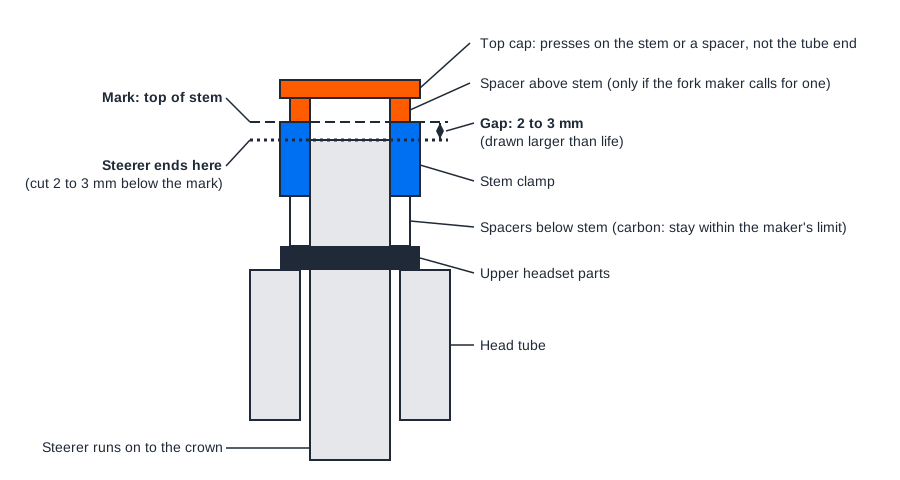
Put the stem on the steerer the way you will ride it, mark the tube at the top of the stem, then cut a few millimeters below that mark. Park Tool says 3 mm. ENVE says 2 mm. Specialized says 3 mm for a carbon steerer and 2 mm for alloy. All three finish with the end of the tube sitting slightly lower than the top of the stem, and your fork maker’s own figure outranks this page.
A cut cannot be reversed, and Park Tool warns that cutting a steering column too short can be an expensive mistake. This page covers threadless forks, where the stem clamps around the outside of the steerer. It does not cover steerer diameters or headset standards.
Find the cut line with a mock-up
- Settle bar height first. The spacers under the stem set how high the bars sit, and a cut steerer cannot be made longer. Settle it with our guides to handlebar setup and bike fit. If the height is still undecided, Specialized suggests a first fitting at the maximum spacer stack it allows (40 mm for its carbon forks) and a second cut once the height is known.
- Assemble the front end uncut. Fit the fork with its crown race, the headset, the spacers you plan to run and the stem on top, with the stem bolts left loose, as ENVE does. Park Tool calls this the slower method, but it checks your actual parts, which matters because the stack height printed on a headset box leaves out extra washers and the stem.
- Mark the tube at the top of the stem. Park Tool scribes at the top of the stem, ENVE marks directly above it, and Specialized marks in line with its top. Unless your fork maker’s sheet says otherwise, mark the stem itself, not a spacer you intend to add above it.
- Take it apart and move the line down. Remove the stem, spacers and fork (on a Specialized carbon steerer, take its plug out first), then place the cut line below the mark: 3 mm for Park Tool, 2 mm for ENVE, and 3 mm for carbon (2 mm for alloy) for Specialized. On carbon, wrap tape over the cut area first. ENVE says the tape keeps fibers from lifting during the cut, which could later damage the headset, and Specialized calls for several layers of masking tape.
- Cut square. A saw guide holds the fork square to the blade, and Specialized calls a straight cut very important. Park Tool generally recommends 24 teeth per inch, or a finer 32 TPI for carbon. ENVE lists 32 TPI or higher. Specialized recommends a carbon-specific blade and accepts a fine-tooth 36-tooth one. On carbon, Park Tool advises keeping the blade wet to reduce dust, and Specialized says not to breathe it.
- Deburr the cut. Park Tool removes the sharp inside edge with a round file or deburring tool and bevels the outer edge. For carbon, ENVE sands the new edge with 100 grit paper and removes any extruding fibers.
- Fit the compression plug. Fit the compression plug or expander your fork maker specifies (on Specialized carbon forks, the supplied plug at 9.0 Nm; ENVE tightens its compression bolt to 8 Nm).
- Reassemble and preload. Refit the fork, headset parts, spacers and stem, then tighten the top cap until the headset reaches its recommended preload (ENVE’s wording). Specialized adds that you should adjust out any free play and confirm the fork still turns freely.
- Align and clamp the stem. Align the stem with the front wheel and tighten its steerer clamp bolts evenly, alternating between them, to the stem maker’s torque.
If you prefer arithmetic, Park Tool’s worked example adds the lower stack, upper stack, washers and stem (74 mm), deducts 3 mm to leave 71 mm, then adds the 103 mm head tube to reach 174 mm, rounding any decimal up.
Why the steerer must end below the stem
On a threadless fork, the headset bearings are adjusted by pressure from the cap on top, as Park Tool describes it. The cap can only push the stack down if it lands on the stem, or on a spacer resting on the stem. If the tube ended level with, or above, the top of whatever the cap rests on (the stem, or a spacer above it), the cap would reach the tube first and stop there, and the bearings would never be loaded. A gap of a few millimeters is enough to prevent that.
ENVE goes a step further and places a 5 mm spacer between the stem and the top cap, giving its reason as complete contact between the stem and the steerer tube.
Where the fork makers differ
The method matches across sources. The numbers and the rule for a spacer above the stem do not.
| Source | Mark at | Cut | Spacer stack under the stem | Spacer above the stem |
|---|---|---|---|---|
| Park Tool (shop guide) | Top of the stem | 3 mm below the mark | Carbon: generally no more than 20 mm extra | — |
| ENVE (Thru Axle CX fork sheet) | Directly above the stem | 2 mm below the mark | 30 mm maximum, upper crown race plus spacers | 5 mm spacer between stem and top cap |
| Specialized (carbon forks guide) | In line with the top of the stem | Additional 3 mm (carbon) or 2 mm (alloy) | 40 mm maximum | Not left there permanently |
Each stack figure belongs to a specific fork, so do not borrow one brand’s limit for another’s.
The last column is where the sources truly disagree. Trek’s owner’s manual says a carbon steerer needs one spacer above and one below the stem, with at least one 5 mm spacer below. Specialized says not to leave spacers above the stem, because they defeat the expander plug’s ability to support the steerer and stem. The answer depends on the hardware, so follow the sheet that came with your fork and plug.
Extra limits on carbon steerers
- Spacer stack. Park Tool says too many spacers between the stem and headset may stress the carbon and lead to failure, and it tells riders to ask the fork maker for limits. Specialized says more than 40 mm of headset spacers can compromise the steerer’s strength.
- Compression hardware. Specialized requires the plug supplied with its fork in a carbon steerer and forbids a star nut, which can damage the inside of the tube. Specialized builds room for that plug into its extra 3 mm cut, so check what your own fork’s compression hardware needs before you mark.
When to stop and use a shop
Hand the job to a shop, or ask the fork maker, if any of these applies:
- The steerer is carbon and you are unsure of the maker’s spacer limit, plug requirement or cut allowance.
- You have not confirmed final bar height. Wait, or cut long and trim later, as Specialized describes.
- The fork maker publishes a limit, such as a maximum spacer stack, that your intended bar height cannot meet.
- The cut came out short, crooked or ragged. Do not ride until a shop confirms the stem clamps properly.
- The steerer has deep scratches, gouges or any crack, before or after the cut. Specialized warns that deep scratches or gouges can weaken the components.
Before the first ride, check for play and smooth steering, then run through the pre-ride checklist. A knock or creak from the front end afterward is worth tracing with our guide to why a bike creaks, which covers checking headset play and stem bolts.
Sources
- Park Tool: Fork Steering Column Length and Sizing
- ENVE Composites: Thru Axle CX Fork Installation
- Specialized: Instruction Guide, Specialized Carbon Forks
- Trek: Owners Manual – Stems
Last reviewed: October 2026.