To turn right at a busy junction in Great Britain, check behind, signal, move to the center of your lane or road, wait for a safe gap in oncoming traffic, look once more, then go. If any step feels unsafe, getting off and walking across is a legitimate option, and the official guidance says so. This article follows the Highway Code for England, Scotland and Wales as published on GOV.UK and reviewed in October 2026. In countries that drive on the right, the mirror image applies and local rules differ, so check your own highway code.
Why a right turn is the hard one
In left-hand traffic, a right turn means crossing the path of oncoming vehicles while following traffic is still behind you. You have two problems at once: drivers behind must see what you intend, and drivers ahead must see you before you cross them. Every step below exists to solve one of those two problems.
The sequence, step by step
- Choose a lane position early. Where a junction has no separate cycle facilities, the Highway Code recommends proceeding as if you were driving a motor vehicle. It also advises riding in the center of your chosen lane, where you feel able to do so safely, so that you are as visible as possible. It adds a second reason: at the approach to junctions, a central position helps when it would be unsafe for drivers to overtake you.
- Optional extra check (Cycling UK advice, not a Highway Code step). Cycling UK advises a look over your right shoulder for oncoming vehicles when moving over in the lane. It describes this in the context of moving around an obstacle; applying it before a right turn is a reasonable extension of the same idea, since you are about to change your lateral position.
- Signal. The Highway Code lists an arm signal for “I intend to move out to the right or turn right”, and it states that arm signals are for use by pedal cyclists. Cycling UK suggests extending the right arm before you move over. Signal before you move, not as you move.
- Move to the center of the road. The Code’s sequence for a right turn is to check the traffic is safe, then signal and move to the center of the road. Keep the signal clear and your line predictable.
- Wait for a gap, then look again. Wait for a safe gap in the oncoming traffic and give a final look before completing the turn. The final look matters because the gap you judged a few seconds ago may have closed.
- Complete the turn and give way to walkers. When turning into or out of a side road, give way to pedestrians crossing or waiting to cross.
Signaling with one hand
Cycling UK notes that it may take some practice to signal safely with one hand off the handlebars. That is the main reason beginners skip the signal. Practice somewhere quiet, where a wobble costs nothing. Cycling UK suggests starting in a quiet area near home to rehearse road positioning and hand signals before tackling busier roads. A well-fitted bar and a comfortable grip also help; see our guide to handlebar setup.
Three alternatives to a full road turn
Wait on the left
The Highway Code says it may be safer to wait on the left until there is a safe gap. This is the “pull over and pause” option. It works well when traffic is constant and you would otherwise be stuck in the middle of the road.
Dismount and push
The Code says it may be safer to dismount and push your cycle across the road. For junctions in general it says that if you do not feel safe proceeding as a driver would, you may prefer to dismount and wheel your bike across the junction. For crossing faster or busy main roads, it says you may find it safer and easier to dismount and push your cycle across. Treat this as a skill, not a failure: experienced riders use it at awkward junctions.
Two-stage turns at signals
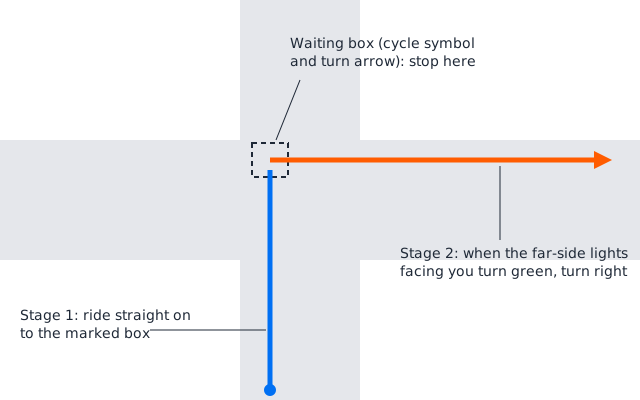
At some signal-controlled junctions, signs and markings tell cyclists to turn right in two stages. In stage one, you go straight ahead to the location marked by a cycle symbol and turn arrow, then stop and wait there. In stage two, when the lights on the far side of the junction, now facing you, turn green, you complete the maneuver. Some junctions also have small cycle traffic lights at eye-level height. Use these where they make your journey safer and easier.
| Situation | Option | Why |
|---|---|---|
| Quiet junction, gaps in traffic | Check, signal, move to center, turn | Follows the Code’s right-turn sequence |
| Steady oncoming traffic | Wait on the left until a gap appears | Avoids stopping in the middle of the road |
| Fast or wide road, or you feel unsure | Dismount and push across | Official guidance names it as a safe choice |
| Marked two-stage box at lights | Follow the two-stage procedure | You turn in two stages instead of waiting in the middle of the road |
Where the sources differ
Lane position is the one point of apparent disagreement. Cycling UK’s advice for general riding is that your default position should be on the left-hand side of the lane, though not in the gutter. The Highway Code, for junction approaches and turns, points toward the center of the lane or road. One way to reconcile them is to separate cruising from turning: ride toward the left in normal conditions, then take the central position on the approach to the junction. That reading is a suggestion for combining the two, not something either source states.
Stop and rethink if
- You cannot see far enough to judge oncoming traffic. Wait on the left or walk.
- You cannot hold a straight line while looking back. Practice on a quiet street first.
Good lights make you easier to see at junctions, particularly in poor light; our lights buyer’s guide covers the choices. For the wider set of habits behind this, see the basic rules of cycling on roads, and when planning routes, mapping a safe route to work lets you avoid the hardest junctions altogether. If you ride with others, riding safely in a group adds extra signaling rules of its own.
Sources
- UK Highway Code (GOV.UK): Rules for cyclists (59 to 82)
- UK Highway Code (GOV.UK): Signals to other road users
- Cycling UK: How to build confidence to cycle on the roads
Last reviewed: October 2026.