Buy a tube by three things: the bead seat diameter printed on your tire (for example the 622 in 40-622), a width range that includes your tire width, and a valve that matches the hole in your rim. The material (butyl or TPU) is a choice about weight and pressure handling, not about fit.
Read the tire to size the tube
The ISO (formerly ETRTO) marking has two numbers: width in millimeters, then bead seat diameter in millimeters. Sheldon Brown explains that if the bead seat diameter matches, the tire generally fits the rim, and that a 700×38 hybrid tire is a 38-622. Inch names are unreliable: the 622 mm size is sold as 700C, 28 x 1 5/8 and “29 inch” (the older “27 inch” size is a different 630 mm), while a label such as 24 x 1 1/8 can mean either 520 or 540 mm. Always use the ISO number.
Tubes carry the same kind of code, with a width range first. Schwalbe labels its butyl tubes with codes such as 40→62-559, meaning a range of tire widths and a 559 mm bead seat diameter; some tubes list several codes. Check that your tire width falls inside the range and the last number matches exactly.
Worked example: a 40-622 tire
The tire reads 40-622, so you need a tube whose code ends in 622 and whose width range contains 40 mm. Schwalbe’s butyl-tube listing shows how the ranges differ at the same 622 diameter: tube 19-AP is listed as 40→62-622 (range includes 40, a fit), 17-AP as 37→47-622 (includes 40, a fit), and 19L-AP as 54→65-622 (starts at 54, too wide for a 40 mm tire). Sheldon Brown notes that a tube that is too large in diameter folds over inside the tire and gives a bumpy ride, while one that is too small stretches over the rim like a rubber band and makes tire installation difficult. A tube listed only as 40-635 is a different diameter and is not a match. Check the current listing, since codes vary by model.
- Diameter: Tubes stretch, so the same tube serves 622 and 630 mm tires (Sheldon Brown). A tube much too large folds over inside the tire, and one much too small stretches over the rim and makes installation difficult.
- Width: Many tubes cover a range. Sheldon Brown’s check is to inflate the tube just enough to hold its shape and see that it leaves a gap about as wide as the rim’s inside.
- Thickness: Most tubes are about 1 mm thick; lightweight tubes are thinner and, he notes, some must be pumped up before every ride.
Valve types
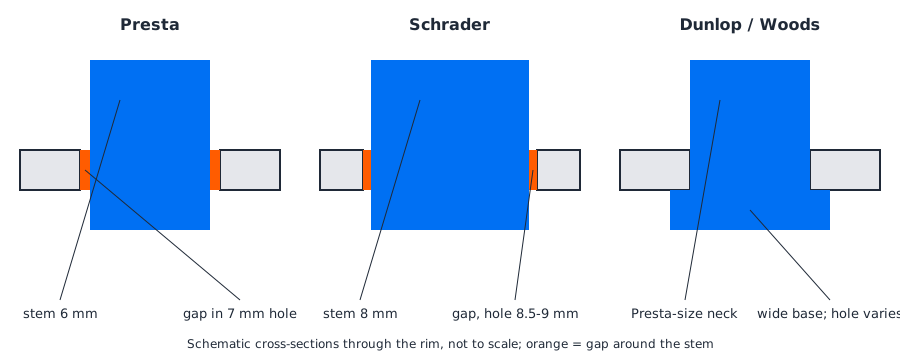
| Valve | Rim hole | What to know |
|---|---|---|
| Presta (Sclaverand, SV) | 7 mm (Sheldon Brown) | Narrower stem (6 mm instead of 8 mm for other valves, per Schwalbe). Has a knurled nut that must be loosened before inflating. Common on higher-performance bikes. |
| Schrader (car valve, AV) | 8.5 to 9 mm (Sheldon Brown) | Spring-loaded valve mechanism (Sheldon Brown), found on less expensive bikes. Schwalbe says it can be inflated very easily at a filling station, but older and simple bike pumps are not compatible with car valves. |
| Dunlop / Woods (DV) | Depends on the rim | Schwalbe calls it the most common worldwide. Sheldon Brown describes a Schrader-style base with a Presta-sized neck that takes a Presta pump. The core can easily be replaced (Schwalbe). |
The valve you need is decided by the hole drilled in your rim. A Presta tube in a rim drilled for a larger valve is the risky mismatch: Schwalbe warns that it often leads to the valve tearing off, because the metal edge of the valve hole can shear the valve stem off the tube. Schwalbe adds that some rims have a 6.5 mm hole on the outside but a larger 8.5 mm hole on the inside, which causes the same problem. Sheldon Brown advises a rubber grommet in the hole if you do use a Presta tube in a Schrader or Woods rim. Sheldon Brown notes that Presta-drilled rims, except the very narrowest, can be reamed to Schrader size with an 8.5 mm (0.326 in), 21/64 in or Q drill bit. Leave that to a shop: the rim is a structural part of the wheel, so do not enlarge a hole casually.
Valve length
Tubes come with stems of different lengths so the valve clears deeper rims. Schwalbe’s butyl-tube listing gives the valve length for each tube, for example 40 mm or 50 mm; measure your rim depth and check the listing. Screw-on valve extenders need a rubber O-ring seal or sealing compound, or they leak while pumping (Sheldon Brown).
Butyl and TPU
Schwalbe’s butyl-tube range comes in three executions: Standard, Extra Light and Air Plus. Extra Light tubes have lower weight with the same reliability as a Schwalbe standard tube. Air Plus tubes have a thicker wall that holds air longer, so they need less frequent re-inflation. The range can be filtered by valve (AV, AV 45°, DV, SCV, SV) and by valve length from 32 to 80 mm.
Schwalbe’s Aerothan is a thermoplastic polyurethane (TPU) tube. Against butyl, Schwalbe’s own comparison says:
| Point | Butyl (Schwalbe) | Aerothan TPU (Schwalbe) |
|---|---|---|
| Weight | Extra Light is the lightest butyl execution | About 40% lighter than a comparable Extralight butyl tube; saves more than 50 g in Schwalbe’s weighing |
| Valve | AV, AV 45°, DV, SCV or SV, 32 to 80 mm | 40 mm SV (Presta) by default |
| Rim brakes | No Schwalbe figure | All Aerothan tubes are approved for use with rim brakes |
| Sealant | No Schwalbe figure | Sealant sprays do not seal them because TPU has a very high surface tension |
| Rolling resistance | No Schwalbe figure | About the same as a latex tube in Schwalbe’s test |
- Outside the tire, inflate an Aerothan tube only to about 0.3 bar. Inside the tire, Schwalbe says it can be used at significantly lower air pressures than conventional bicycle tubes.
- Schwalbe says an AV (about 8.5 mm) rim hole is larger than the tube’s SV valve (about 6.1 mm), which can cause noise and extra strain on the material. For that mismatch it describes a reducing sleeve pushed over the valve stem and held in the hole by the valve, and says Schwalbe does not offer reducing sleeves or valve hole adapters.
- Schwalbe says never to machine the valve stem.
Latex is a third tube material. Schwalbe reports that its Aerothan tube has about the same rolling resistance as a latex tube, at much less weight.
Pumps and checks
Check that your pump head fits your valve before you ride. See our guide to choosing a bike pump, and set pressure using tire pressure basics.
If you get a flat, see what to do about a flat tire, and to reduce the odds, read how to prevent punctures. If you want to remove tubes entirely, tubeless setups are covered separately.
Stop riding and have a shop inspect the wheel if a valve hole shows cracks, if the rim edge around it is sharp or damaged, or if tubes repeatedly fail at the valve.
Sources
- Sheldon Brown: About Bicycle Inner Tubes
- Sheldon Brown: Tire Sizing
- Schwalbe: Bike Tire Valves
- Schwalbe: Standard Butyl Tubes
- Schwalbe: Aerothan Tube
Last reviewed: October 2026.