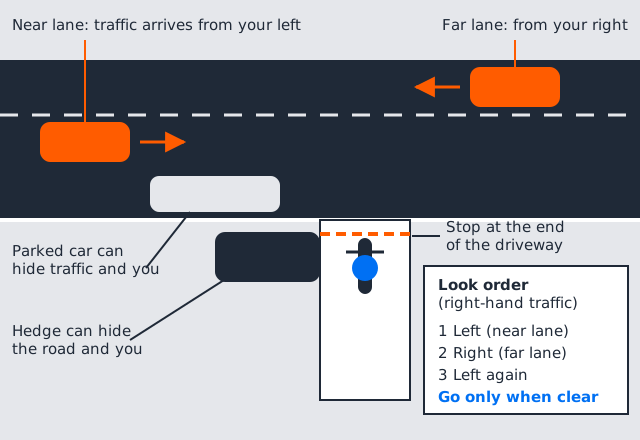
Stop at the end of the driveway, creep forward only until nothing blocks your view, look left-right-left, and roll out only when the road is clear. Skipping that pause is how the “mid-block rideout” happens, the crash type US safety groups use for a rider who enters the road from a driveway, alley or curb without slowing, stopping or looking for traffic. Below: the routine, the reason for each step, the same risk when crossing driveways on a sidewalk, and what parents should weigh.
Why the rideout crash happens
NHTSA’s crash-type handout (April 2007) calls this driveway, alley or curb entry the most frequent crash type for young riders. AAA explains the mechanism: a rider who appears suddenly leaves the driver too little time to avoid a collision. A driveway makes the surprise worse, because hedges, fences, garage walls and parked cars can hide the road from you and hide you from the road.
Driveways are also where rides begin. AAA’s 2011 Bike Basics brochure, which addresses young riders and their parents, says bicycle crashes are most likely within five blocks of home and that almost half of all bicycle crashes occur on driveways and sidewalks. That second figure is from 2011 and counts crashes of every kind, not only collisions with cars, so treat it as a pointer to where trouble clusters rather than a current rate.
The routine, step by step
- Slow down early and stop at the end of the driveway or alley. The Oregon quick-tips card from the Bicycle Transportation Alliance and Bellevue’s police guide both put the stop before the road, not on it. Brake early so the stop is controlled; a bike still rolling while you look is already entering traffic.
- Give way to anyone on the sidewalk. The Oregon card lists yielding to pedestrians as part of leaving a driveway.
- Creep forward until you can see. The Oregon card says to move forward until you have a clear view around buildings and parked cars, and Bellevue advises edging out to see beyond parked cars. At home, Bellevue also suggests trimming back bushes or trees that block the view, a one-time fix for a daily hazard.
- Look left, right, then left again. NHTSA, AAA and Safe Kids Worldwide all teach this order. The reason: where traffic drives on the right, as in the US, the lane nearest you carries vehicles coming from your left, so you check it first. Anything can arrive while your eyes are on the far lane, so the second look left catches it. In countries where traffic keeps left, such as the UK and Australia, the near lane is on your right, so reverse the order.
- Go only when it is clear, and do not assume you have been seen. AAA reminds riders that drivers may not see them, and Safe Kids tells parents to teach children to make eye contact with drivers.
Once you are out, ride with traffic, not against it. NHTSA lists wrong-way riding as its own common crash type because motorists do not expect traffic to come from that direction. For lane position and signaling beyond the driveway, see The Basic Rules of Cycling on Roads.
The skill underneath: looking without swerving
AAA suggests practicing on a dry, clean, level area away from traffic, including turning your head to look behind without the bike drifting. New riders can build this in their first weeks; The First 30 Days of Cycling covers what to expect.
Crossing someone else’s driveway on the sidewalk
Riding on the sidewalk swaps one hazard for another. Bellevue’s police guide lists a sidewalk crash among the most common for young children: a driver pulling out of a driveway, usually without coming to a complete stop, never looks to the right to check the sidewalk for pedestrians or bicyclists, and the rider assumes the driver sees them or will stop. Transport for NSW gives the same warning in shorter form, saying riders need special care at driveways where vehicles may be driving in or out.
| Situation | Why it is risky | What to do |
|---|---|---|
| Leaving a driveway or alley onto the road | Hedges, fences and parked cars can hide the traffic and hide you | Follow the five steps above |
| Crossing a driveway while riding the sidewalk | A driver pulling out may not stop fully and may not check the sidewalk | Make eye contact before you cross and make a sound, such as a bell or your voice, so the driver knows you are there |
| Coming off the curb mid-block | Drivers do not expect a rider to appear from between parked cars | Enter the road where motorists expect riders, such as a street corner |
Teaching a child to leave the driveway
These three sources agree that young children should stay out of traffic and differ on whether a sidewalk, with its driveways, is acceptable.
- Safe Kids Worldwide says it can be hard for kids to judge the speed and distance of cars until age 10, and advises limiting riding to sidewalks (with care for vehicles in driveways), parks or bike paths until then.
- Transport for NSW says that until at least age 10 a child should ride off-road, away from vehicles and driveways, and that fenced areas are the safest places. It adds that a child who quickly learns to pedal, steer and brake is still not ready to cycle near traffic or on the road.
- Bellevue’s police guide says children under 10 are better off on the sidewalk than the street.
Whichever approach you choose, the end of the driveway is where supervision matters most. Safe Kids recommends actively supervising until you are comfortable that a child can ride alone, and says children should show riding competence and knowledge of the rules of the road before cycling with traffic.
Rehearse the routine in pieces. Start somewhere clear of cars, chalk a line, and have the child stop at it, say aloud what they see, and wait for your “clear.” Then repeat at the real driveway with you standing at the road edge. Children copy what they watch, so do the full stop yourself every time.
Before you roll to the road: brakes, helmet and when to get help
The routine only works if the bike stops when asked. Safe Kids includes working brakes in its before-ride check, and AAA says brake levers that touch the handlebars need adjustment and sends more complex problems to a repair shop. If the bike does not stop smoothly and predictably, keep it off the road until a shop has checked it. The 5-minute pre-ride checklist covers the quick checks.
AAA advises wearing a helmet on every ride, however short or close to home, so the ride out of the driveway counts. It also describes head injuries as the most serious injury and the most common cause of death among bicyclists. For fit and choice, see Cycling Helmets: How They Work, MIPS, and Choosing the Right One. After any crash that involves a blow to the head, have a doctor check the rider.
Sources
- AAA Traffic Safety Programs: Bike Basics brochure (2011)
- NHTSA: Common Types of Collisions Between Bicyclists & Motorists (April 2007)
- Bicycle Transportation Alliance and Oregon Department of Transportation: Safe Biking Quick Tips
- Bellevue Police Department: Bicycle Safety in Bellevue, a guide for parents and children
- Safe Kids Worldwide: Bike Safety Tips
- Transport for NSW: Wearing helmets and riding safely
Last reviewed: October 2026.