Since 1 October 2026, a driver in Spain who passes a cyclist must leave at least 1.5 m (about 4.9 ft) of sideways space, move completely into another lane when the road has more than one lane in that direction, and, outside built-up areas, travel at least 20 km/h below the speed limit from before the pass begins until it is finished. A group of riders counts as a single unit. All of this comes from paragraph 4 of article 85 of Spain’s General Traffic Regulation (Reglamento General de Circulación), as rewritten by Real Decreto 518/2026.
The rule at a glance
| Situation | What the driver must do |
|---|---|
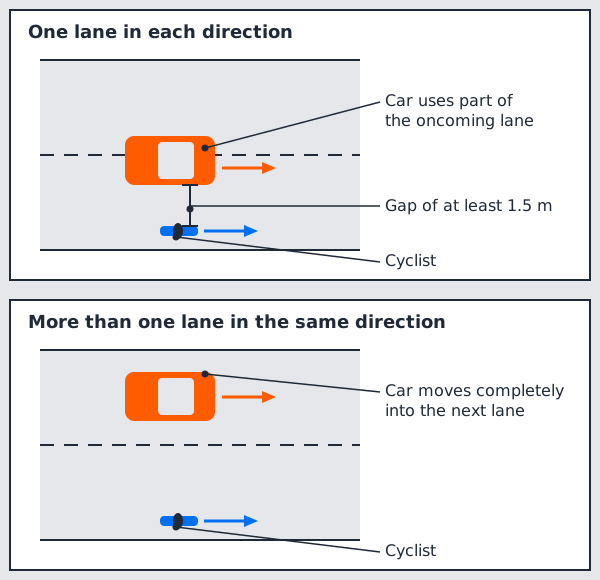
| Sideways clearance | At least 1.5 m (about 4.9 ft). The driver may use part or all of the adjoining or oncoming lane to get it. |
| More than one lane per direction | Change lanes completely. |
| Speed outside built-up areas | At least 20 km/h below the limit on that road, before the pass starts and until it ends. On a stretch signed 90 km/h, that is 70 km/h or less (about 43 mph). |
| A group of cyclists | Treated as one mobile unit. |
| Oncoming traffic | No passing that endangers or obstructs it, even if it is on the shoulder (arcén). |
The same paragraph also names pedestrians, animals, animal-drawn vehicles, mopeds and personal mobility vehicles among the road users who must be passed with special care. Its general duty is to avoid creating any dangerous situation for whoever is being passed.
Why the driver slows down instead of speeding up
The decree’s preamble explains the reversal. When a car passes a bicycle, the speed difference is already large, so protecting the weaker party means slowing down. The earlier idea, according to the preamble, was to accelerate so the risky maneuver would be over sooner. The paragraph itself gives the purpose of the slowdown: the people being passed should not have their stability and safety compromised.
Two practical points follow from the wording:
- The reduction is measured against the limit that applies to the road, not against the speed the driver happened to be doing before.
- It has to be in place before the driver pulls out, and it lasts through the whole pass, not just the moment the cars are level.
Two Spanish terms are worth knowing: adelantamiento is overtaking, and fuera de poblado means outside a built-up area, in other words outside a town.
Gap and lane change on the road
On a road with one lane in each direction, a 1.5 m gap often means leaving your own lane. The regulation allows that, but it also forbids a pass that endangers or obstructs oncoming traffic. If the oncoming lane is not clear, or the view ahead is too short to finish the pass with the full gap, the driver has to stay behind the rider.
On a road with more than one lane per direction, the wording calls for a complete lane change. Edging partway over beside the rider does not meet it.
Groups of cyclists
The paragraph says riders traveling as a group are considered one mobile unit. Read naturally, that makes the whole group one thing to pass, not a string of individual riders to squeeze past one at a time. The paragraph does not say how long or spread out a group can be before it stops counting as one, so a stretched-out line of riders is a gray area. If you ride in a group, keep it compact and predictable; our guide to riding safely in a group covers the habits.
Towns versus open roads: where the sources differ
The article text attaches the “outside built-up areas” condition to the speed reduction only. The 1.5 m clearance and the lane-change wording carry no such condition. Yet the decree’s preamble describes the change as a rule for passing a cyclist on an interurban road, and the DGT’s summary (the national traffic authority, Dirección General de Tráfico) lists all three overtaking points under a heading for interurban roads. Its list for urban roads has different items, covered below.
A safe working reading: the 20 km/h reduction is explicitly an outside-town rule, and 1.5 m is the minimum gap everywhere. How strictly the lane-change duty is applied inside towns is not spelled out in either text, so treat that point as unsettled.
Other numbers from the same decree
- Stopped vehicles: the DGT says vehicles passing others immobilized by an accident, breakdown, rescue work, maintenance or traffic management must also leave 1.5 m and drop at least 20 km/h below the limit.
- Following a cyclist in town: the new urban title requires drivers of motor vehicles to keep at least 5 m (about 16 ft) behind a cyclist ahead in the same lane. The DGT lists the same figure.
- Lane position: the urban rules say cyclists should preferably ride toward the center of the lane, as far as their own safety and other users’ safety allow.
- Local rules: town councils may develop details of the urban rules through ordinances, but those ordinances cannot contradict the regulation.
What this means on the road
A legal minimum describes what drivers are supposed to do. It does not guarantee that every driver will. As a rider, you can still help the pass go well:
- Hold a steady line and avoid swerving as a vehicle approaches; the basic rules of cycling on roads explain lane position.
- Be easy to see and judge. Good front and rear lights help drivers estimate distance at dusk.
- Favor roads with room to pass. Mapping a safe route works the same way for a commute or a holiday, and our cycling holiday planning guide covers touring.
If you drive, the rule boils down to: slow down before you pull out, give the rider more than the minimum when the road allows, and wait when the oncoming lane or the view ahead is not clear.
After a close pass, stop in a safe place and write down the time, location and vehicle details while you remember them. Local police or a lawyer can tell you how to report it. If you fell, were struck or feel pain, get medical attention. A bike that was hit or crashed needs its wheels, fork, frame and handlebars checked by a shop before you ride again; do not keep riding on anything cracked, bent or dented.
Checking the primary text
Date checked: 9 October 2026. The Spanish-language text of the decree controls over any explainer, including this one, and nothing here is legal advice. Fines and points for breaking the rule are a separate question, and the DGT is the place to check current penalties and any later guidance.
Sources
- Boletín Oficial del Estado: Real Decreto 518/2026, de 24 de junio, por el que se modifica el Reglamento General de Circulación (BOE-A-2026-13889)
- DGT: Entra en vigor la reforma del Reglamento de Circulación para reforzar la protección de los usuarios vulnerables
Last reviewed: October 2026.