A parallel crossing is a zebra-style crossing with a cycle route running alongside the stripes. In England, Scotland and Wales, drivers must give way to a pedestrian or cyclist who has moved onto it, but are only advised to give way to one who is still waiting. The wording is deliberately two-speed: it matters whether you are on the crossing or at its edge.
This page follows the Highway Code as published on GOV.UK in October 2026, which covers England, Scotland and Wales; Northern Ireland is outside its scope. Rules change, so read the current Rule 195 before relying on this page in a dispute.
How to recognize a parallel crossing
The Highway Code describes a parallel crossing as similar to a zebra crossing, but with a cycle route alongside the black and white stripes. The Department for Transport’s cycle design guidance, Local Transport Note 1/20 (July 2020), describes the same thing and says the prescribed layout includes yellow globes, zig-zag markings that define a controlled area, and a give-way line.
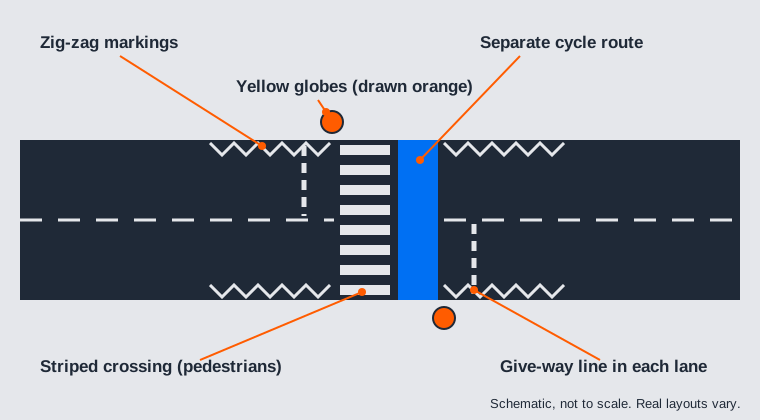
The quick test is to look for the yellow globes, the zig-zag markings and the give-way line, plus a separate cycle route marked alongside the black and white stripes. The cycle route is the deciding feature: zig-zag markings belong to the Code’s rules for pedestrian crossings in general, so they alone do not make a crossing parallel. If a central island splits the crossing, it counts as two separate crossings, so repeat your checks at each half.
Who has priority
| Situation at a parallel crossing | What drivers must or should do | Where it is written |
|---|---|---|
| A pedestrian or cyclist has moved onto the crossing | Must give way | Rule H2 and Rule 195 |
| A pedestrian or cyclist is waiting to cross | Should give way, and should look out and slow down or stop | Rule H2 and Rule 195 |
| A driver waves or flashes lights to invite people across | Drivers are told not to, because another vehicle may be approaching | Rule 195 |
The split between “must” and “should” is not a technicality. Rules marked MUST are legal requirements, and breaking one is a criminal offense. The Code says that not following its other rules does not in itself lead to prosecution, but that it may be used as evidence in court proceedings under the Traffic Acts, advisory wording such as “should” and “do not” included.
For a rider the consequence is practical. Once you are on the crossing, a driver who does not stop is breaking a legal requirement. While you wait at the edge, the driver is only being advised to stop, so approach as though they have not seen you. Do not read a wave as a promise that the next lane will stop either.
When the Highway Code wording changed
The Highway Code was updated on 29 January 2022, and GOV.UK’s summary of the changes lists this priority among the points the updated Code clarifies: drivers, motorcyclists and cyclists must give way to people on a zebra crossing and to people walking and cycling on a parallel crossing. The update followed a public consultation, held from July to October 2020, that proposed a hierarchy of road users and clearer pedestrian and cyclist priority.
The priority was not invented in 2022. Rule 195 cites the underlying law as TSRGD schedule 14 part 5 (the Traffic Signs Regulations and General Directions), and the DfT design guidance published in July 2020 already said parallel crossings provide “a legal priority to pedestrians and cyclists”. The 2022 update spelled that priority out in the Code.
Riding onto a parallel crossing
- Slow down early. Arrive at a speed that lets you stop at the edge if the driver does not slow. Stopping takes longer on wet or icy roads, as the Code reminds drivers (see cycling in the rain). Brakes that feel weak, or levers that pull close to the handlebar, need a mechanic’s attention before you ride on; the 5-minute pre-ride checklist covers the quick checks.
- Use the cycle route, and walk the stripes. Rule 81 says not to ride across a pelican, puffin or zebra crossing and to dismount and wheel your bike across. That “do not” wording is advisory, and parallel crossings are not named, so the cautious reading is to ride only on the cycle route and walk your bike if you cross on the striped part.
- Check every lane, both directions. The Code asks drivers to take extra care where queuing traffic or badly parked vehicles block the view of either side of the crossing, so a queue can hide you from the next driver. A stopped car is a good sign for its own lane only.
- Commit once traffic has stopped, and keep moving. Cross at a steady pace instead of pausing partway.
- Treat an island as a fresh start. Stop at the island and repeat the checks before the second half.
How it compares with other crossings
| Crossing | How a cyclist crosses | How traffic is controlled |
|---|---|---|
| Zebra | Dismount and wheel the bike across (Rule 81) | Drivers must give way to pedestrians on the crossing |
| Parallel | Use the cycle route beside the stripes | Drivers must give way to pedestrians and cyclists on the crossing |
| Toucan | Cyclists are permitted to ride across (Rule 82) | Light-controlled; pedestrians and cyclists see the green signal together |
| Pelican and puffin | Dismount and wheel the bike across (Rule 81) | Signal-controlled; a pelican has a flashing amber after red, a puffin has none |
When a cycle path crossing is not a parallel crossing
A cycle path meeting a road does not always come with parallel-crossing priority. The DfT guidance describes a separate “cycle priority crossing”, where a cycle route over a lightly trafficked street may be given priority by give-way markings. It says the globes and zig-zags of a parallel crossing make it more visible to drivers than that design, so it suits sites with higher traffic flows and speeds. Where no controlled crossing is provided, cyclists crossing roads must give way to motor traffic, according to the same guidance.
So if the globes, zig-zags and cycle route beside the stripes are not all there, do not assume parallel-crossing priority; give way unless markings or signs clearly say otherwise. When you map a safe route to work, note which crossings on it are parallel, toucan or unmarked.
If you are driving
- Look out for pedestrians or cyclists waiting to cross, and slow down or stop. You should give way to them, and you must once they are on the crossing.
- Do not park on the crossing or in the zig-zag area, and do not overtake the moving vehicle nearest the crossing or the nearest vehicle that has stopped to give way. Both are MUST NOT rules within the Code’s pedestrian crossing rules, 191 to 199.
- In queuing traffic, you should not enter the crossing if you cannot clear it completely.
For the wider picture of how the Code treats riders, see the basic rules of cycling on roads. Who was at fault in any collision depends on the facts, which a general guide cannot judge; if you are hurt or in a dispute, seek advice from a qualified source.
Sources
- GOV.UK: The Highway Code, Introduction (Rules H1 to H3)
- GOV.UK: The Highway Code, Using the road (159 to 203)
- GOV.UK: The Highway Code, Rules for cyclists (59 to 82)
- GOV.UK: The Highway Code, 8 changes you need to know from 29 January 2022
- GOV.UK / Department for Transport: Review of The Highway Code to improve road safety for cyclists, pedestrians and horse riders
- Department for Transport: Cycle Infrastructure Design, Local Transport Note 1/20 (PDF)
Last reviewed: October 2026.