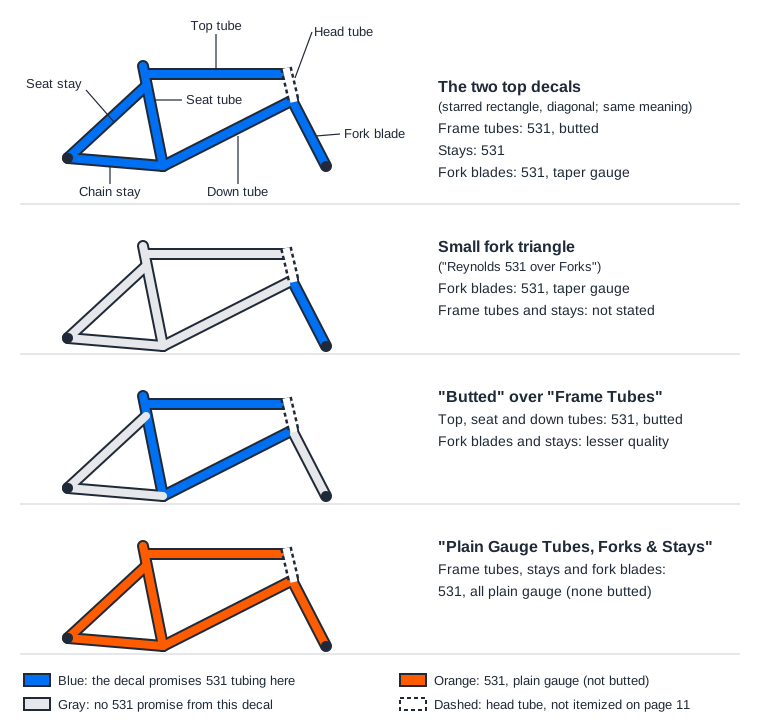
Reynolds’ own 1972 booklet explains five 531 decals, which make four different promises. The two top marks mean a full 531 build: 531 stays, taper-gauge fork blades and butted frame tubes. The “BUTTED FRAME TUBES” decal covers only the top, seat and down tubes. The “PLAIN GAUGE TUBES” decal means every tube is 531 but none of it is butted. The small fork triangle vouches for the fork blades and nothing else.
This guide reads each mark the way the maker defined it, then shows how to use that on a used steel frame. It covers the 1972 set only and does not compare frame materials; for carbon and aluminum, see our carbon vs aluminum frames guide.
The five decals at a glance
The source is a 12-page booklet from Reynolds Tube Company Ltd., whose printer’s code dates it to December 1972. It is written for ordinary riders, not as a trade catalog. Page 11 is headed “Reynolds 531 decals explained” and reproduces all five marks, each with a short statement of what it means.
| Decal | Frame tubes | Stays | Fork blades |
|---|---|---|---|
| Starred rectangle, or the diagonal design (the two top decals, same meaning) | 531, butted | 531 | 531, taper gauge |
| Small triangle, “Reynolds 531 over Forks” | Not stated | Not stated | 531, taper gauge |
| “Butted” over “Frame Tubes” | Top, seat and down tubes: 531 butted | Lesser quality | Lesser quality |
| “Plain Gauge Tubes, Forks & Stays” | 531, plain gauge | 531, plain gauge | 531, plain gauge |
Terms used below: gauge is wall thickness; stays are the paired thin tubes running back to the rear wheel; fork blades are the two legs of the fork.
The two top decals: the full specification
One is a starred rectangle and the other a diagonal layout, but Reynolds says they mean the same thing: 531 stays, taper-gauge forks and butted frame tubes. The booklet’s opening text (page 2, after the cover) gives the same specification as 531 butted frame tubes, fork blades and stays.
Two of those words need unpacking. A butted tube has a thicker wall near each end, where the joints are, and a thinner wall in the middle. A taper-gauge fork blade starts as a light-gauge tube with one long, gradual butt, and the thinner end is then tapered. The result is a wall that is thinner at the end meant to flex than at the end meant to stay rigid.
The fork triangle covers blades only
Reynolds says the small triangular decal is always fixed to a fork blade and shows that 531 taper-gauge blades were used. It was normally applied alongside the top decals. Because it names only the blades, a surviving fork triangle tells you nothing about the frame tubes or stays, which matters if the frame’s other decals have peeled or been painted over.
The two lesser decals are the ones people misread
Reynolds itself called these its “lesser” decals.
“Butted” over “Frame Tubes.” The top, seat and down tubes are 531 butted. Fork blades and stays are described only as “of lesser quality,” so the 531 promise stops at those three tubes. The booklet names no other frame tube for this decal, not even the head tube.
“Plain Gauge Tubes, Forks & Stays.” All the tubing is 531: frame tubes, chain and seat stays and fork blades. None of it is butted. This is the opposite trade: 531 steel everywhere, with no thick-ends, thin-middle profile. The booklet does not rank the two lesser marks against each other, so do not assume either one is the “better” frame.
Reynolds adds that French machines carry French equivalents of all these decals. The booklet does not reproduce them, so French wording needs a separate source.
Why butting earned its own decal
Reynolds explains the problem this way: frames built from very thin tubing tend to buckle at the points of maximum stress near the joints, and the weakest point in a cycle tube is next to the brazed joint. Butting thickens the wall there without increasing the outside diameter. By the booklet’s example, a butted 531 tube may be as thin as 24 swg (about 0.56 mm, or 0.022 in) in the middle, increasing to 21 swg (about 0.81 mm, or 0.032 in) at each end.
The steel addressed the same problem. Reynolds describes 531 as a manganese-molybdenum alloy steel and says its crystal structure changed very little at correct brazing temperature, unlike earlier tube steels. That helped keep the tubing’s strength at the points of maximum stress.
What “531” stands for is disputed
The booklet tells readers to say it “five-three-one” and gives no breakdown of the digits. Cycling Weekly says the numbers come from the ratio of manganese, carbon and molybdenum in the steel. Wikipedia lists an approximate composition of 1.5% manganese, 0.25% molybdenum and 0.35% carbon, without tying those figures to the name. Treat the ratio explanation as unconfirmed; it changes nothing about how a decal is read.
Dates differ slightly too. Cycling Weekly says 531 launched in 1935, while Wikipedia’s article on Reynolds Technology says 1934.
Using the decals on a used frame
- Find every decal. Cycling Weekly places the 531 sticker on the seat tube of classic racing bikes, and Reynolds says the fork decal is always on a fork blade. Check both spots and note exactly what each says.
- Match the wording to the table. A “Butted” over “Frame Tubes” mark promises 531 only in the top, seat and down tubes. Do not assume the stays and fork match.
- Treat a decal as a claim, not an inspection. It says nothing about condition or crash history, and a repainted frame can carry transfers applied later. If the wording, layout or era looks off, treat the tubing as unverified.
- Know the era. This is the 1972 set. Cycling Weekly names other variants such as 531ST (Super Tourist) and 531ATB (All Terrain), and Wikipedia lists complete 531 sets for different uses, including 531c (Competition). Marks from those lines fall outside this guide. Our piece on what makes a bike vintage covers the age and brand side of the question.
When to stop and ask a frame builder
A decal describes tubing as it left the factory, not what has happened since. Do not ride a frame with cracks, deep dents, buckles or rust-through near the joints, and have a frame builder inspect it first. Reynolds says the weakest point of a tube is next to the brazed joint, so that is where to look hardest.
- Rust can start inside. A steel-repair guide on Sheldon Brown’s site reports a chainstay that had rusted out from the inside and broken, so sound-looking paint and a clean outside prove little. For keeping rust away from a frame you do own, see how to store your bike for winter.
- Forks need a second look. The same guide calls a fork bent forward an extremely dangerous bend. A fork that has taken a hard hit or sits out of line should be checked by a professional before any ride.
- Repair is a builder’s call. That guide names replacement as the best repair apart from slight, simple bends, so whether a damaged frame can be saved is not something to test by riding it.
If you are unsure, treat the frame as unsafe until a frame builder says otherwise. Once a frame passes, make the 5-minute pre-ride checklist a habit.
Sources
- Ebykr: Reynolds 1972 Top Tubes Booklet — How a Tube Is Made and What the 531 Decals Guarantee
- Cycling Weekly: Icons of cycling: Reynolds 531 tubing
- Wikipedia: Reynolds 531
- Wikipedia: Reynolds Technology
- Sheldon Brown: Steel bicycle frame repairs
Last reviewed: October 2026.