A dropper seatpost is a seatpost whose height you change while riding, using a lever or switch on the handlebar. It lets you lower the saddle for descents and raise it again for pedaling. It is most useful where descents are steep or technical enough that a high saddle is in the way.
What a dropper does
A dropper seatpost (also called a dropper post or “dropper”) can be adjusted remotely while riding, using a lever or switch on the handlebar. Lowering the saddle puts it out of the way so you can position your body better on technical sections. The same control returns the saddle to its normal height for pedaling.
The reason this matters: a saddle set for efficient pedaling is high, and on a steep descent it gets in the way of shifting your weight back and low. Lowering it opens up space to move around the bike. The saddle height guide explains how to set the climbing height you return to.
How the mechanism works
Two separate things are easy to confuse: what holds the post up, and how you trigger it.
- Spring and damping. Most dropper posts use a hydraulically damped air or coil spring. This is what raises the saddle and controls its speed.
- Actuation. The lever can operate the post by cable, by hydraulic line or electronically (wireless remotes are in this last group).
Air or coil is the spring; cable, hydraulic or electronic is the actuation, meaning how the handlebar lever tells the post to move.
Cable, hydraulic or electronic remote
| Actuation | What to know |
|---|---|
| Cable | The cable and housing need the same care as brake and gear cables; see cable and housing maintenance. On Cannondale’s cable-actuated DownLow, a barrel adjuster on the lever takes up slack in the cable. |
| Electronic (wireless) | RockShox describes its Reverb AXS as using a shared battery, charger and controller, with the AXS Controller sold separately. Check the maker’s specifications for how the battery is charged and replaced. Hydraulic-line actuation, the third type, replaces the cable with a fluid line; follow the post maker’s instructions or use a shop for any service on it. |
Travel is how far the post drops. It varies by model. As one example, RockShox lists its Reverb AXS in these sizes, and says it suits riders running a 100 mm up to a 250 mm dropper post:
| Spec (RockShox Reverb AXS) | As listed by the maker |
|---|---|
| Travel | 100 mm, 125 mm, 150 mm, 175 mm, 200 mm, 225 mm, 250 mm |
| Diameter | 30.9 mm, 31.6 mm, 34.9 mm |
Other makers offer different ranges, so compare the drop length, post diameter and minimum insertion of the exact model before buying. Your frame’s seat tube length and your saddle height set how much travel physically fits.
Choosing the right fit
- Diameter. The post must match the inside of your seat tube. Seatpost diameters generally range from 22 mm to 35 mm in 0.2 mm increments, and larger sizes such as 30.9 mm are used on some modern bikes with thicker tubing. Check your frame’s stated size rather than guessing. Shims exist to adapt a too-small post to a too-large seat tube, but Cannondale’s manual for its 31.6 mm dropper says not to use adapters or shims with that post, so follow the post maker’s instruction.
- Drop length. The minimum insertion mark must always stay inside the frame. To check a candidate, measure the seat tube length from the bottom bracket to the top of the tube, and note the post length the model lists. The post must not be so long that it hits the frame’s internal obstruction (bottom bracket, bend or brace) before reaching the minimum-insertion mark, and its travel must still leave your climbing height reachable with the mark inside the frame. If either check fails, step down to a shorter-travel model.
- Overall length. Seatposts range from 75 mm to 430 mm in length, and mountain bike posts tend to be longer than road posts.
Minimum insertion: a safety limit
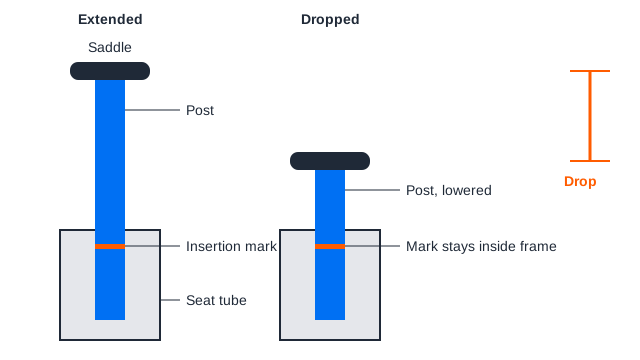
A seatpost usually carries a mark indicating the minimum insertion (or maximum extension). Do not raise the post so the mark shows above the frame. As an example of a maker’s spec, Cannondale lists a minimum seat post insertion of 100 mm for its DownLow dropper, which it rates for all-mountain use and not for downhill, freeride or dirt jump. Droppers differ in intended use, so match the post to how you ride. Your model’s figure will differ, so use the one in its manual.
Frames can also have their own insertion limit. Cannondale’s installation steps tell the installer to observe any maximum seat post insertion requirements specified by the frame manufacturer, so check the frame documentation as well as the post.
Stop riding and have a mechanic inspect the post and frame if you see bending, cracking, denting, discoloration, fluid leakage, a frayed cable or housing, loose or missing parts, deep scratches, or if the post does not function normally. The same applies after a crash or major impact. Never force a post into a frame; if it is hard to install, ask a shop.
Seatposts should also be periodically removed, cleaned, greased and refitted to prevent them seizing in the frame. For droppers, follow the maker’s service intervals and have internal service done as the maker specifies.
Do you need one?
Wikipedia describes droppers as found on mountain and gravel bikes, and they are not limited to them: Matej Mohorič used a dropper seatpost on his road bike to help win the 2022 Milan–San Remo. Whether one suits you is a judgement call; the checklist below is the site’s own opinion, not a sourced rule.
- Terrain. If your rides include descents steep or technical enough that you want your weight behind and below a high saddle, a dropper is worth considering. On smooth, flat routes the benefit is small in our judgement.
- Insertion room. Check that your frame’s seat tube can take the post’s length while keeping the minimum-insertion mark inside the frame, and that your frame’s own insertion limit allows it. If it cannot, a shorter-travel post is the answer, not a post pushed past its mark.
- Travel. Choose a drop that fits within your frame’s insertion limit; a longer drop gives more room to move on steep ground, but a post that does not fit is not a bargain at any length.
- Budget. A dropper adds a post, a lever and a cable, line or battery to the bike. Compare current prices from several shops, and weigh them against other upgrades such as tires or fit.
Related reading: getting started with mountain biking, mountain bike suspension and gravel biking.
Sources
- Wikipedia: Seatpost
- RockShox (SRAM): Reverb AXS
- Cannondale: DownLow Dropper Seat Post Owner’s Manual
Last reviewed: October 2026.