A bicycle wheel is a tensioned structure: the hub hangs from the rim by spokes pulled tight, and the rim carries the tire. Hubs are the center of that system. They hold the bearings that let the wheel spin and, on the rear, the mechanism that lets you coast. This guide explains each part, the main hub designs, and how to read the numbers you will meet when shopping or repairing.
At a glance
- Parts: tire, rim, spokes, nipples, hub (shell, flanges, bearings, axle).
- Tire fit: set by the ISO/ETRTO bead seat diameter in millimeters, not by the “inch” name.
- Standards: axle and spacing (for example 10 x 135 quick release, 12 x 142 or 12 x 148 thru-axle), disc rotor mount, and freehub body type must all match your frame, brakes and cassette.
- Rear hub types: freewheel (ratchet screws on) or freehub/cassette (ratchet built into the hub).
- Hub bearings: cup-and-cone (adjustable) or cartridge (sealed units).
- Stop and see a shop: cracked rims or flanges, loose or broken spokes, wobble that scrubs the brake, or play you cannot adjust out.
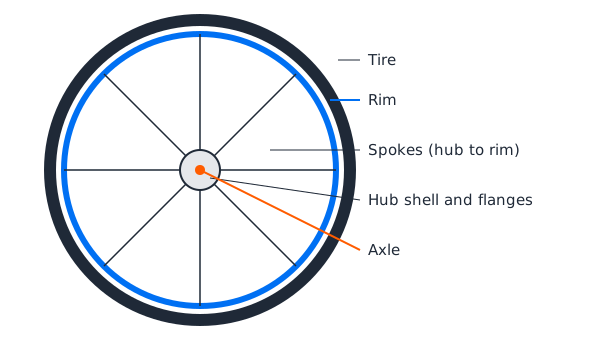
How the parts work together
The rim is usually extruded aluminum. Sheldon Brown describes single-wall and double-wall (box-section) rims, with eyelets or sockets at the spoke holes. The spokes connect rim to hub; stainless steel is the preferred material, while cheaper wheels use plated carbon steel, which is weaker and rusts. A nipple (usually nickel-plated brass) threads onto each spoke at the rim, and turning it is how you adjust tension.
The hub has a central axle, bearings, and a shell with a flange at each end where spokes attach. Sheldon Brown notes that thick flanges with flared spoke holes support the spoke elbows, which is why flange quality matters for wheel life.
Spokes: size, count and lacing
Spoke thickness is given as a gauge. Per Sheldon Brown: 13 gauge is 2.3 mm, 14 is 2.0 mm, 15 is 1.8 mm and 16 is 1.6 mm. Butted spokes are thinner in the middle, for example 2.0/1.8/2.0 mm. Spoke length is measured from the inside of the elbow to the end of the threads, and on a dished rear wheel the right-side spokes are 1 to 2 mm shorter than the left. Use a spoke calculator and your actual rim and hub measurements rather than guessing.
Common counts are 32 or 36. The cross number describes how many other spokes each spoke crosses. Brown lists 36 spokes as cross 3 or 4 (most wheels are built cross 3), and notes that higher cross numbers leave the flange more tangentially, which helps resist pedaling and braking torque. He also says a rear wheel should generally have more spokes than the front, that 28/36 is better than 32/32, and describes the 1980s switch to 32-spoke production wheels as a cost-cutting move that produced noticeably weaker wheels than comparable 36-spoke ones.
Radial spoking (cross 0) has two separate drawbacks in Brown’s account. First, Brown says drive wheels and wheels with hub brakes should never be radially spoked, because torque at the hub can greatly raise spoke tension and risk hub or spoke failure; he describes radial lacing as suitable only for front wheels that do not use hub brakes. Second, radial spokes can rip the outer edge of the flange off along the line of the spoke holes, a risk he says is highest on small-flange 36-hole hubs. He adds that many hub makers advise against radial spoking and will not honor warranties on radially spoked hubs, so check your hub maker before choosing it. Brown’s rule names hub brakes; for disc hubs, follow the hub maker’s lacing guidance. If you see a cracked flange or torn spoke holes, or a radial front wheel mysteriously loses true, stop riding the wheel.
Why rear wheels are dished and tension is uneven
Sheldon Brown notes that a highly dished rear wheel has very light tension on the left-side spokes, which can fatigue and break, and that when a wheel is correctly dished the left side will be noticeably looser. The explanation below of why this happens is general mechanics rather than a direct quote.
On a rear wheel the cassette occupies space on the drive side, so the rim must sit centered between the frame’s dropouts while the flanges sit off-center. This offset is called dish. Because of it, spokes on the cassette side are tighter than on the left. A front wheel without a disc or hub brake is symmetric. The practical lesson: tension should be even among spokes on the same side, but not identical side to side.
Rim and tire sizes
The ISO/ETRTO system names a rim by its bead seat diameter (BSD) in millimeters. Sheldon Brown states that if this number matches, the tire will fit the rim. Examples from his cross-reference:
| BSD (mm) | Traditional names |
|---|---|
| 622 | 700C, 29 inch |
| 584 | 650B, 27.5 inch (“27 five”) |
| 559 | 26 x 1.00 through 5.0 inch |
| 406 | 20 x 1.5 to 2.125 inch |
| 451 | 20 x 1 1/8 to 1 3/8 inch |
Brown calls “27 five” a marketing term for wide, knobby 584 mm tires, and lists 650B as another name for the same size. See our guide to tire pressure for how width and pressure interact, and tubeless setups for rim-and-tire pairing.
Rear hub types: freewheel vs freehub
A freewheel is a ratchet unit that screws onto the hub; it tightens as you pedal and needs a special puller to remove. A freehub has the ratchet as an integral part of the hub, and cassette sprockets slide onto splines on the freehub body. Several freehub body standards exist and they are not all interchangeable (see below). Brown says the industry moved to 8-speed clusters with 130 mm spacing in the early 1990s, but the longer unsupported axle on the freewheel side led to frequent axle breakage; 8-speed freewheels disappeared after that, and he states that 9- or 10-speed freewheels have never been produced. Converting a freewheel bike to a cassette generally means replacing the rear wheel. If your shifting is poor, worn sprockets and chain are more likely causes than the hub, but this compatibility matters when buying a replacement wheel.
Hub standards: axles, spacing, disc mounts and freehub bodies
Hub width is described as axle diameter times hub width, in millimeters. Mountain Bike Action gives 10 x 135 (quick release) as the original rear standard, 12 x 142 (thru-axle) as the newer trail standard that keeps the 135 chainline, and 12 x 150 for long-travel, downhill and fat bikes. Sheldon Brown’s frame-spacing chart lists rear spacing of 120 mm (5-speed and track), 126 mm (6- and 7-speed road), 130 mm (8- to 11-speed road without discs), and 135 mm (MTB, and road with disc brakes), plus 142 mm (12 mm thru-axle) and 148 mm (“Boost”) for MTB. For front hubs he lists 100 mm, with 110 mm for some Boost hubs. Fat bikes use much wider spacing. Spacing is not interchangeable: confirm your frame and fork standard before buying a wheel.
| Standard | Axle and spacing (mm) | Source |
|---|---|---|
| Quick release rear | 10 x 135 | Mountain Bike Action |
| Thru-axle rear | 12 x 142 | Mountain Bike Action |
| Thru-axle rear, long travel/fat | 12 x 150 | Mountain Bike Action |
| Boost rear (MTB) | 12 x 148 | Sheldon Brown |
| Front hub | 100 mm (110 for some Boost) | Sheldon Brown |
Disc brake hubs. Disc hubs carry a rotor mount on the hub shell, and Brown’s chart lists 135 mm rear spacing for road bikes with disc brakes. Brown names the 6-bolt ISO pattern, the Hope 3-bolt and the Rohloff 4-bolt as common rotor mounts, notes that Shimano Alfine hubs use the Centerlock fitting, and warns that replacement rotors can be hard to find for some older patterns. Check that a new rotor matches your hub’s mount. Disc brakes also change wheel geometry: Brown notes that a front wheel with a disc is no longer symmetrically dished, and that the spoke tension ratio may differ from a rim-brake wheel.
Freehub body standards. BikeRadar lists several: Shimano HG (nine raised splines, two spaced differently so sprockets mount one way), Shimano Micro Spline (23 splines, 12-speed MTB), SRAM XD and XDR (shorter body, no separate lockring; XDR is 1.85 mm wider), and Campagnolo (deeper splines and a different lockring). It states that some are inter-compatible but many are not: Campagnolo cassettes work only on Campagnolo bodies, Micro Spline and 12-speed road HG are not interchangeable, and an XDR cassette will not fit an XD body. Check the body type before buying a cassette. BikeRadar also notes that Shimano-standard 8-, 9- and 10-speed cassettes need a 1.85 mm spacer on a modern HG body, and a further 1 mm for 10-speed.
Engagement. Engagement is how far the wheel turns before the freehub catches. BikeRadar gives the formula angle = 360 divided by points of engagement, so 36 points is 10 degrees and 72 points is 5 degrees. It lists DT Swiss ratchets at 18 to 54 points. More points means a quicker catch. Tooth counts vary by model and ratchet generation, so use the maker’s spec for your hub.
Hub bearings: cup-and-cone and cartridge
In a cup-and-cone hub, cups are fixed into the shell and conical nuts (cones) thread onto the axle, with steel balls rolling between. A locknut holds each cone in place. Too tight, and the cones press on the balls, causing friction and early wear; too loose, and the wheel rocks on its axle. Sheldon Brown says the correct setting is sensitive, often within about a tenth of a turn. Cartridge-bearing hubs use sealed bearing units instead. Cartridge hubs are not adjusted this way, so follow the hub maker’s service instructions.
Brown describes play as the wheel shaking back and forth on its bearings, which he says is unpleasant and may cause control problems. A simple check is to hold the wheel off the ground, rock the rim side to side, then spin it and feel for roughness. Play or grinding means service is due. If adjustment does not remove play, or the axle, cones or flanges look damaged, have a shop inspect it.
Quick release vs thru-axle
Sheldon Brown explains that a quick-release skewer slides into a hollow hub axle and clamps the dropouts against the hub locknuts, so the locknuts, not the axle, transmit the loads to the fork or frame. A thru-axle is thicker than a skewer: it inserts through a hole in one forkend or frame end, passes through the hub, and screws into the other end or a frame fitting. Some are tightened with an Allen key and others have a cam lever. No part of the hub extends into the forkend holes. Thru-axle length and thread pitch are specific to the frame, so use the maker’s documentation.
When to stop riding
- Cracks in a rim, hub flange or axle.
- Several loose or broken spokes, or a wheel that wobbles enough to touch the brakes. See brake servicing for the brake side.
- Bearing play that adjustment does not remove.
Truing and re-tensioning are skilled jobs: uneven tension can make a wheel fail. Have a qualified mechanic handle anything beyond minor checks. A quick wheel check also fits into your pre-ride checklist.
Sources
- Sheldon Brown: Wheelbuilding
- Sheldon Brown: Tire Sizing
- Sheldon Brown: Freewheels
- Sheldon Brown: Cone Adjustment
- Sheldon Brown: Frame/Hub Spacing
- Sheldon Brown: Thru Axles
- Sheldon Brown: Disc Brakes
- BikeRadar: Freehubs explained
- Mountain Bike Action: Making Sense of Rear-Wheel Spacing
Last reviewed: October 2026.