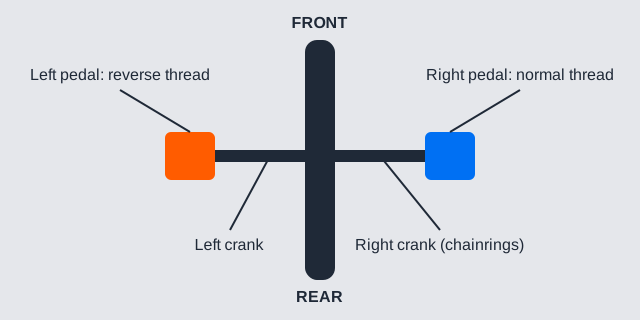
The left pedal has a reverse (left-hand) thread because a normal thread on that side would slowly work itself loose while you ride. The right pedal uses an ordinary thread. In practice, turn each pedal axle in the direction the pedal spins when you ride forward to tighten it, and the opposite way to loosen it. That holds on both sides, which is why the rule is easier to remember than “righty-tighty, lefty-loosey”.
The rule in one table
| Pedal | Thread | To tighten | To loosen |
|---|---|---|---|
| Right (drive side, chainrings) | Normal, right-hand | Clockwise, as seen from the right side of the bike | Counterclockwise |
| Left (non-drive side) | Reverse, left-hand | Counterclockwise, as seen from the left side of the bike | Clockwise |
Both rows say the same thing: tightening means turning the axle toward the front of the bike at the top, the direction your foot drives it. Sheldon Brown’s pedal guide gives the same instruction: right pedal normal, left pedal reverse, and for installation you “turn the pedal axle in the direction of pedaling”.
Why the reverse thread works: precession
It is tempting to think the reverse thread is about pedal bearings. The left pedal body spins clockwise on its bearing relative to the crank, which looks like it should tighten a normal thread. Yet bearing friction is not the culprit. The cause is precession, a small rolling motion that happens whenever a slightly smaller round part turns inside a slightly larger hole.
A loose pencil in a fist shows the idea: swing the pencil’s free end around in a circle and its body rolls against your fingers, turning the opposite way. A pedal axle sits in the crank much like that, because Brown notes the axle thread is slightly smaller than the crank’s internal thread, leaving it free to roll a little.
Under load, your foot presses the spindle against the crank thread at a contact point. As the crank rotates, that point rolls around clockwise relative to the crank on the left side. Friction there gently drags the outside of the spindle counterclockwise. A right-hand thread loosens when turned counterclockwise, so a normal thread on the left would back out over time. A left-hand thread turns that same drift into a tightening push. Wikipedia describes the same mechanism for the left spindle.
Two myths worth dropping
- “It is so a seized pedal unscrews instead of breaking your ankle.” Brown calls this a popular armchair theory. The left thread was a fix for a practical problem: left pedals kept unscrewing.
- “The precession effect means you can go light on tightening.” It does not. The same guide says precession does not replace tightening the pedals “in good and tight”.
Installing a pedal without cross-threading
- Match each pedal to its side before you start, so you are turning the correct way for the thread.
- Grease the thread. Brown says the threads, like almost all threads on a bicycle, should have grease or at least oil. That helps stop the pedal seizing in the crank.
- Start the thread by hand, turning the axle in the pedaling direction. If it binds, back out and realign rather than forcing it.
- Finish with the wrench, snug and firm, turning in the same direction.
Removing a stubborn pedal
Removal is trickier than installation (except on a fixed-gear bike) because the cranks freewheel backward, so the chain will not hold them still. Two common fixes:
- Turn the crank so it faces forward and set the wrench on the flats pointing backward toward the crank axle. Hold the handlebar with one hand, press down on the saddle with the other, then push the wrench down with your foot.
- If the cranks keep turning, wrap an old toe strap or rope around the opposite crank and the chainstay so they cannot rotate.
If your pedal has an Allen fitting, do not overstress a skinny key, as Brown cautions. Remember the reversal: the left pedal comes off clockwise.
Thread size and when to stop
Most adult-bike pedals use a 9/16 inch by 20 threads-per-inch thread, and the size is often stamped into the crank near the pedal hole. Some older French bicycles used a 14 mm by 1.25 mm thread, though these are quite rare. A French pedal in a standard crank, or the reverse, starts to thread and then binds. Do not force it, because that damages the crank.
Stop and take the bike to a shop if:
- the pedal will not start by hand, or binds after a turn or two;
- the crank thread looks stripped or the pedal feels loose in the crank after tightening;
- the pedal axle is bent. Brown’s check is to watch the outer end as you screw the pedal in or out; if it traces a small circle, the axle is bent and must be replaced;
- you suspect a bent or cracked crank.
As a general precaution, if a pedal keeps working loose, do not keep riding on it; have a shop inspect the pedal and crank thread first.
Where this fits in routine care
Brown also advises removing pedals and relubricating the threads yearly, since road dirt, splash and winter salt can corrode them in place. As a general habit, grip each pedal by hand and check it is not loose in the crank when you do your pre-ride bike checklist. If you are moving to clipless pedals, choosing the right cycling shoes comes first. For other jobs where you work around the drivetrain, see how to maintain your bike chain and how to fix a flat tire.
Sources
Last reviewed: October 2026.