Austrian law treats an electric bicycle as a bicycle, not a motor vehicle, when its rated continuous power is no more than 250 W, its design speed is no more than 25 km/h, and it is not an EU class L1e-B vehicle. The third condition is the one that matters from 1 October 2026. An “E-Moped”, meaning an e-bike without pedal assistance, is no longer treated like an e-bike even if it stays within 250 W and 25 km/h. It follows moped rules instead. This covers Austrian federal law as of 9 October 2026, from the Federal Law Gazette and the consolidated texts in RIS, the federal legal database.
The legal test, in two statutes
Two laws work together. The Motor Vehicles Act (Kraftfahrgesetz, KFG) says in § 1 Abs. 2a that electrically driven bicycles count as bicycles for road-traffic purposes, and not as motor vehicles, if they meet the conditions in the table. The Road Traffic Act (Straßenverkehrsordnung, StVO) then defines the Elektrofahrrad by pointing back to that KFG rule. The new wording of both comes from Federal Law Gazette Part I No. 17/2026, issued on 23 April 2026 as the 36th StVO amendment. The bicycle definitions take effect on 1 October 2026.
| Test | Requirement | Where it sits |
|---|---|---|
| Rated continuous power (Nenndauerleistung) | No more than 250 W | KFG § 1 Abs. 2a |
| Design speed (Bauartgeschwindigkeit) | No more than 25 km/h | KFG § 1 Abs. 2a |
| Vehicle class | Not L1e-B | KFG § 1 Abs. 2a; StVO § 2 Abs. 1 Z 22 lit. b and d |
Three terms are worth defining. Rated continuous power is what the motor is rated to deliver continuously, not a brief peak. Design speed is the speed the vehicle is built for, not how fast it can coast downhill. L1e-B is an EU vehicle class that Austrian law calls a zweirädriges Kleinkraftrad, a two-wheeled light motorcycle. The KFG’s definition of a moped (Motorfahrrad) includes vehicles of class L1e, which is why an L1e-B vehicle is handled like a moped.
The StVO builds its bicycle definition in layers. The base case is a vehicle with a device that transfers human power to the drive wheels. Add an electric drive as defined in the KFG rule and it is an Elektrofahrrad (lit. b). A separate item, lit. d, covers electrically driven vehicles whose drive corresponds to such an e-bike’s drive. Both lit. b and lit. d now state that L1e-B vehicles do not count as bicycles.
What changed on 1 October 2026
Before the change, KFV (the Austrian road safety board) reports, E-Mopeds followed the same rules as e-bikes as long as they stayed within 25 km/h design speed and 250 W rated continuous power. From 1 October 2026 they count as motor vehicles and are equated with mopeds of up to 45 km/h.
Which side is a bike on?
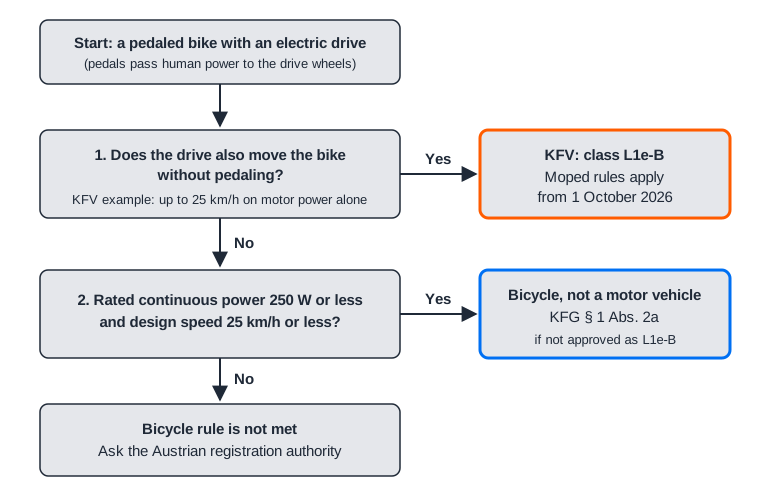
KFV’s test is function, not appearance. In a conventional e-bike, which KFV calls a Fahrrad mit Antriebssystem (class L1e-A), the auxiliary drive up to 25 km/h only supports pedaling. A vehicle that has pedals but whose drive also works without pedaling falls into L1e-B, the same class KFV applies to E-Mopeds, so the new rules reach it too. Our guide to throttle versus pedal assist explains how those two control styles differ.
Treat KFV’s L1e-A label as shorthand for the conventional design. Article 2(2)(h) of Regulation (EU) No 168/2013, the EU approval rule for two- and three-wheel vehicles, exempts a pedal-assist bicycle whose auxiliary electric motor is rated at 250 W or less of continuous power, cuts out when the rider stops pedaling, and is fully cut off before the bike reaches 25 km/h. Such a pedelec sits outside EU type approval, so it carries no L1e approval.
- Ask whether the drive can propel the bike without pedaling, as in KFV’s example of a bike that reaches 25 km/h on motor power alone. If it can, KFV counts it in L1e-B.
- Find the manufacturer’s stated rated continuous power and design speed. Both must be at or below 250 W and 25 km/h for the bicycle rule to apply.
- Ask the dealer or manufacturer, in writing, whether the model is a pedal-assist bicycle outside EU type approval or is type-approved as L1e-A or L1e-B. An L1e-B approval puts it on the moped side.
- If the answer is L1e-B, or stays unclear, check with the Austrian registration authority before riding on public roads. KFV itself notes that legal questions can only be answered in basic terms without knowing every circumstance.
- Do not change the motor, controller or firmware to move a vehicle across the line. A modified vehicle may no longer match its approval papers.
What the moped side requires
KFV’s summary: all E-Mopeds follow the same rules as more powerful mopeds from 1 October 2026, even at 25 km/h design speed and no more than 250 W.
| Topic | Rule from 1 October 2026 |
|---|---|
| Where to ride | The roadway, not cycle infrastructure |
| Driving license | Required: at least class AM, or a class A or B license |
| Helmet | Required at any age; KFV’s release specifies a moped or motorcycle helmet |
| Plate, registration, insurance | All required |
| Alcohol limit | 0.5 per mille, down from 0.8 |
| Inspections | Recurring § 57a inspections, according to KFV; the ministry’s scooter page lists an annual inspection (Pickerl) for scooters classed as mopeds, so confirm the interval with the registration authority |
On helmets, KFV’s release says that riding with a bicycle helmet instead of a motorcycle or moped helmet is penalized like riding without one. The age limit for E-Mopeds rose in steps: up to age 12 until 30 April 2026, up to age 14 from 1 May to 30 September 2026, and all ages from 1 October 2026. For a conventional e-bike the helmet obligation runs until the 14th birthday, a rule that is new from 1 May 2026. Riders of e-bikes and bicycles stay at the 0.8 per mille alcohol limit. For fit and construction, see our cycling helmets guide.
Registering an affected vehicle needs paperwork such as a type certificate, proof of individual approval, an approval-database extract or an EU certificate of conformity (CoC). Without a CoC, KFV says the manufacturer or general importer can be asked to issue one later; otherwise the remaining route is an individual approval at the state’s technical testing body.
Where the sources differ
The ministry’s scooter page on oesterreich.gv.at still describes an E-Moped/E-Roller with a design speed up to 25 km/h and no more than 250 W rated continuous power as a bicycle. That page shows a last update of 12 January 2026, so it predates the October change. Where it and the statute disagree, the statute and KFV’s reading of it are the better guide. For a borderline case, such as an imported or modified bike, take its papers to the authority.
Do not confuse the 250 W bicycle limit with the separate category of electric small and mini scooters (Klein- und Miniroller), which the StVO defines with an output of no more than 600 W. For how other regions draw their lines, see e-bike laws in the US, UK and EU. If you are shopping, how to choose your first e-bike covers the practical side, and mid-drive versus hub motors compares the two common motor layouts.
Sources
- Rechtsinformationssystem des Bundes (RIS): Bundesgesetzblatt I Nr. 17/2026
- Rechtsinformationssystem des Bundes (RIS): Kraftfahrgesetz 1967, consolidated federal law
- Rechtsinformationssystem des Bundes (RIS): Straßenverkehrsordnung 1960, consolidated federal law
- legislation.gov.uk: Regulation (EU) No 168/2013, Article 2 (as adopted)
- KFV: 36. StVO-Novelle: Fragen und Antworten zu den Änderungen in Österreich
- KFV: Neue Regeln für “E-Mopeds”: Ist Österreich bereit für den 1. Oktober?
- oesterreich.gv.at: Scooter
Last reviewed: October 2026.