The legal line for an e-bike is set by three things: how much power the motor has, the speed at which it stops helping, and whether you have to pedal for it to work. Stay on the right side of those and, in the UK, you ride like any cyclist. In the US, federal law defines the product, but states and land managers decide where and how you may ride it.
United States: federal definition, state rules
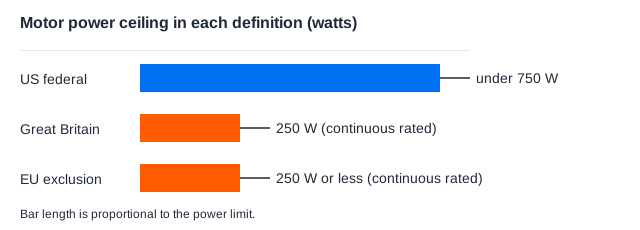
US federal law defines a “low-speed electric bicycle” as a two- or three-wheeled vehicle with fully operable pedals and a motor under 750 watts (1 horsepower), whose motor-only top speed is under 20 mph (32 km/h) on a paved, level surface with a 170 lb (77 kg) rider. Bikes meeting that definition are regulated as consumer products by the Consumer Product Safety Commission.
That definition is about the product. Rules for riding it, such as minimum age, helmets, and which paths are open, come mostly from state and local law, and they differ. Check your state vehicle code and the rules of the specific path or trail before you ride, and look at what motor power, assist speed and class information is printed on the bike itself.
Most people meet the three-class labels instead. The US National Park Service, for its own lands, defines Class 1 as assistance that stops at 20 mph (32 km/h), Class 2 as a motor that can propel the bike alone but not once it reaches 20 mph, and Class 3 as assistance that stops at 28 mph (45 km/h). Under 36 CFR 4.30, e-bikes on park lands may be used on park roads, parking areas and administrative roads and trails, and are prohibited in locations the Superintendent has not designated. State definitions are similar but not identical, so read your own state’s.
Great Britain: the EAPC rules
This section covers Great Britain (England, Scotland and Wales); Northern Ireland is not covered here. A legal e-bike is an “electrically assisted pedal cycle” (EAPC). You can ride one from age 14, with no license, registration, tax or insurance. An EAPC must have pedals that can propel it, and its motor must have a continuous rated power of no more than 250 watts and must not be able to propel the bike when it is travelling faster than 15.5 mph (25 km/h).
The detail people often get wrong is the throttle. An EAPC can be propelled up to 15.5 mph without pedaling only if it has been approved, so a “twist and go” bike needs vehicle approval. For more on the two ways of controlling a motor, see throttle vs pedal assist. If the bike does not meet the EAPC rules, it is classed as a motorcycle or moped: it must be registered and taxed, you need a valid driving license, a motorcycle helmet that meets British safety standards, and insurance. You can then ride it only on the road, not on cycle tracks or cycle lanes. Even a legal EAPC may not be ridden on pavements.
The bike must also be marked with its continuous rated power and the manufacturer, plus either the battery voltage or the maximum speed the motor can propel it. Check the markings before buying.
European Union: where the bicycle ends
EU vehicle type-approval rules (Regulation 168/2013) exclude pedal-assist cycles from the moped and motorcycle categories when the motor is 250 W or less, cuts off when you stop pedaling, and is progressively reduced and finally cut off before the bike reaches 25 km/h. Bikes inside that exclusion are not covered by the moped and motorcycle type-approval categories.
Faster or more powerful machines fall into the L1e categories. For example, a two-wheeled vehicle whose motor assists pedaling, cuts off at 25 km/h or less and is rated 1,000 W or less is classed as an L1e-A powered cycle.
Pedal-assist bikes that keep assisting above 25 km/h, often called speed pedelecs, do not fit either the exclusion or L1e-A. The regulation places light two-wheel powered vehicles with a maximum design speed of 45 km/h or less in category L1e, and its L1e-B subcategory, the two-wheel moped, takes any L1e vehicle that is not an L1e-A. Member states apply the rules on licensing, insurance, helmets and age, so check national law for the country you will ride in.
Quick comparison
| Region | Motor power | Assist cut-off | Where the rules live |
|---|---|---|---|
| US (federal product definition) | Under 750 W | Motor-only speed under 20 mph (32 km/h) | 15 U.S.C. 2085, plus state and local rules |
| Great Britain (EAPC) | 250 W continuous rated | 15.5 mph (25 km/h) | GOV.UK electric bike rules |
| EU (bicycle exclusion) | 250 W max continuous rated | Cuts off before 25 km/h | Regulation 168/2013, plus national law |
Trails and parks
Where an e-bike is legal on the road, a trail manager can still restrict it. Land managers set their own rules for trails, so confirm access with the managing agency or club before riding off-road.
Practical steps
- Choose a bike whose motor power, assist speed and class are clearly printed on it and in its manual. See how to choose your first e-bike.
- Do not alter the speed limiter or motor settings to exceed the legal limits; doing so can change how the law classes the bike.
- Wear a well-fitting helmet whatever the local requirement; see how cycling helmets work.
- Understand what the motor type means for how the bike delivers power: hub vs mid-drive motors.
- Laws change. Read the current text from your government’s official source, linked below, and ask your local authority if your case is unusual.
Sources
- GOV.UK: Riding an electric bike: the rules
- Cornell Legal Information Institute: 15 U.S. Code 2085, Low-speed electric bicycles
- Cornell Legal Information Institute: 36 CFR 1.4, Definitions
- Cornell Legal Information Institute: 36 CFR 4.30, Bicycles
- EUR-Lex: Regulation (EU) No 168/2013
Last reviewed: October 2026.