The best commuter bike is the one that stays reliable in all weather, carries your things and fits you. Four features decide that more than brand or price: mounts for a rack and fenders, brakes that work in the rain, a tire size you can easily replace, and a riding position you can hold on a daily ride. This guide explains each so you can judge any specific bike in a shop or listing.
What a commuter bike usually is
A commuter bike is a hybrid built with daily trips in mind. Hybrids combine a mountain bike’s flat handlebar and upright seating with the lighter frame, narrower wheels and smooth tires of a road bike. A typical commuter version has derailleur gearing, 700c wheels with fairly light 29 mm tires, a carrier rack, full fenders, and a frame with mounting points for baskets or panniers. A well-equipped one also has front and rear lights.
Many hybrids are sold without those extras. Fitness-oriented “cross” hybrids in particular are not normally fitted with fenders, lights or racks, so check the frame and fork for threaded mounting eyelets before buying. For a wider comparison with road and mountain bikes, see Road Bike, Hybrid or Mountain Bike: Which Should a Beginner Buy?
Rack and fender mounts
Eyelets are small threaded holes in the frame and fork where a rack or fenders bolt on. Fenders matter in wet weather: Sheldon Brown notes that without them the chain, derailleurs and brakes get sprayed with sandy, muddy water, and that fenders shield both rider and bicycle from spray off puddles. If you plan to carry more than a small bag, a rack is the usual solution; see Panniers, Backpack or Frame Bag for how to choose a load setup.
Brakes for all-weather stopping
Rim brakes squeeze the wheel rim; disc brakes squeeze a metal rotor at the hub. Rim brakes perform relatively poorly when the rims are wet and brake unevenly if the rim is even slightly warped. Disc brakes, by contrast, tend to hold up equally well in water, mud and snow. For a bike ridden daily in all weather, our recommendation is to choose discs.
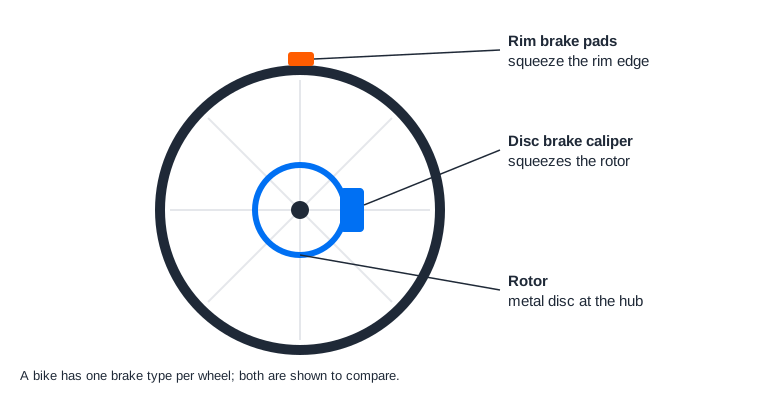
Disc brakes come in two kinds. Wikipedia’s bicycle brake entry says cable-actuated (mechanical) discs are argued to offer lower cost, lower maintenance and lighter system weight, while hydraulic discs are said to offer more braking power and better control. Both types work; the practical difference is cost and upkeep against power and feel. Hydraulic systems use sealed fluid lines, so have a shop service them rather than working on the fluid yourself. If a brake lever pulls to the handlebar, feels spongy, squeals badly or the rotor is bent, stop riding and have a mechanic inspect the bike. For routine upkeep see How to Service Your Own Brakes.
Wheels and tire size
Tire sizes carry a width and a bead seat diameter in the ISO/ETRTO format. A 700 x 38 hybrid tire is a 38-622: 38 mm wide on a 622 mm rim. Sheldon Brown notes that if the bead seat diameter number matches, the tire will generally fit the rim. Check how much clearance the frame and any fenders leave before going wider. For setting pressure, see Tire Pressure.
Fit and riding position
A flat bar and upright posture are standard on hybrids, but frame size and saddle height decide whether the bike stays comfortable over a daily ride. Ride a bike before buying if you can, and see How to Fit a Bike Properly.
One current example to measure against
The Giant Escape Disc 2, which Giant calls a flat-bar all-rounder, is one example of how the checklist reads on a spec sheet. It is not a ranking or a recommendation over other brands. As listed on Giant’s US site in October 2026 it was $675 (original price $775). Giant describes “integrated rack mounts” and “powerful disc brakes”; the spec lists a rack-mount fork, Tektro HD-R280 brakes with 160 mm rotors, and Giant S-X2 700x38c tires with 45 mm maximum tire clearance. Prices change often and vary by dealer, so confirm before buying. Fender mounts are not stated on that page, so check the frame yourself.
A checklist for comparing bikes
| Check | What good looks like | Why it matters |
|---|---|---|
| Mounts | Eyelets for rack and fenders on frame and fork | Secure load carrying and wet-weather protection |
| Brakes | Disc brakes, mechanical or hydraulic | Consistent stopping in rain and mud |
| Tires | 700c (622 mm) with clearance listed for a wider tire | The 622 mm number tells you which tires fit the rim |
| Serviceability | Standard parts and a nearby shop that can service it | A bike that is down for repair is not a commuter |
| Fit | Frame size matched to your height and reach | Comfort over daily distances |
Specifications and prices change every model year, so compare current manufacturer pages against this checklist. If you already own a bike, converting it to a commuter may cover the same features; for riding habits and route planning, see How to Make Cycling to Work Actually Work. If you buy used, have a shop check the brakes, wheels and frame first. If you are considering electric assist, read E-Bike vs Regular Bike, and add lights from Best Commuter Bike Lights.
Sources
- Wikipedia: Hybrid bicycle
- Wikipedia: Bicycle brake
- Sheldon Brown: Tire Sizing
- Giant Bicycles: Escape Disc 2
- Sheldon Brown: Fenders for Your Bicycle
Last reviewed: October 2026.