A Fahrradstraße (bicycle street) is a street marked with sign 244.1. In Germany, vehicles other than bicycles may not use it unless a supplementary sign allows them, vehicle traffic is held to 30 km/h (about 19 mph) and that includes bicycles, and cyclists may ride side by side. Ordinary road-use and right-of-way rules still apply. The rules are written into Anlage 2 of the Straßenverkehrs-Ordnung (StVO), Germany’s federal road traffic regulations, and this page describes them as of October 2026.
What the signs mean
Sign 244.1 marks the start of a bicycle street and sign 244.2 its end. Both sit in Anlage 2, the schedule of regulatory signs attached to § 41(1) StVO, and the rules are spelled out in the entry for 244.1. The ADFC (Allgemeiner Deutscher Fahrrad-Club, Germany’s national cyclists’ club) describes these as streets where bicycle traffic predominates.
| Topic | What the entry for sign 244.1 says | How to read it |
|---|---|---|
| Who may enter | Vehicle traffic other than bicycles, plus electric micromobility vehicles under the eKFV, is barred unless a supplementary sign allows it. | Look for the small plate under the main sign. The eKFV is the regulation on small electric vehicles such as e-scooters. |
| Crossing | Other vehicles may cross the street at a junction to reach the continuing street. | A crossing needs no plate; driving along the street does. |
| Speed | 30 km/h for Fahrverkehr, meaning vehicle traffic. Bicycle traffic must be neither endangered nor hindered, and motor traffic slows further when necessary. | Both ADFC pages confirm the cap covers bicycles. The duty to adapt falls on motor traffic. |
| Side by side | Riding side by side on bicycles is permitted. | No condition about obstructing other traffic. |
| Everything else | The rules on road use and on right of way apply. | Right before left and keep right carry over, plus bicycle lighting rules (ADFC Köln). |
Who may enter, and who may only cross
A supplementary sign (Zusatzzeichen) is the extra plate mounted under the main sign. Anlage 2 says one plate can show several permitted traffic types together. ADFC Köln, the Cologne branch of the club, says plates are usually there for Anlieger, roughly “residents and others with a destination on the street”, and describes car drivers there as guests. An “Anlieger frei” plate gives no priority over cyclists; it only limits motor traffic to those Anlieger.
E-bikes split into two groups. A pedelec (pedal-assist e-bike) with a motor rated at no more than 0.25 kW (250 W) whose assistance is cut off at 25 km/h or earlier is not a motor vehicle under § 1(3) of the Straßenverkehrsgesetz (StVG), the federal road traffic act, and the bicycle rules apply to it. A fast pedelec (S-pedelec), assisting up to 45 km/h, falls outside that exemption: the ADFC says it counts as a Kleinkraftrad, a small motorized two-wheeler class. That puts it among the “other vehicle traffic” in the entry, so it may use a bicycle street only where a supplementary sign admits it. Pedelec limits elsewhere: e-bike laws in the US, UK and EU.
Crossing is the one case that needs no plate: other vehicles may cross a bicycle street at a junction to reach the continuing street, but may not drive along it.
Parked cars are the other thing to expect. ADFC Köln says cars and motorcycles may park in bicycle streets unless signs forbid or restrict it. The same page says the usual safety distances apply “wie auf jeder anderen Straße auch”, as on any other street, so keep them when you pass.
The 30 km/h limit and who has to adapt
The federal text caps Fahrverkehr, vehicle traffic, at 30 km/h and does not single out any type of vehicle. The two ADFC pages confirm that bicycles are included: the national page says all vehicles may go at most 30 km/h, and ADFC Köln says the limit applies to all vehicles, bicycles included. A fit rider on a long descent can pass 30 km/h without noticing, so glance at your speed.
The same entry puts the burden on motor traffic: bicycle traffic must be neither endangered nor hindered, and motor traffic must slow further when necessary, which the ADFC summarizes as drivers having to adapt to cyclists. ADFC Köln adds that an oncoming driver must also slow down, if needed to a stop, and keep as far right as possible. That is the club’s reading, not sign-entry wording.
Riding side by side
Outside bicycle streets, § 2(4) StVO allows bicycles to ride next to each other only if that does not hinder traffic, and otherwise requires single file. The entry for sign 244.1 is shorter: riding side by side on bicycles is permitted, with no hindrance test attached. The national ADFC page summarizes it as cyclists being allowed to ride two abreast always. The sign entry names no number and the ADFC speaks of pairs, so treat two as the limit.
On road position, all three sources keep the keep-right duty in force. The sign entry leaves the general road-use rules applying, the national ADFC page lists bicycle streets among the places where keep-right holds, and ADFC Köln lists the road-use rules, with keep-right as its example, among the provisions to observe. The tension sits inside the Köln article itself. It describes the whole roadway width as reserved for bicycle traffic and says motor traffic has no right to overtake cyclists, yet it also says keep-right still applies. In practice, ride your pair toward the right, leave the left for oncoming riders, and drop into single file where the street is narrow. For pair-riding habits, see riding safely in a group; for general positioning, the basic rules of cycling on roads.
What still applies on a bicycle street
- Right before left. At a junction without signs or signals, traffic from the right goes first. ADFC Köln stresses that priority along the street is not right of way at its junctions, which is regulated as on any other street. Look right before crossing side streets.
- Keep right. Section 2(2) StVO tells vehicle users to keep as far right as possible.
- Lights and equipment. ADFC Köln lists the lighting and equipment rules for bicycles among the StVO provisions that still apply, so a quiet evening street is no reason to skip your lights; see commuter bike lights.
Bicycle zones: sign 244.3
Sign 244.3 marks the beginning of a bicycle zone (Fahrradzone) and sign 244.4 marks its end. The ADFC says that since April 2020 a zone can designate a larger connected area under bicycle-street rules. The zone entry in Anlage 2 follows the street entry’s pattern, with two differences.
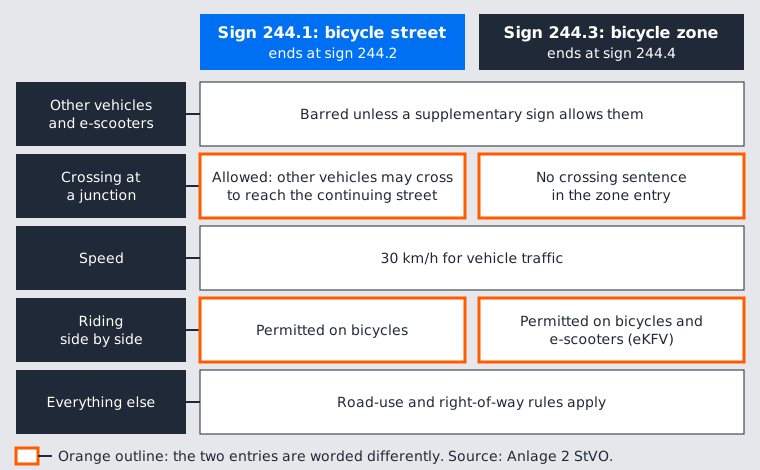
Read the sign you are actually under: only the zone entry names e-scooters in its side-by-side sentence, and only the street entry has the junction-crossing sentence.
Before you rely on this
The plate under the sign in front of you decides who else may be there. The ADFC pages are explanations from a cyclists’ organization, not law; the authoritative wording is Anlage 2 on the federal portal gesetze-im-internet.de. For a specific dispute or a fine, ask the local traffic authority or a lawyer. If you are planning a commute, mapping a safe route to work helps you find these streets.
Sources
- Bundesministerium der Justiz: Anlage 2 StVO, Vorschriftzeichen (Internet Archive copy of 29 September 2026)
- Bundesministerium der Justiz: § 2 StVO, Straßenbenutzung durch Fahrzeuge (Internet Archive copy of 6 October 2026)
- Bundesministerium der Justiz: § 1 StVG, Zulassung (Internet Archive copy of 4 September 2026)
- ADFC: Verkehrsregeln für Radfahrende
- ADFC Köln: Sicheres Fahrradfahren: in der Fahrradstraße
Last reviewed: October 2026.