Panniers are the better fit if your bike has rack mounts and you want easy access, large capacity and bags you can unhook at a campsite. Bikepacking bags are the better fit if you ride rough terrain, or your bike has no rack mounts. The two can also be mixed. The right choice depends on your bike, the surface and how much you really need to carry.
How the two systems differ
Panniers are paired bags that hang on either side of a rack over the front or rear wheel. They need a rack, and therefore a bike with the mounting points a rack requires. A touring bike is typically built with this in mind: Wikipedia describes one with “frame fittings for front and rear pannier racks”.
Bikepacking bags strap straight to the frame, saddle rails and handlebar. The bikepacking.com definition of the sport is “the synthesis of all-terrain cycling and self-supported backpacking.” Wikipedia notes that this style “may utilize soft bags which can be fitted directly to most bicycles”, whereas racks and panniers “can require eyelets on the bicycle frame and fork for mounting.”
| Question | Panniers | Bikepacking bags |
|---|---|---|
| Needs a rack? | Yes, front and/or rear | No |
| Where the load sits | On both sides of a wheel | Strapped to frame, saddle and bars; Wikipedia suggests this can sit closer to the center of mass (marked there as needing a citation) |
| Example kit volume (bikepacking.com) | 102 liters | 42.7 liters |
| Example weight of bags and racks (bikepacking.com) | 5019 g (11 lb) | 1779 g (3.9 lb) |
The last two rows come from one bikepacking.com comparison of a lightweight touring kit and a standard bikepacking kit. Other bag models will give different totals, but the gap in volume is the point: panniers hold much more, and bikepacking bags force you to carry less.
Panniers in practice
Capacity is quoted per bag. Wikipedia describes the most common touring setup as “smaller panniers (10 to 15 liters each) mounted on a low rider” at the front, with “larger ones on the rear carrier (20 to 30 liters each).” Treat these as typical sizes, not rules.
What to check when choosing:
- Attachment. “Removable panniers hook onto the top edge of the rack and are often held in place by a latch or elastic mechanism.” Test that the bag cannot bounce off, and that it clears your heel on every pedal stroke.
- Weather protection. “Many panniers are built to be water-repellent or waterproof by themselves. Others include built-in rain-covers.” Water-repellent is not the same as waterproof, so line anything that must stay dry (sleeping bag, electronics, spare clothes) with a roll-top dry bag.
- Rack fit. Wikipedia notes panniers are “usually built to attach to a rear rack or front rack already fitted to the bicycle”, so check your rack’s tube diameter and the bag’s hooks match before you buy.
Bikepacking bags in practice
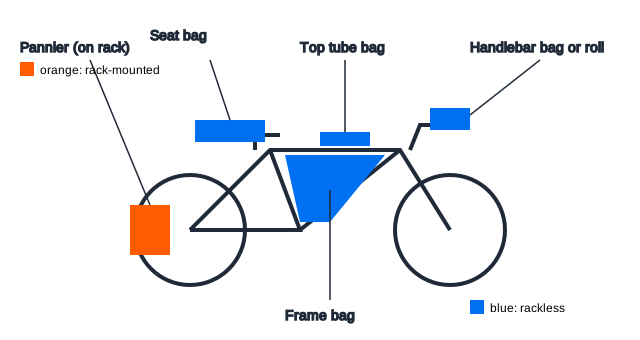
Wikipedia lists the usual set:
- Seat bag: “Affixed to the seat above the rear wheel.” Bikepacking.com calls a sleek seat pack the lightest and most nimble option for singletrack, and says a traditional saddlebag holds a little more but often needs a small rack.
- Frame bag: “Fits inside the frame triangle.” Bikepacking.com suggests a custom bag to make the most of the triangle, and warns that overfilling a zippered frame bag strains the zipper until it fails. Check that the bag still leaves room for your bottle cages.
- Top tube bag: “Mounted on the frame’s top tube behind the steering tube”, for snacks, phone and other things you reach for while riding.
- Handlebar bag or roll: a bag or a dry bag on a harness. Riders writing for bikepacking.com note that “a handlebar harness is more versatile than a handlebar roll, simply because it allows you to strap various size dry bags.”
Bikepacking.com notes that some handlebar rolls pack long and narrow, which can suit a bike with a suspension fork. Whatever you choose, make sure no bag presses on cables, brakes or the tire.
Capacity and weight
Bikepacking.com compares a touring kit of 102 liters of panniers (plus racks) with a bikepacking kit of 42.7 liters. By its own estimate of about 500 g of gear per liter, the smaller kit caps what you can carry far lower. Its advice for bikepacking is blunt: “If I am in doubt, I’ll leave it out.” If your trip needs more room for food, water and camp gear, the larger capacity of panniers is the trade for their extra weight.
Handling is the other trade. Wikipedia says that without side panniers, “the packaging can come closer to the bicycle’s center of mass”, which it says “can give better handling” but tags as needing a citation, so treat it as plausible rather than proven. A bikepacking.com author who toured with four panniers reports: “The bike’s handling offroad suffered as a result. It was a tank.” Big panniers invite you to fill them, and extra weight is extra work on every climb.
Whichever system you use, do a loaded ride near home before a first overnight, keep left and right sides balanced, and re-tighten every strap afterward. The pre-ride checklist covers the bike itself.
Which to choose
- Rack-equipped touring or commuting bike, mostly paved roads, longer trips: panniers. See our guide to panniers, backpacks and frame bags for commuters for everyday carrying, and converting a bike to a commuter if it needs rack mounts.
- Mountain or gravel bike with no rack mounts, trails and rough surfaces: bikepacking bags. The same site observes that bikepacking “doesn’t require a bike built with extra heavy-duty tubing specced to carry racks and great loads.”
- Not sure: start with the bags and rack you can borrow for a single overnight. Our introduction to bikepacking covers getting started.
Whatever you choose, a rack or bag that rubs a tire, brake or cable, or a rack with cracked tubing or loose mounts, needs fixing or replacing by a bike shop before you ride loaded.
Sources
- Wikipedia: Pannier
- Wikipedia: Bikepacking
- Wikipedia: Bicycle touring
- Bikepacking.com: What is Bikepacking?
- Bikepacking.com: Panniers vs Bikepacking Bags
Last reviewed: October 2026.