Regular cycling improves your aerobic fitness, and beginners usually notice it first as the same ride feeling easier. How much improves, and how fast, varies a lot from person to person. Published training studies in healthy adults found an average gain in maximal oxygen uptake over 6 to 13 weeks, but a large study of sedentary adults also found some people barely responded to 20 weeks of structured training. Treat any timeline as a rough guide and compare yourself with your own starting point.
What “fitness” means here
VO2 max is the maximum rate at which your body can take up and use oxygen during hard exercise. It is the standard lab measure of aerobic capacity and is usually given in liters per minute, or in milliliters per kilogram of body mass per minute. Resting heart rate is your pulse when you are calm and have been still for a while. Stroke volume is the amount of blood the heart pumps with each beat.
What the research shows about VO2 max
A 2013 meta-analysis pooled 37 studies of interval training in healthy adults under 45 who were sedentary or recreationally active. The programs lasted 6 to 13 weeks with at least three sessions a week. It reported an average rise in VO2 max of 0.51 L/min, with a 95% confidence interval of 0.43 to 0.60 L/min. That is an average across heterogeneous studies, not a promise, and these were structured hard-interval programs rather than casual riding.
The same paper highlights the spread between individuals. It describes the HERITAGE study, in which 483 sedentary adults completed a 20-week endurance program, and notes that some participants showed little or no improvement in cardiorespiratory fitness. If your numbers move slowly, that does not mean you are doing it wrong.
The authors also state that gains in VO2 max come from increases in cardiac output and in how much oxygen the muscles extract. Stroke volume is one contributor to cardiac output, and its share differs between individuals, so a precise timeline for stroke volume gains is not something to count on.
What to expect over time
Aerobic gains show up as the same ride feeling easier, but the size of the change differs between people.
The 6 to 13 week programs in the meta-analysis are the best-documented window for measurable aerobic gains in beginners. Past that, progress is individual, so judge it against your own earlier rides rather than a calendar. Consistency matters more than any single hard ride.
Cycling fitness is also specific. Strong cycling legs and aerobic base carry over only partly to running or swimming, because muscles and technique adapt to the sport you practice.
Intensity: how hard to ride
The NHS describes a simple talk test: moderate intensity is the level at which you can still talk but not sing. Vigorous activity makes you breathe hard and fast, so you cannot say more than a few words without pausing. The NHS lists riding a bike under both moderate activities and, when fast or on hills, vigorous ones. Its adult target is at least 150 minutes of moderate or 75 minutes of vigorous activity a week.
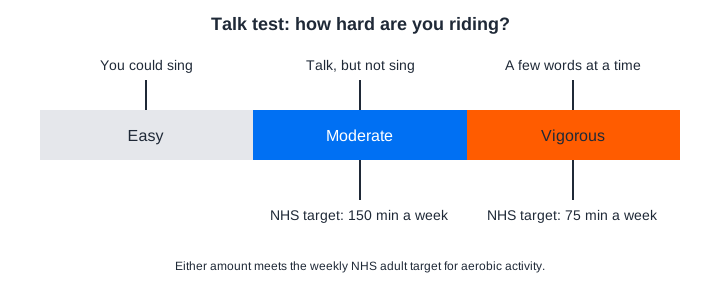
That gives beginners a workable plan: mostly conversational rides, a few harder efforts on hills as you get comfortable, and strength work on at least 2 days a week, since the NHS adult guidelines list muscle-strengthening activity in addition to aerobic activity. If you have not exercised for some time, or have medical conditions or concerns, the NHS advises speaking to your GP first. If a ride brings on symptoms that worry you, stop and get medical advice.
Resting heart rate
MedlinePlus gives a normal resting pulse for adults of 60 to 100 beats per minute and 40 to 60 for well-trained athletes. Resting heart rate often drifts down as fitness improves, but it also moves with sleep, stress, caffeine, illness, medication and heat, so a single morning reading says little. Track the trend over weeks. A resting rate that stays high or is accompanied by symptoms is worth raising with a clinician.
How many calories you burn
Energy use depends on your body mass, your speed and terrain, and the effort you put in, so one figure per hour cannot fit everyone. The Compendium of Physical Activities assigns each activity a MET value, a multiple of resting energy use. Higher MET means more energy per minute at the same body mass.
| Activity (2024 Compendium) | MET |
|---|---|
| Leisure cycling to work or for pleasure, under 10 mph (16 km/h) | 4.0 |
| Cycling to or from work, self-selected pace | 6.8 |
| Cycling at a self-selected vigorous pace | 9.0 |
| E-bike without electronic support | 6.8 |
| E-bike with high electronic support | 4.0 |
The practical point: an e-bike on a high assist setting costs about the same as an easy leisure ride, so it is a fine way to ride more often, just not the same stimulus as a hard ride. Energy burned does not translate automatically into weight change, because food intake matters too. For that side of the question see cycling for weight loss.
Tracking progress
Ride the same route every few weeks at a similar effort and note time, average speed and heart rate. If the time falls or the heart rate at the same speed drops, you are fitter. Weather, wind, sleep and fatigue add noise, so look at several rides, not one. A good fit also affects comfort and efficiency; see how to adjust saddle height and run the pre-ride checklist before each ride.
New to regular riding? The first 30 days of cycling covers how to build the habit, and commuting by bike is an easy way to fit rides into your week.
Sources
- PLoS ONE (Bacon et al.): VO2max Trainability and High Intensity Interval Training in Humans: A Meta-Analysis
- NHS: Physical activity guidelines for adults aged 19 to 64
- MedlinePlus: Pulse
- Compendium of Physical Activities: Bicycling
Last reviewed: October 2026.