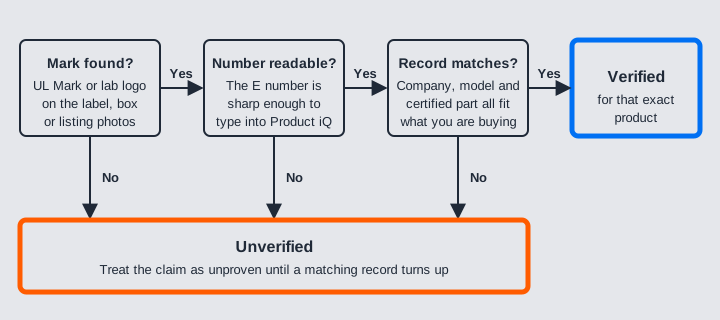
Find the UL Mark, read the E number in it, search that number in UL’s Product iQ database, and confirm the record covers the exact product you are buying. If no record matches, treat the “UL Certified” claim as unverified.
UL’s shopper page cites US Consumer Product Safety Commission (CPSC) records of at least 208 fires from overheating events, reported from 39 states over 2021 and 2022. A certification claim only protects you if it can be checked.
The five-step check
- Find the mark. UL says e-bikes, e-scooters, hoverboards and similar products carry its holographic label, and the batteries and chargers that run them may show the UL Mark too. Online, check the product photos, spec sheet and any box or manual images.
- Read the E number. UL’s Mark FAQ says some certification Marks include a unique identifier or file number in a dedicated module, and UL’s shopper page calls the number in the Mark design the E number. Type the number into UL’s site yourself rather than trusting a code a seller supplies.
- Search it in Product iQ. UL links its database at productiq.ulprospector.com, calls Product iQ complimentary and points shoppers to its abridged version. UL’s FAQ says to put the identifier or file number into the keyword search field, and the result links through to the certification information, including a certification record. If the site asks you to sign in, UL’s instructions say you can create a complimentary account. When the label gives you no number, UL also says Product iQ can produce a full list of UL Certified e-bikes, e-scooters and e-mobility devices, so you can look for the brand and model there.
- Match the record to the product. Compare the company, product type and model on the record with what you are actually buying, and check which part is certified. UL treats a certified battery, motor or charger as a separate matter from a certified micromobility device, so a record for a battery pack does not certify the whole bike.
- Decide. A record matching the right company and product is your evidence. A missing or mismatched record means the claim is unverified.
Reading the wording on a listing
| Wording | What it tells you | What to do |
|---|---|---|
| “UL Certified e-bike” with an E number | A claim you can check | Search the number and match the record to the model |
| “Tested to UL standards” | UL says a “tested to” claim does not amount to certification | Ask for the E number; unverified until a record turns up |
| “UL Certified battery” (or charger, or motor) | UL treats a certified part as separate from a certified micromobility device | Check which part the record covers and ask about the complete e-bike |
| “UL Listed” | UL uses “Certified” as the umbrella word for both “Listed” and “Classified” | Verify it the same way |
| UL logo, no readable number | Nothing to search by number | Ask for a clear photo of the label, or use Product iQ’s full list of UL Certified e-bikes, e-scooters and e-mobility devices and look for the brand and model |
The gap between “tested to” and “certified” matters, UL says, because certification also means the factory is monitored on a recurring basis by field engineers who check that compliance continues.
What New York City requires, and what that means elsewhere
New York City’s Local Law 39 of 2023, approved by the Mayor on March 20, 2023, covers the sale, lease and rental of powered bicycles, powered mobility devices and storage batteries. The electrical system of a powered bicycle must be certified by an accredited testing laboratory to UL 2849, and a storage battery for such a bicycle to UL 2271. The law also lets a city department substitute a different standard by rule, so check the current requirements before relying on this summary.
- The proof can be on paper. The certification, or the laboratory’s logo or name, may be shown on the packaging or documentation provided at sale, or directly on the bicycle or its battery. A marked box does not show that the pack itself carries a mark, so check the battery on arrival.
- Used and rented items have an exception. The display requirement does not apply to second-hand or rented items that come without packaging or printed documentation. With a used bike and no label there is nothing to search, so ask the seller for model details and original paperwork, or treat the claim as unverified.
The Fire Department of the City of New York (FDNY) gives matching advice: check for the “logo, mark, or name” of the accredited testing laboratory that issued the certification, and buy or sell devices and batteries only when they are certified to UL safety standards. The law and FDNY both name an accredited testing laboratory rather than UL itself, so the lab shown on a product may not be UL. In that case, start with the Accredited Testing Laboratory List that FDNY points to at nyc.gov/dcwp, then check whether that lab offers its own certification lookup. Product iQ is UL’s database, so it fits UL Marks.
These rules cover New York City sales only; other places differ, and E-Bike Laws: What You Can and Cannot Do (US, UK and EU) gives the wider picture.
If nothing matches
- Ask first. Request the E number and a label photo for the bike and the battery.
- Use UL’s channels. UL points to its Customer Experience Center for doubts about whether a certification is valid, and invites reports about any UL Certified product that worries you.
- Stay with the compatible battery. FDNY advises replacing a battery only with the manufacturer’s own battery for your device. Never open a pack to inspect or repair it.
For a bike or pack you already own and cannot verify, FDNY’s charging rules still apply: connect the charger itself straight to a wall outlet, charge and store the battery away from anything that can burn, use the cord and adapter the manufacturer made for that device, and keep charging out of the bedroom, away from exits and off extension cords. This site’s own precaution, not an FDNY rule: charge an unverified pack only while you are home and awake, so you can act at the first warning sign listed below. E-Bike Battery Care: How to Make It Last Longer covers everyday charging and storage habits.
When to stop using a pack
FDNY lists odors, changes in shape or color, leaking and odd noises as things to watch for. A swollen case is a change in shape, so it counts. If you notice any of them, FDNY says to stop using the device straight away. When you can do it safely, it says to move the device clear of anything flammable, and to call 911, the US emergency number. Once the situation is safe, contact the manufacturer or a qualified shop for instructions before you move, charge or ride with the pack again; do not ride to see how it behaves.
A damaged pack does not go in household trash. FDNY’s battery page says it is illegal in New York City to put rechargeable batteries in the trash or recycling, and FDNY points to a Special Waste Drop-Off Site (nyc.gov/dropspecialwaste) for batteries. Ask the manufacturer or shop how to handle the pack on its way there. A quick look at the pack makes a good addition to the 5-Minute Pre-Ride Checklist Every Cyclist Should Do.
Sources
- UL Solutions: Is There an E-Bike in Your Future?
- UL Solutions: FAQ, Enhanced and Smart UL Certification Mark
- UL Solutions: Product Sourcing and Certifications Database
- UL Solutions: Finding UL Listed and Certified Fire-Rated Products with UL Product iQ
- FDNY: Lithium-Ion Batteries and Micromobility Devices, Safety Tips for Retailers and Consumers
- FDNY: Lithium-Ion Battery Safety
- City of New York: Local Law 39 of 2023
Last reviewed: October 2026.