Measure your sit bones, then pick a width
Width is the first decision. Your sit bones (the ischial tuberosities, the two bony points you feel when you sit upright on a hard chair) carry most of your weight on a saddle, so the saddle’s width should be related to the space between them. Shape, length and padding come second.
How to measure at home
- Put a sheet of stiff cardboard or a sheet of aluminum foil on a firm but slightly yielding surface, such as a yoga mat or carpet.
- Sit on it in the clothing you ride in, feet raised so your knees are above your hips, and stay still for about 30 seconds. Lean forward a little if you ride in an aggressive position.
- Stand up. If the dents are faint, rub chalk across the cardboard to bring them out.
- Measure from the center of one dent to the center of the other, in millimeters.
Adult sit bone widths in one fitting guide range from 90 to 160 mm, so a result anywhere in that span is normal.
Turn the number into a saddle width
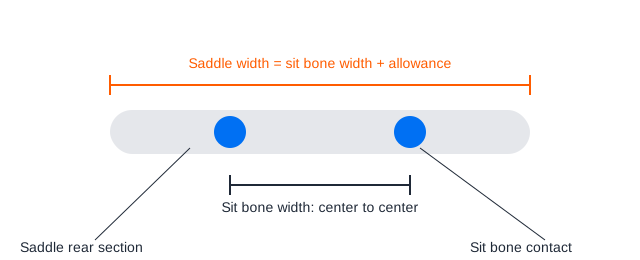
Sources disagree on the exact allowance, and the right figure depends on how far forward you lean. A more upright rider carries weight on a wider part of the pelvis and wants more width; a rider in a deep drop rotates the pelvis forward and wants less.
| Riding position | bike-size.com: add to sit bone width | Ribble: add to sit bone width |
|---|---|---|
| Upright (commuter, hybrid) | 25 to 30 mm | 20 mm (hybrid, gravel, mountain bike) |
| Endurance road or gravel | 20 mm | 10 mm |
| Aggressive road (drop of 10 cm or more) | 10 to 15 mm | Not listed here |
The two sources disagree by 10 to 15 mm for the same positions, so treat any allowance as a range to test, not a rule.
For example, sit bones of 135 mm point to a 155 mm saddle with the common 20 mm allowance. Treat the result as a starting point: brands measure and label width differently, so check the listed width of each model rather than assuming a “wide” label means the same thing everywhere.
Shape: flat, curved, and relief channels
- Flat saddles with no cutout have a continuous, lightly padded surface and are often preferred by racers because nothing interrupts the ability to slide fore and aft.
- Cutouts and channels remove material under the perineum (the soft tissue between the sit bones). Sheldon Brown advises that cyclists with persistent problems consider a saddle with a cutout or dip.
- Split-nose saddles divide the front into two padded prongs and are used by riders prone to numbness.
Women’s saddles are often marketed separately. Sheldon Brown notes that the ones that work best are somewhat wider and somewhat shorter than those that work best for men, while bike-size.com says the fit variable is sit bone width and soft-tissue anatomy, which vary widely within each gender. Choose by measured width and comfort, not by the label.
Padding: softer is not automatically better
Thick soft foam feels good in a shop, but a saddle guide from bike-size.com warns that heavy padding can increase soft-tissue pressure. Sheldon Brown makes a related point, that the softest saddle is not the most comfortable to ride. Choose width and shape first, then a moderate amount of padding.
Before you buy: set it up properly
A saddle at the wrong tilt or height can feel wrong even if the model is right. Start with the saddle close to horizontal, then adjust in small steps. Our guides to adjusting saddle height and fitting a bike properly cover height and reach, and cycling posture explains how your position changes where your weight lands.
Give it time, and know when to stop
Sheldon Brown notes that it takes a while to re-accustom your backside to cycling, so a new saddle or a return after a break will feel odd at first. Initial soreness is normal; persistent numbness or hot spots is not. If you notice numbness, tingling or pain that persists, change the saddle or position, get a qualified bike fit, and see a doctor if numbness or pain does not settle.
Sources
- Sheldon Brown: A Comfortable Bicycle Saddle
- Ribble Cycles: How to Choose the Perfect Bike Saddle
- BikeParts: Measuring Your Sit Bones
- bike-size.com: Bike Saddle Width and Sit Bone Measurement Guide
Last reviewed: October 2026.