For a commuter who wants the least upkeep, an internal gear hub usually wins, but it trades away some weight, efficiency, price and easy roadside repair. A derailleur is the opposite bargain: lighter and easier to repair, but its chain and sprockets sit out in the weather.
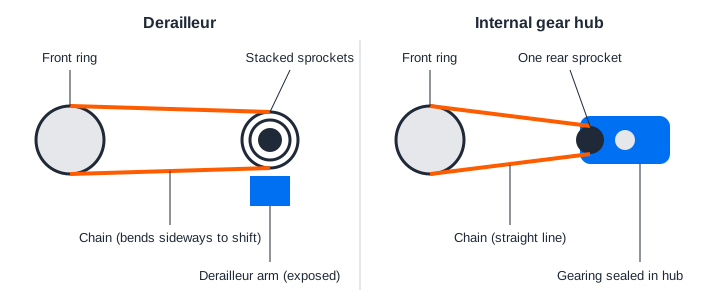
Definitions first. A derailleur is the cable-moved arm that pushes the chain between sprockets of different sizes. An internal gear hub (IGH) puts the gearing inside the rear wheel’s hub shell, so the chain runs in a straight line between one front ring and one rear sprocket.
Why a hub needs less cleaning
Maintenance mostly comes down to exposure. In a hub, the gears and their lubricant are enclosed, which Wikipedia says protects them from water, grit and impacts. Sheldon Brown, a long-standing bicycle reference author, goes further and calls hubs more reliable than derailleur systems with much less maintenance needed.
The chain also lives an easier life. A single chainline means the chain is never bent or twisted sideways to reach other sprockets. That is a large part of why shifting trouble on a derailleur bike (see why your bike shifts badly) rarely appears on a hub bike.
What a hub still asks of you
Low maintenance is not zero maintenance.
- Internal lubrication. Brown notes that hubs, as sold, need periodic cleaning and fresh application of a special grease that will not make the internal pawls stick, and that Shimano sells a relubrication kit for its grease-lubricated hubs. Follow the maker’s service interval rather than guessing.
- Chain tension. As a chain wears it lengthens, so with a single sprocket it needs periodic readjustment. A neglected chain is more likely to fall off.
- Dry storage. Brown recommends keeping the bike somewhere dry, and he reports water contamination causing failures of grease-lubricated hubs in wet climates. If you ride year-round in rain, see our rain riding guide and wash gently, as in how to wash your bike properly, rather than aiming a hose at the hub.
Side-by-side
| Factor | Internal gear hub | Derailleur |
|---|---|---|
| Exposure to weather | Gears sealed in the hub | Sprockets, chain and derailleur exposed |
| Routine upkeep | Chain tension plus occasional internal service | Exposed parts; shifting depends on cable adjustment |
| Shifting at a stop | Yes | Generally needs the wheel turning |
| Weight | Heavier | Lighter |
| Efficiency | Lower, especially in some gears | Higher when well maintained |
| Purchase cost | Typically higher | Typically lower |
| Fixing it yourself | Harder | Easier |
Where the hub costs you
Stop-and-go convenience
This one favors the hub. Brown points out that an IGH can shift while you are stationary, which suits traffic lights. Wikipedia adds that it can be hard or impossible to select another gear while pedaling, because pressure has to be released first, so ease off the pedals as you shift.
Weight and efficiency
Both sources agree hubs tend to be heavier than derailleur setups with comparable gearing. On efficiency the sources differ in tone. Brown says hubs are slightly less efficient in some gears but that a direct-drive middle gear can beat a derailleur, since it has no pulley drag. Wikipedia states that current hub gears are typically about 10% less efficient than reasonably maintained derailleur gears. Treat the 10% as a typical figure, not a promise for every hub and gear.
Repairs and flats
Wikipedia describes hub gears as more complex and usually harder for the rider to repair. The wheel is also fussier to remove: the rear wheel cannot be fully separated from the bike without disconnecting the gear cable, and Brown says most hubs cannot take a quick-release axle. Wikipedia also says hub-gear repair is hard for the rider, so a rear flat may take longer than on a quick-release wheel. Practice the steps in our flat tire guide at home first, and carry the right wrench for your axle nuts.
Price and limits
Wikipedia says hub gears usually cost more than derailleur systems. Brown also cautions that some hubs are not rated for extremely steep climbs under a heavy load, so check the manufacturer’s rating if you carry cargo or live somewhere hilly.
Which to choose
- Choose a hub if you commute daily in mixed weather, want fewer exposed drivetrain parts, and value shifting at a stop over the last bit of lightness.
- Choose a derailleur if you ride hilly terrain with loads, want the lightest and cheapest setup, or like fixing your own bike with common parts.
Whichever you pick, a quick look at the drivetrain belongs in your pre-ride checklist. If a hub slips under pedal pressure, makes grinding noises, or the chain keeps dropping after adjustment, stop riding and have a bike shop inspect it rather than forcing it. For wider commuting planning, see how to make cycling to work actually work.
Sources
Last reviewed: October 2026.