The Highway Code gives cyclists two default road positions: the center of the lane when you need to be seen or kept from being squeezed, and a position further left when faster traffic needs to get by. Rule 72 sets out both. The skill is knowing which one the situation calls for, and switching without drama.
The two positions at a glance
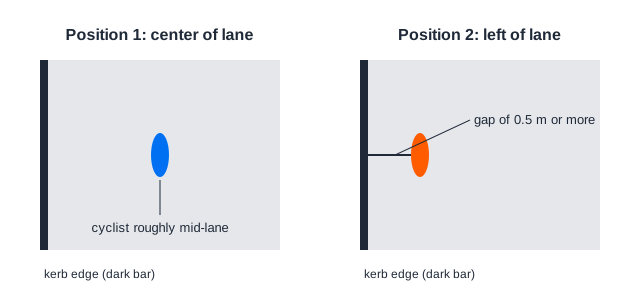
| Position | Where you ride | Use it when |
|---|---|---|
| Center of the lane | Roughly mid-lane, not tucked against the kerb | Quiet roads, slower-moving traffic, and the approach to junctions or road narrowings where a pass would be unsafe |
| Left, clear of the kerb | At least 0.5 m (and further where safer) from the kerb edge | Busy roads where vehicles are moving faster than you and can overtake safely |
Neither is a fixed rule to apply mechanically. The Code frames them as positions to adopt “depending on the situation”, so you are expected to keep reading the road.
Why the center of the lane is safer than hugging the kerb
The Code’s stated reason for the central position is visibility: it says to ride there to be as clearly visible as possible. There is also a geometry argument. Rule 73 gives the same reasoning for junctions: position yourself centrally “to avoid being overtaken where this would be dangerous”.
That is why the Code ties the central position to junctions and road narrowings “where it would be unsafe for drivers to overtake you”. These are the spots where a close pass is most likely to end in a side-swipe or a forced swerve.
When to ride centrally
- Quiet roads. Stay central, but if a faster vehicle comes up behind you, the Code says to move left so it can overtake, provided you can do so safely.
- Slower-moving traffic. When traffic starts to flow more freely, move left if it is safe so faster vehicles can pass.
- Approaching junctions and narrowings. Take the lane before the pinch point, not after it.
- Junctions without cycle facilities. The Code recommends proceeding as if you were driving a motor vehicle and sitting in the center of your chosen lane where you feel able to do so safely. If that does not feel safe, it allows you to dismount and wheel the bike across.
- Roundabouts, turning right. You can ride in the left or right-hand lanes and move left when approaching your exit. Stay central in your lane where it is safe and signal right to show you are not leaving. The Code’s alternative is walking your cycle round on the pavement or verge.
When to ride further left
On busy roads with faster vehicles, the Code asks you to let them overtake where it is safe, keeping at least 0.5 m from the kerb edge, and further where that is safer. Treat 0.5 m as a floor. The Code does not explain the reason, but as general advice, road edges are where debris and damaged surfaces tend to collect, so extra distance gives you more room to steer around them.
Fast dual carriageways deserve special mention. The Code points out that traffic on most of them moves quickly, and asks for extra care when crossing slip roads.
Space around you: doors, large vehicles and groups
Road position is not only about left versus center. Three related points from the same Code section:
- Parked cars. Leave a door’s width or 1 meter so an opening door does not hit you. This will often put you well out into the lane, which is consistent with the central position.
- Lorries and other large vehicles. Pass them on the left only when they are stationary or moving slowly, and with caution. The Code warns that a lorry may swing right before turning left, so its rear wheels can then come very close to the kerb. The safe place for you is never alongside that gap.
- Riding with others. You can ride two abreast, and it can be safer in larger groups or with less experienced riders. Let drivers pass when you feel it is safe, for example by moving into single file.
When you are going straight on at a junction, you generally have priority over traffic waiting to turn into or out of the side road, unless signs or markings say otherwise. Having priority does not mean being seen, so keep your central, visible position and watch for drivers turning across you.
Practical habits that make positioning work
- Look back early and often (general advice). You cannot choose between positions without knowing what is behind you. Glance, then decide, then signal.
- Commit to the position (general advice). A wobbling line between kerb and center is harder for drivers to predict than either extreme.
- Pick routes that reduce the decision load. Our guide to mapping a safe cycling route to work helps you avoid the roads where position choices are hardest.
- Be easy to see. Annex 1 requires white front and red rear lights lit when cycling at night; see commuter bike lights for choosing them.
- Keep the bike able to react. The same Annex says you must ensure your brakes are efficient. If they are weak or uneven, do not ride on traffic roads until a mechanic has checked them.
For the wider picture, start with the basic rules of cycling on roads, and for daily riding see how to commute by bike. In wet weather, as general advice, give yourself more room and time; our rain-riding guide covers it.
Where this does and does not apply
This article describes the Highway Code as checked in October 2026 (page updated 22 October 2025). If you are unsure how a rule applies in a particular case, check the official page.
Sources
- GOV.UK: The Highway Code, Rules for cyclists (59 to 82)
- GOV.UK: The Highway Code, Annex 1: You and your bicycle
Last reviewed: October 2026.