In Ireland a pedal-assisted bike counts as an e-bike only if it passes three tests at once: a continuous rated motor power of 250 W or less, a motor that cuts off when you stop pedaling, and motor output that fades out before the bike reaches 25 km/h. Fail any one and the Department of Transport categorizes the bike as an e-moped, which brings registration with Revenue, annual motor tax, a minimum age of 16 and a motorcycle helmet. Both e-bikes and e-mopeds have been legal on Irish roads since 20 May 2024 under the Road Traffic and Roads Act 2023.
The details follow the Department of Transport e-bike page (updated 4 June 2024), the Citizens Information e-bike (edited 12 January 2026) and e-moped (edited 15 June 2026) pages, and the Department’s overview table. For the wider picture, see E-Bike Laws: What You Can and Cannot Do (US, UK and EU).
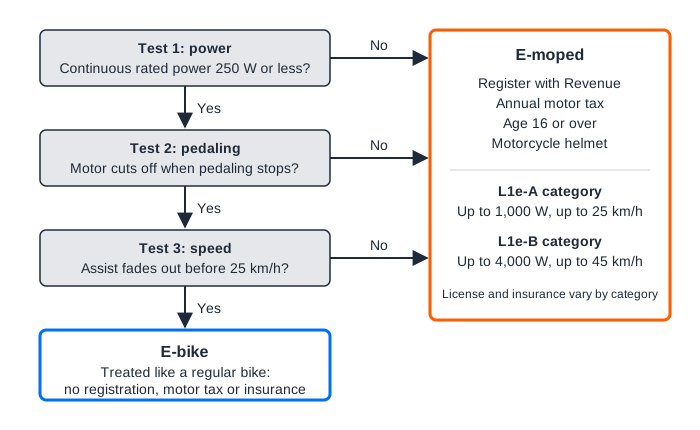
The three tests, one at a time
| Test | What the Department requires | What to check on a bike |
|---|---|---|
| Power | Maximum continuous rated power of 250 W or less | The continuous rating, not a “peak” figure |
| Pedaling | An electric motor that cuts off when pedaling stops | No control that drives the bike without pedaling |
| Speed | Motor output that progressively reduces, and finally cuts off, before the speed reaches 25 km/h | Assist tapers away and ends before 25 km/h |
Continuous rated power is the power a motor is rated to deliver steadily, as opposed to a brief peak. A brochure quoting only a peak number does not answer the first test.
A bike whose motor can keep running when you stop pedaling fails the second test. Citizens Information says vehicles with motor power available without pedaling are classed as e-mopeds, and it describes these as typically throttle-assisted models. E-Bike Throttle vs Pedal Assist explains how the two systems differ.
Cargo bikes that meet the same requirements are treated as e-bikes too, so a cargo bike is judged by the same three tests.
Where the official pages word it differently
The Department’s technical-requirements list says motor output must fade and cut off before 25 km/h, although the page’s opening summary also says simply “a maximum speed of 25 kilometres per hour”. Citizens Information gives shorter versions in different places, “maximum speed of 25km per hour” in one list and “less than 25kph” in an earlier sentence, and states the power test as “250 watts or less” without the word “continuous”.
The Department’s technical-requirements list is the most specific wording, so treat it as the test. If a bike’s assist is advertised as ending at exactly 25 km/h, or its motor rating is vague, ask the retailer to confirm in writing that it meets the Irish e-bike requirements. Citizens Information says the retailer should give you a declaration of conformity, and the CE plate should show the manufacturer’s details, manufacture date and serial number.
What changes when a bike fails a test
The Department categorizes any bike that does not meet the three requirements as an e-moped, and cites EU Regulation 168/2013 Article 2(h) as the basis. E-bikes are treated the same as regular bikes under Irish law, while e-mopeds are mechanically propelled vehicles.
Citizens Information describes two e-moped categories. L1e-A covers pedal- or throttle-assisted vehicles up to 25 km/h and 1,000 W, with output that fades out before 25 km/h. L1e-B covers vehicles up to 45 km/h and 4,000 W. Two examples:
- A pedal-assist bike with a 500 W motor whose assist fades out before 25 km/h passes the pedaling and speed tests but fails on power. It sits inside the power and speed range described for L1e-A, so it is an e-moped, not an e-bike.
- A pedal-assist bike that keeps helping beyond 25 km/h fails the speed test. The Department’s table lists the L1e-B two-wheel moped, which requires pedaling, at 4 kW and up to 45 km/h and notes that it is also known as a speed pedelec or S-pedelec.
Side by side
| Requirement | E-bike | L1e-A e-moped | L1e-B e-moped |
|---|---|---|---|
| Motor power | 250 W or less | Up to 1,000 W | Up to 4,000 W |
| Speed | Assist cuts off before 25 km/h | Up to 25 km/h | Up to 45 km/h |
| Registration and tax | None | Register with Revenue; annual motor tax of €35 | Register with Revenue; annual motor tax of €35 |
| Driving license | None | None for pedal assist only; Category AM for throttle-assisted models | Category AM plus Initial Basic Training |
| Helmet | Advised, not legally required | Motorcycle helmet | Motorcycle helmet |
| Age | Children may ride; young children should be supervised | 16 or over | 16 or over |
Fees as listed by Citizens Information, page edited 15 June 2026. Registering an e-moped with Revenue also requires a manufacturer’s Certificate of Conformity, so ask whether one exists before buying a high-power bike.
Lanes and insurance are less clear-cut
L1e-B e-mopeds are not allowed in cycle or bus lanes. For L1e-A the rules list says they can use cycle and bus lanes, but the same page’s summary table limits bus lanes to pedal-assisted models, and the Department’s overview table lists throttle L1e-A bikes as not permitted in cycle lanes or bus lanes. Do not assume a throttle model may use either until you have confirmed it.
Insurance is described inconsistently. For throttle-assisted L1e-A models, the e-moped page gives two different design-speed thresholds for the insurance exemption, 25 km/h in one passage and 14 km/h in another, and the Department’s table says 14 km/h; all three also mention a weight over 25 kg. Pedal-assist-only L1e-A e-mopeds need neither insurance nor a driving license. For throttle-assisted L1e-B models, the requirements list says to get motor insurance, while the page’s summary table ties it to models that go above 25 km/h. Confirm the current rule with an insurer and Revenue before you ride.
Before you buy or ride
- Get the three numbers in writing: rated continuous power in watts, whether anything moves the bike without pedaling, and the speed at which assist fades out.
- Ask for the declaration of conformity and check the CE plate details described above.
- Treat doubt as a reason to ask, not to ride. If you cannot confirm all three, check with the retailer, and see the Road Safety Authority and Department of Transport websites that Citizens Information points to, before riding on public roads.
- Do not alter the limits. By the Department’s wording, a bike changed so that it no longer meets the requirements is categorized as an e-moped, and the registration, tax, age and helmet rules above then apply. If you are still choosing, How to Choose Your First E-Bike covers the practical side.
Once it counts as an e-bike
An e-bike needs no registration, motor tax, license or compulsory insurance. It rides under bicycle rules:
- Keep left, including in cycle and bus lanes, which e-bikes may use. Footpaths, pedestrianized areas and motorways are off limits.
- Do not hold or use a mobile phone while riding.
- Fit front and rear lights and switch them on during lighting-up hours and darkness. See the cycling lights buyer’s guide.
- Wear a helmet. Both the Department and Citizens Information advise it even though it is not legally required; Cycling Helmets: How They Work, MIPS, and Choosing the Right One helps you pick one.
Breaking the rules of the road can bring a fine of between €40 and €80, according to Citizens Information (page edited 12 January 2026). This is general information from the pages below, not legal advice.
Sources
- Department of Transport (gov.ie): E-Bikes
- Citizens Information: E-bikes
- Citizens Information: E-mopeds
- Department of Transport (gov.ie): Micro Mobility, Overview Table of e-scooters, e-bikes and e-mopeds (PDF)
Last reviewed: October 2026.