In New York City, you may not ride an e-bike, e-scooter or pedal-assist commercial bicycle faster than 15 mph (24 km/h), unless official signs post a different limit. The rule took effect on October 24, 2025, and it applies to every e-bike class, including Class 3 bikes whose motors keep helping up to 25 mph (40 km/h). This page covers New York City only, as of October 2026.
What the rule says
The city’s Department of Transportation (DOT) states that the limit for e-bike, e-scooter and pedal-assist riders is 15 mph, and that e-bikes and e-scooters are “prohibited from going above” it “on any city street.” The adopted rule, which amends Sections 4-01 and 4-06 of the city Traffic Rules, bars anyone from operating a bicycle with electric assist, an electric scooter or a pedal-assist commercial bicycle at a speed greater than fifteen miles per hour, except where official signs indicate a different maximum. That sign exception is the only one the adopted text names.
The NYC Rules website lists the rule as adopted by DOT with an effective date of October 24, 2025. DOT first published the rule in the City Record on June 13, 2025, held a public hearing on July 14, 2025, and received about 900 comments. It made no changes in response to them.
The wording regulates how fast you travel, not how hard the motor works. Nothing in the adopted text separates speed gained from the motor from speed gained on a downhill, so treat 15 mph as the ceiling either way. Nor does the rule sort riders by purpose: DOT says the lower limit applies to everyone on an e-bike “for work, for commuting, or for leisure.”
Why the class labels say 20 or 25 mph when the limit is 15
An e-bike’s class describes its motor, not a speed you are allowed to ride. The city’s definition of a “bicycle with electric assist” points to section 102-c of the state Vehicle and Traffic Law, and the DOT summary of city bicycle rules spells out each class by the point at which the motor stops helping:
- Class 1: the motor assists only while you pedal, and it stops assisting at 20 mph (32 km/h).
- Class 2: the motor can drive the bike by itself, and it cannot assist at 20 mph (32 km/h). Running without pedaling is what a throttle provides; see our guide to throttle versus pedal assist.
- Class 3: the motor can also drive the bike by itself, but the cutoff is 25 mph (40 km/h).
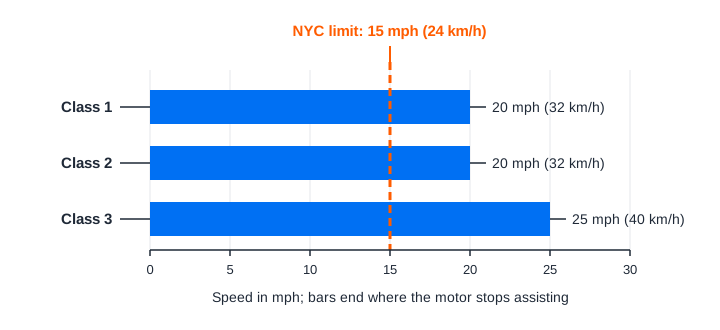
DOT’s own chart lists both numbers side by side:
| Type | How fast can it go? | How fast may I go? | Helmet, per DOT chart |
|---|---|---|---|
| E-bike Class 1 | 20 mph (32 km/h) | 15 mph (24 km/h) | Recommended (Yes, if working) |
| E-bike Class 2 | 20 mph (32 km/h) | 15 mph (24 km/h) | Recommended (Yes, if working) |
| E-bike Class 3 | 25 mph (40 km/h) | 15 mph (24 km/h) | Yes |
The first speed column is what the vehicle is built to reach; the second is what the law lets you do. On a Class 3 bike the motor can keep assisting for another 10 mph (16 km/h) past the legal ceiling, so the rider has to hold the speed down using the speedometer and the assist setting.
The rule also names the pedal-assist commercial bicycle, which the DOT summary defines as a cargo-carrying bike with no throttle whose motor engages only while the operator pedals and speed is below fifteen miles per hour.
What changed, and what stayed the same
The adopted notice says the limit for e-bikes and pedal-assist commercial bicycles went from 25 mph (40 km/h) to 15 mph (24 km/h). The 25 mph limit for human-powered devices stays, because DOT treats them as lighter than e-devices, which it describes as heavier “due to their motor and battery.” An ordinary pedal bike is therefore held to a higher limit than an e-bike.
DOT gives two reasons for 15 mph. It matches the state limit for electric scooters: the notice says the state Vehicle and Traffic Law prohibits operating them at speeds in excess of 15 mph. And DOT wants speed limits “applied consistently across all e-mobility devices.”
The rule was contested. Some commenters argued that a lower limit could put e-bike riders at greater risk among motor vehicles; DOT replied that it is not aware of any evidence that a differential speed limit would increase safety risk. Others worried about delivery workers; DOT answered that e-bikes traveling at high speeds present a serious danger to public safety.
Mopeds and other vehicles outside the 15 mph limit
DOT’s chart separates mopeds from e-bikes. The three moped classes are listed as limited use motorcycles, their speed entry reads “As Posted,” and the chart answers yes for a driver’s license and for DMV registration. E-bike Classes 1 to 3 need neither, though the chart notes the rider must be 16. A moped is not subject to the 15 mph cap described here.
The chart also allows e-bikes in vehicle lanes with speed limits no greater than 30 mph (48 km/h), so you can share a 30 mph lane and still be capped at 15. DOT warns that vendors may not sell, lease or rent an e-bike that exceeds 25 mph, which is the Class 3 figure. For other countries, see e-bike laws in the US, UK and EU.
Helmets
The DOT summary of bicycle laws says you must wear a helmet when riding a class 3 e-bike, which it describes as allowing assistance up to 25 mph. For Class 1 and Class 2 the chart reads “Recommended (Yes, if working).” Separately, the same summary says an operator of a bicycle used for commercial purposes must wear a helmet provided by the business; if you ride for a business, confirm with DOT what “if working” means for you. For e-scooters, helmets are recommended and required for 16 and 17 year olds; the chart shows the same 20 mph and 15 mph figures for them. Even where the chart says only “Recommended,” DOT’s safety tips include “Wear a helmet.” See how cycling helmets work and how to choose one.
Staying under 15 mph in practice
The legal line is a speed, and the bike will not enforce it for you. Many e-bike displays show speed; our guide to reading an e-bike display explains the common readouts, and a bike computer or GPS unit does the job on any bike. Easing off a throttle or dropping to a lower assist level gives you more control over speed, and gravity can push you past 15 mph on a descent just as a motor can. DOT’s other safety tips: stay off the sidewalk, yield to pedestrians and watch for turning vehicles.
This is a city traffic rule, and city rules can be amended or challenged. DOT’s e-bike page and its summary of bicycle laws, dated March 31, 2026, both state the 15 mph limit. Check the DOT page for current wording before relying on this article, for example when disputing a summons.
Sources
- NYC Department of Transportation: Electric Bicycles and More
- NYC Rules (DOT): Speed Limits for E-Bikes, E-Scooters, and Pedal-Assist Commercial Bicycles
- NYC Department of Transportation: Notice of Adoption, Bicycle Speed Limits
- NYC Department of Transportation: Summary Listing of Bicycle Laws, Rules and Regulations
Last reviewed: October 2026.