Ontario drivers who pass a cyclist are required to leave at least one meter (a little over 3 feet) of space “where it is practical to do so.” The duty falls on the driver: nothing obliges a cyclist to provide a one-meter space, and a driver who skips the gap may face a fine and two more demerit points. The details below come from two Government of Ontario pages, Bicycle safety (updated March 19, 2026) and a chapter of the Official MTO Driver’s Handbook (updated September 3, 2026). This is general information, not legal advice.
The rule in three parts
- The gap. A driver passing a cyclist has to leave at least one meter of clearance. That figure is a floor, so extra room is always welcome.
- The qualifier. The requirement applies “where it is practical to do so.” Neither of the two government pages cited here defines “practical” or lists situations that qualify.
- The consequence. The handbook says a driver who fails to keep the gap may be given a fine and two additional demerit points. The word “may” matters: the handbook does not say points follow automatically, and it states no fine amount.
What “where practical” does and does not mean
In everyday English, “practical” means reasonably achievable in the circumstances. Because the pages cited here leave the term undefined, nobody can promise that a particular tight squeeze would count as impractical. Whether a specific pass met the standard depends on the facts. If you face a ticket or a collision claim, talk to a lawyer rather than relying on a general explainer.
What the handbook does supply is a default way to meet the rule: “Whenever possible, you should change lanes to pass.” A driver who moves into the next lane no longer has to fit beside the cyclist at all, which makes the lane change the cleanest answer to the practicality question. If a lane change is not possible, hanging back until enough room opens up is the safe alternative. Treat the qualifier as an allowance for genuinely tight spots, not as a reason to pass close because it is quicker.
Quick reference
| Situation | Who it applies to | What the Ontario pages say |
|---|---|---|
| Passing a cyclist | Driver | Leave at least one meter between vehicle and cyclist where practical; change lanes whenever possible |
| Leaving space for cars | Cyclist | No one-meter space is required of the rider, but every other rule of the road still applies |
| Being overtaken | Cyclist | Move toward the right so the vehicle can get by |
| Following a cyclist | Driver | Leave extra following room; a bicycle gives no brake-light warning |
| Lane position | Cyclist | Right side of the road, keeping about a meter off the curb or parked cars where practical; anywhere in the lane when safety requires it |
| Penalty | Driver | A fine and two more demerit points are possible |
Two different one-meter figures
The number one shows up twice in Ontario’s cycling guidance, and the two uses are easy to mix up. One is the gap a driver owes a cyclist while passing. The other is where a cyclist is asked to ride in relation to the curb or parked cars.
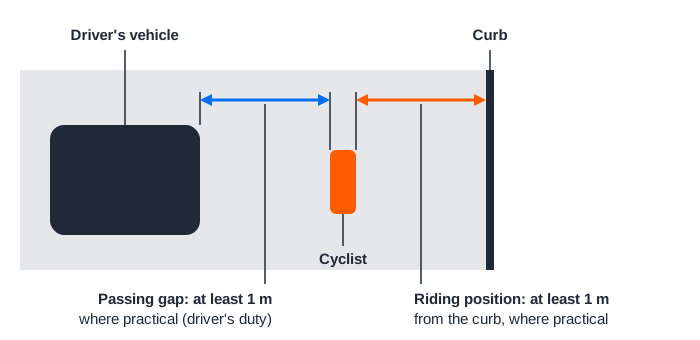
The two pages word the second figure a little differently. Bicycle safety asks riders to hold a steady line toward the right, keeping at least one meter off the curb or parked cars where practical. The handbook expects bicycles traveling slower than the traffic around them to ride about a meter out, and, where there is no curb, to stay as near the right edge as is practical. One source says “at least,” the other says “about,” so treat the figure as a guide with room for judgment rather than a measured lane position.
Both pages also let a rider take whatever position in the lane safety requires. The handbook’s examples include avoiding obstacles such as ice, sand, debris, potholes and sewer grates, and crossing streetcar or railway tracks at a right angle. A driver who sees a rider move out around a grate should read that as a permitted position, not erratic riding.
When a cyclist does not have to stay right
Bicycle safety lists several situations where a rider need not stay to the right:
- about to turn left
- passing another vehicle
- traveling faster than the other vehicles
- a lane too narrow for sharing
The handbook adds that a rider may take more of the lane to “discourage passing” when the lane is “too narrow to be shared safely.” Against that, a rider being overtaken should move toward the right so the vehicle can pass, and stay as near the right side as possible while being passed. In a lane wide enough to share, moving right is the cooperative move; in a lane too narrow to share, the exceptions above apply, and the driver’s route is the handbook’s lane change. How to balance the two in the moment is left to the rider’s judgment of lane width and traffic.
For drivers: passing well
- Change lanes to pass whenever you can, rather than squeezing alongside.
- Leave extra following room. A bike gives no brake-light warning before it slows, so a tight gap leaves you less time to react.
- Go easy on the horn. A sudden blast while overtaking may startle a rider into losing control. If a warning is truly needed, give one short, light tap well before you reach the rider.
- Check before turning right. Signal early and look over your right shoulder as well as in your mirrors.
- Check before opening a door. Before opening a door at the curb, look back for an approaching rider in your mirror and over your shoulder.
For cyclists: what you control
Under Ontario’s Highway Traffic Act a bicycle counts as a vehicle, so riders hold the same rights and duties as drivers and are bound by all traffic laws. The gap duty is the driver’s, but no rule guarantees that every driver complies, so ride in ways that give you options.
- Be predictable. Hold a steady line toward the right where practical, and use more of the lane only for the reasons covered above. Our guide to the basic rules of cycling on roads covers signaling and lane habits, though it is not specific to Ontario.
- Be easy to see. Ontario’s required equipment includes a bell or horn, a white light on the front, a rear red light or reflector for night riding, and reflective tape on the forks (white at the front, red at the rear). For choosing lights, see our commuter bike lights guide.
- Choose roads with margin. A route with wider lanes or fewer pinch points makes a one-meter pass easier for drivers to manage. See mapping a safe cycling route to work for finding a calmer way to ride, and the commuting guide for route, gear and timing together.
Where to check the current rule
This explainer covers Ontario only. Other provinces and countries set their own passing rules, and Ontario can amend its own. For a ticket, a collision or a dispute, confirm the wording on the official Bicycle safety page and in the Driver’s Handbook chapter, and get advice from a lawyer who practices in Ontario.
Sources
- Government of Ontario: Bicycle safety
- Ontario Ministry of Transportation: Sharing the road with other road users (Official MTO Driver’s Handbook)
Last reviewed: October 2026.