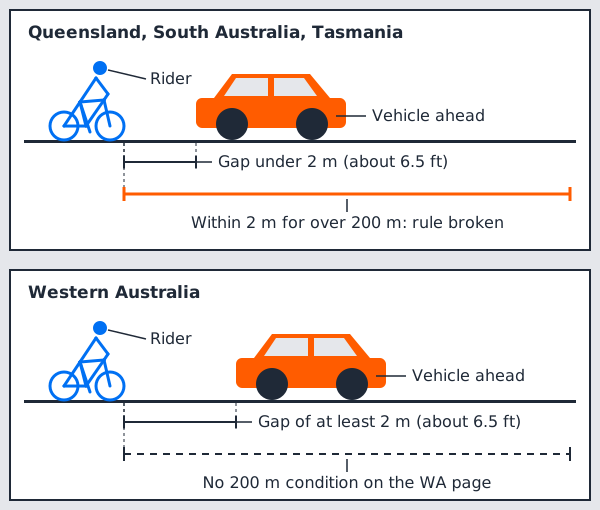
In Queensland, South Australia and Tasmania, a bike rider may not stay within 2 m (about 6.5 ft) of the back of a vehicle ahead (a “motor vehicle” in the South Australian wording, a “moving motor vehicle” in the Tasmanian one) for more than 200 m (about 650 ft). Western Australia’s official page is blunter: ride at least 2 m behind a vehicle, with no 200 m test mentioned. A separate rule bans holding on to a moving vehicle altogether. Below: how each source words the limits, and how to stay clear of both rules on a commute.
The following-distance rule in four places
This rule concerns a vehicle ahead of you, not the gap between riders in a group. The Tasmanian and South Australian sources number it rule 255 and the Queensland Law Handbook cites regulation 255, a handy search term for your own state’s road rules.
| Place | Distance | When it applies | What the source says about penalties |
|---|---|---|---|
| Queensland | At least 2 m from the back of a vehicle | When you follow that vehicle for over 200 m | Riders get the same fines as motorists but no demerit points; no amount is given for this rule |
| Western Australia | At least 2 m behind a vehicle | No 200 m figure on the page | $100 infringement listed for riding less than 2 m behind a vehicle (WA page updated 6 February 2026) |
| South Australia | Not within 2 m of a motor vehicle | For more than 200 m | No amount given; the handbook refers readers to SAPOL’s “PD320A – Expiable Offences and Fees” |
| Tasmania | Not within 2 m of the rear of a moving motor vehicle | Continuously, for more than 200 m | Maximum 5 penalty units (handbook page last updated February 2020) |
Penalty amounts change, and each jurisdiction converts penalty units to dollars, so confirm current figures with your state’s road authority.
Where the wording differs, and why it matters
The 200 m test. Queensland, South Australia and Tasmania tie the rule to following for more than 200 m. The Western Australian page states the 2 m minimum with no such qualifier. In WA, the safe reading is that 2 m always applies.
“Continuously” and “moving”. The Tasmanian handbook and the Queensland Law Handbook both say a rider must not stay within 2 m of the rear of a moving motor vehicle continuously for more than 200 m. That points at sustained trailing, not a van pulling alongside at a junction. Nothing in the wording says how a stop-start queue is treated, so do not assume an exemption; leave room when you can.
“Vehicle” versus “motor vehicle”. The Queensland Government and Western Australian pages say “vehicle”; the legal handbooks for Queensland, South Australia and Tasmania say “motor vehicle”. The Tasmanian handbook and the Queensland Law Handbook also state that bicycles count as vehicles, which is why the extra word matters: as quoted, it points at cars, vans and trucks, not the rider ahead of you in a group. Where a page says plain “vehicle”, as in WA, ask the state road authority before assuming a tight paceline is fine. Our guide to riding safely in a group covers spacing between riders.
Holding on and towing are separate bans
Rule 254 (regulation 254 in the Queensland Law Handbook) deals with a different act: holding on to a moving vehicle so that it pulls you along. The Tasmanian and Queensland texts cover being towed as well. None of the statements below sets a distance threshold.
- Queensland: the government page says you must not hold on to a moving vehicle while riding a bicycle, or ride a bicycle that is being towed by another vehicle. The Queensland Law Handbook cites regulation 254 for the same ban.
- New South Wales: the NSW Government lists being towed by or holding onto another moving vehicle among the things a bike rider must not do.
- South Australia: the Law Handbook calls it illegal to ride while holding on to a moving vehicle, citing Australian Road Rules rule 254.
- Tasmania: the handbook says riders may not be towed by another vehicle or hold onto a moving vehicle (rule 254, maximum 5 penalty units).
- Western Australia: the page says bicycles may not tow other bicycles, vehicles or animals, or be towed.
Why the gap exists
The temptation has a name: drafting, or slipstreaming, meaning riding close behind something large to shelter from the wind.
The cost is time. To stop, you must notice the vehicle’s brake lights, react, and then brake. At ordinary riding speeds you cover 2 m in well under a second, so a hard stop ahead leaves no room for that sequence. The vehicle also blocks your view, so a pothole, an opening car door or a pedestrian shows up only after the vehicle has passed it. Wet roads and tired brake pads stretch your stopping distance further; see cycling in the rain.
Holding on is worse. The driver usually cannot see you, and any sudden steer or stop passes straight to your bike.
Staying inside the rules on a normal ride
- Use a two-second gap as a rule of thumb. This is a common riding habit, not a figure from any of these road rules. Pick a fixed mark such as a lamp post; when the back of the vehicle passes it, count two seconds before you reach it. Anything faster than 3.6 km/h (2.2 mph) covers more than 2 m in two seconds, and at 20 km/h (12 mph) the gap is about 11 m (36 ft), which also leaves braking room.
- Do not shelter behind buses and trucks. Their size hides the road ahead.
- Back off on descents. Gravity closes gaps quickly. How to descend a hill faster and more safely covers braking points and line choice.
- Check your brakes before riding in traffic. Work through the pre-ride checklist. If a lever pulls close to the handlebar or the bike slows weakly, have a shop inspect it before you ride among vehicles.
- Know your e-bike’s status. Queensland says e-bike riders must obey the general road rules as well as the specific ones for bicycle riders. The WA page says the rules for regular bicycle riders also apply to eBike riders, but warns that not all electric bicycles sold in WA are legal on its roads and paths.
For wider road-position habits, see the basic rules of cycling on roads.
Which rules apply where you ride
This guide covers the following-distance rule in Queensland, Western Australia, South Australia and Tasmania. In New South Wales, Victoria, the Australian Capital Territory and the Northern Territory, read your road authority’s current rule text before assuming it matches the figures above.
The pages differ in how current they are: the Queensland Government page was updated on 1 July 2026, the Western Australian page on 6 February 2026, the Queensland Law Handbook page on 29 May 2026 and the Tasmanian handbook page on 25 February 2020, so its penalty figure is the oldest. This is general information, not legal advice.
Sources
- Queensland Government: Bicycle road rules and safety
- Western Australia Road Safety Commission: Bicycle riders
- Legal Services Commission of South Australia: Law Handbook, Cycling
- NSW Government: Special road rules for bicycle riders
- Hobart Community Legal Service: Bicycle and cyclist specific laws
- Queensland Law Handbook: Bicycles and Traffic Offences
Last reviewed: October 2026.