A stem is the part that joins the handlebars to the fork. Its length sets how far forward of the steering axis the bars sit, its angle sets how high or low they sit, and its type (quill or threadless) decides how it attaches to the fork. Three sizes must also match: the stem to the handlebar clamp, the stem to the steerer, and the stem to the headset style on your bike.
What a stem does
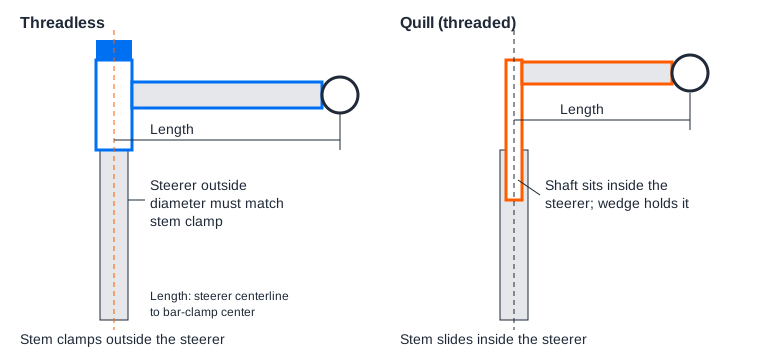
Wikipedia defines the stem as the component that connects the handlebars to the steerer tube of the fork. The steerer tube is the tube that rises from the fork crown through the frame’s head tube.
Two measurements change how the bike feels. Wikipedia notes that stem length determines how far forward of the steerer tube the handlebars are. Angle (also called rise) changes how high the bars end up. Sheldon Brown adds that moving the stem is a way to move the bars higher or lower, closer to or farther from the saddle, or both. For the reasoning behind choosing a reach and bar height, see our guides to bike fit and cycling posture.
Quill vs threadless
| Feature | Quill (threaded) | Threadless (Aheadset style) |
|---|---|---|
| How it attaches | Slips inside the steerer and is held by an expander wedge | Clamps around the outside of the steerer |
| Steerer | Threaded, ends at the headset | Not threaded, extends above the headset |
| Height adjustment | Slide the stem up or down, within the minimum insertion mark | Move spacers above or below the stem, or change or flip the stem |
| Sizing that matters | Stem shaft diameter matches the steerer’s inside diameter | Stem clamp matches the steerer’s outside diameter |
The descriptions of the two types come from Wikipedia and Sheldon Brown. Sheldon Brown describes the quill type as a “quill/expander/wedge type stem” and notes that on threadless systems the stem usually does double duty as the clamp that holds the headset together.
Quill stems
Sheldon Brown says a good rule of thumb is that at least 50 mm (2 in) of the stem should remain inside the fork, and that many quill stems carry a “minimum insertion” mark: if you can see the mark, the stem is too high. Treat that mark as a hard limit. Never ride with it showing.
Do not size a quill stem by its visible dimensions. Sheldon Brown notes that the stem diameter is smaller than the headset size, for example 22.2 mm (7/8 in) for a 1 in threaded fork and 25.4 mm for 1 1/8 in threaded, and warns that people often measure the stem and wrongly conclude they have that headset size.
Threadless stems
The stem clamps the outside of the steerer, so the stem’s inner diameter must match the steerer’s outer diameter. Sheldon Brown’s list includes 1 in (25.4 mm), 1 1/8 in (28.6 mm), 1 1/4 in (31.8 mm) and 1.5 in (38.1 mm). Wikipedia gives 25.4 mm and 28.6 mm as the common steerer sizes, with 31.8 mm and 38.1 mm less common. On a threadless bike, the top cap bolt pulls on a star nut to set bearing preload, and Sheldon Brown notes that once the stem’s binder bolts are tight, the cap bolt is under no significant stress. Adjusting preload and alignment is a safety-critical job; if you are unsure, have a shop do it, and follow the stem maker’s torque markings.
Sheldon Brown warns against putting a threadless stem on the threads of a threaded fork, because the threaded section is not made to resist the stress from the stem and could break off.
Length and angle
Wikipedia gives threadless angles from 0 to 40 degrees, notes that stems can be flipped to angle up or down, and says threadless stems are commonly available up to about 130 mm in length.
- Longer stem: bars sit farther forward, so you stretch more.
- Shorter stem: bars come toward you, so the reach feels shorter.
- More rise: bars sit higher. Flipping a threadless stem changes that rise from up to down.
Angle numbers are not used consistently. Sheldon Brown explains that a stem whose extension is perpendicular to the steerer can be called either a 90 degree stem or a 0 degree stem, depending on the maker, and that a traditional “7” shaped road stem may be called a 73 degree stem. Wikipedia adds that a 17 degree stem angled downward would mimic the angle of a typical road quill stem. Check how a brand states its angle before comparing numbers. Sheldon Brown’s suggested reach for drop bars is a stem extension around 10 cm. Wikipedia adds that adjustable-angle stems may lose some rigidity.
If your bars feel too low, Sheldon Brown says chances are you will need to buy a new stem, since most bikes leave the shop with the stem already set at its maximum height. Raising the bar changes your handlebar setup, so recheck brake lever angle and reach afterward.
Reach and rise compared
Stem length is usually quoted along the extension. The table converts that length to horizontal reach and vertical rise with basic trigonometry, assuming the angle is measured from horizontal and the length is center to center. Brands differ on both conventions, so use it for comparing options, not for exact fit.
| Stem (length, angle) | Horizontal reach | Rise at the bar clamp |
|---|---|---|
| 100 mm, +6 degrees | 99.5 mm | +10.5 mm |
| 100 mm, -6 degrees (flipped) | 99.5 mm | -10.5 mm |
| 100 mm, -17 degrees | 95.6 mm | -29.2 mm |
| 120 mm, -17 degrees | 114.8 mm | -35.1 mm |
A -17 degree stem is the downward-angled equivalent Wikipedia compares to the traditional road quill, so the 17 degree row lowers the bars about 29 mm at 100 mm length, versus a 10 mm swing from flipping a 6 degree stem.
Worked sizing example
You want to replace the stem on a threadless bike with drop bars.
- Steerer: with calipers, measure the outside diameter of the steerer above the headset (the stem’s clamp sits here). A reading near 28.6 mm (1 1/8 in) means you need a stem with a 28.6 mm clamp. Wikipedia lists 25.4 and 28.6 mm as the two main steerer sizes.
- Bar clamp: measure the bar where the stem grips it, away from any knurled area. About 31.8 mm means a 31.8 mm bar clamp; about 26.0 mm means the older Italian size.
- Length: note your current stem length (often printed on it) and decide whether you want the bars nearer or farther. Brown suggests about 100 mm for drop bars as a starting point.
- Compare: use the table above to see how a different angle shifts bar height, then confirm the stem maker’s size, angle convention and torque figures on its own page.
If your steerer is short, cracked or the headset has play, stop and have a shop inspect it before fitting anything.
Handlebar clamp diameter
The bar and stem must match at the clamp. Sheldon Brown lists the common sizes:
- 25.4 mm: the ISO standard, used on the vast majority of newer bicycles, per Sheldon Brown.
- 26.0 mm: the Italian standard for drop bars. Wikipedia calls it the most common clamp size for road bars.
- 31.8 mm: oversized road and mountain bar size.
Wikipedia adds that a stem with a one-piece pinch bolt must be accurately matched to the bar’s clamp diameter, while stems with removable faceplates tolerate small differences. Measure the bar, or read the size printed on the stem or bar, rather than guessing. Wikipedia also notes that shims are available for smaller bars; use one only if the stem maker allows it.
Stop and have it checked if
- the bars rotate or move under load, or the stem twists relative to the wheel;
- you see a crack, bend or deep gouge in the stem or at the clamp;
- a quill stem’s minimum insertion mark is showing;
- the headset feels loose or rattles when you apply the front brake and rock the bike.
Do not ride until a mechanic has inspected it. Our pre-ride checklist covers a quick bar and stem check.
Sources
Last reviewed: October 2026.