A bicycle spoke is a thin steel wire with a bent head at one end (the elbow), a threaded end that screws into a nipple at the rim, and a diameter that may or may not change along its length. Three choices describe almost any spoke in a wheel: its gauge (thickness), whether it is butted (thinner in the middle), and the lacing pattern (how spokes run from hub to rim). This page explains each, what it changes in how a wheel behaves, and where the real numbers for your own wheel come from.
Gauge: thickness, and a numbering trap
Spoke diameter is often given as a wire gauge number. Sheldon Brown notes that several national gauge systems exist and that French numbers get smaller for thinner wire while U.S./British numbers get larger for thinner wire. The two cross over right in the range used for spokes, so “14 gauge” can mean different spokes depending on who wrote it. Current ISO practice is to ignore gauge numbers and give the diameter in millimeters.
| U.S./British gauge | Diameter |
|---|---|
| 13 | 2.3 mm |
| 14 | 2.0 mm |
| 15 | 1.8 mm |
| 16 | 1.6 mm |
Sheldon Brown also gives the crossover example: U.S./British 14 gauge equals French 13, and U.S./British 13 equals French 15. When you order spokes, use the millimeter figure and the manufacturer’s own spec sheet, not a bare gauge number.
Straight-gauge and butted spokes
A straight-gauge spoke has the same thickness from head to threads. A swaged or butted spoke is thicker at one or both ends and thinner in between. Sheldon Brown describes three common types:
- Single-butted: thicker at the hub end, thinner from there to the threads. Uncommon, used where a thick spoke has to fit a rim with normal-size holes.
- Double-butted: thicker at both ends than in the middle. The popular sizes are 2.0/1.8/2.0 mm (14/15 gauge) and 1.8/1.6/1.8 mm (15/16 gauge).
- Triple-butted: three different diameters along the spoke, aimed at durability under heavy loads such as tandems and loaded touring.
Why bother? Brown’s explanation is that the thick ends keep the spoke as strong where stress is highest, while the thinner middle makes it more elastic. When a sharp local load hits, the most loaded spokes can stretch temporarily and pass some load to their neighbors. That matters when the limit is how much stress the rim can take around its spoke holes. Brown says butted spokes do more than save weight, though DT Swiss also lists weight saving as a benefit.
Triple-butting also solves a fit problem. Spoke threads are rolled, so the thread diameter is larger than the wire’s base diameter, and the hub hole must be big enough for the threads to pass. Brown points out that a close match between the spoke at the elbow and the hub hole matters for resisting fatigue breakage. A spoke that is thick at the head and thinner at the threads can use a hub hole sized for the thick wire.
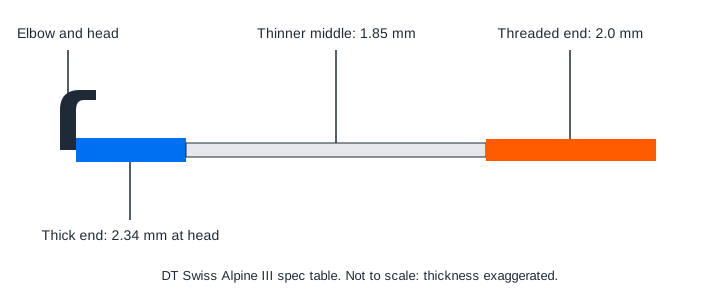
Real product data shows the pattern. DT Swiss lists its Alpine III as triple-butted: 2.34 mm at the head, 2 mm at the thread and 1.85 mm in the middle (Brown’s page gives the middle as 1.8 mm; the DT Swiss spec table governs), with a stated weight saving of 173 g against a constant-diameter spoke (DT Swiss’s claim; the page gives no basis for it), and describes it as suited to high-performance e-bike and tandem wheels. Its Champion is a straight-gauge spoke offered in 1.8, 2.0 and 2.34 mm, and its Competition is double-butted. DT Swiss’s Alpine III page lists e-bike approval as “max. 32 km/h or max. 250 W”, so a faster or more powerful assisted bike is outside that approval; check the same line on any spoke’s page before buying for an e-bike. For hub-motor background, see E-Bike Motors Explained: Hub Drive vs Mid-Drive.
Lacing patterns
The lacing pattern describes how each spoke leaves the hub flange. In the common “semi-tangent” patterns the pattern is named by a cross number: cross 3 means each spoke crosses three other spokes from the same flange. Brown says most wheels are built cross 3.
| Pattern | What it means | Trade-off per Sheldon Brown |
|---|---|---|
| Cross 3 / cross 4 | Spokes leave the flange closer to tangent | Better able to resist the twisting forces of hard pedaling in low gears and of hub brakes |
| Cross 2 or lower | Spokes leave closer to perpendicular to the flange | Shorter spokes, so slightly lighter; can be slightly stronger side to side |
| Radial (cross 0) | Spokes run straight out, no crossings | Only for front wheels without hub brakes; see cautions below |
| Half-radial | Semi-tangent on the right side, radial on the left of a rear wheel | Can make a highly dished rear wheel more durable on the left side |
Brown notes that a wheel with more spokes needs a higher cross number for a similar spoke angle. His typical pairings: 48 spokes cross 5, 40 spokes cross 4, 36 spokes cross 3 or 4, 32 spokes cross 3, and 28 or 24 spokes cross 2. For very large hubs in small rims, fewer crosses are common to avoid bending spokes where they exit the nipples. His example is the Rohloff Speedhub, which has 32 spoke holes and is usually laced cross 2.
Why radial lacing carries warnings
Brown calls radial lacing suitable only for front wheels without hub brakes, and lists two concerns. Nipples pointing straight inward can turn more easily and work loose. The spokes can also pull on the flange along the line of spoke holes, which can crack a hub, most likely a small-flange 36-hole hub. He adds that many hub makers specifically recommend against radial spoking and will not honor warranties on hubs spoked that way. A note from John Allen on the same page describes a crack found along a line of spoke holes on a radially laced machined hub, and says the earlier slight loss of true was a warning sign he missed. Check your hub maker’s instructions before choosing radial lacing for any hub.
Why half-radial exists
In a rear wheel with many sprockets, the cassette side forces a large dish, and the left-side spokes start with low tension. Brown explains that under pedaling torque the left-side “leading” spokes can go slack on every cycle, and repeated tension and slack fatigues them at the bends until they break. Making the left side radial removes those leading spokes. The page also notes that this pattern relies on the hub’s barrel resisting torque only on one side: a hub that must resist torque on both sides, such as one with a disc or drum brake, should not be laced this way. Confirm against the hub maker’s guidance.
Spoke count
Brown argues that more, thinner spokes make a stronger wheel than fewer, thicker ones, and that with very few spokes a single broken spoke can leave the wheel unridable. He recommends more spokes in the rear wheel than the front, giving 28/36 as better than 32/32 for a given wheel pair. This is one builder’s view; manufacturers’ rated wheels may differ, so follow the weight and use ratings for the wheel you own.
Spoke length, in brief
Spoke length is measured from the inside of the elbow to the end of the threads and is worked out from hub and rim dimensions and the lacing pattern. Sheldon Brown’s spoke-length page says to measure the hub and rim yourself rather than trust listed figures, and describes the effective rim diameter (ERD) and the elbow-to-thread length measurement. On his wheelbuilding page, spokes are usually sold in 1 mm increments (some brands only 2 mm). He says spokes that are too short leave threads showing at the nipples, which are prone to breakage, and that spokes 2 or 3 mm too long mean grinding down the spoke ends if the rim lacks recessed spoke holes.
Choosing a pattern: a decision guide
Brown’s cautions above reduce to one question: does the hub transmit torque into the spokes, and through how many of them? Use this as a starting point, then confirm with the hub and wheel maker.
| Wheel | What loads the spokes | Sensible default |
|---|---|---|
| Front, rim brake | Mostly radial load from the road | Cross 2 to cross 3 per spoke count; radial is the only case Brown allows, and only if the hub maker permits it |
| Front, disc or hub brake | Braking torque through the hub | Crossed (tangent) lacing; Brown excludes hub-brake wheels from radial |
| Rear, rim brake | Pedaling torque on the drive side | Crossed on the drive side; half-radial on the left only if the wheel is highly dished and the hub maker allows it |
| Rear, disc brake | Pedaling and braking torque | Crossed on both sides, since half-radial needs a hub that resists torque on one side only |
| E-bike, either wheel | Motor or brake torque plus extra load | Use the wheel or spoke maker’s e-bike approval and recommended lacing, not a general rule |
For a hub-motor wheel the motor adds its own torque, so see Mid-Drive vs Hub Motor for how the two layouts load the wheels. Speed and power limits for e-bikes vary by region (see E-Bike Laws), so rely on the wheel’s own rating.
When a spoke problem needs a shop
A single loose spoke can be adjusted when you know how, and How to True a Bicycle Wheel covers that. Stop riding and have a mechanic look if you find:
- a broken spoke, especially on a rear wheel or a disc-brake wheel;
- a crack in the hub flange or around spoke holes in the rim;
- spokes that repeatedly loosen, or a wheel that keeps losing true.
A quick wheel and spoke check belongs in your pre-ride checklist. Protruding spoke ends on a rim without recessed holes can puncture the tube, one more reason spoke length matters if you ever see repeated flats; see Flat Tire? Here Is Exactly What to Do.
Sources
- Sheldon Brown: Wheelbuilding
- Sheldon Brown: Measurements for Bicycle Spoke-Length Calculations
- DT Swiss: DT Alpine III spoke
- DT Swiss: DT Champion spoke
- DT Swiss: DT Competition spoke
Last reviewed: October 2026.