The number that decides whether a tire fits a rim is the bead seat diameter (BSD) in millimeters, not the inch name. The common names map to these diameters: 26-inch mountain bike wheels are 559 mm, 27.5 and 650B are both 584 mm, and 29-inch and 700C are both 622 mm. Match that number first, then check width against your frame and brakes.
Two naming systems
Traditional inch and French names describe the approximate outside diameter of an inflated tire. The ISO/ETRTO system (ETRTO is the European technical organization for tires and rims) instead names the diameter of the rim’s bead seat, the ledge where the tire bead sits. Sheldon Brown calls the second ISO number the critical one: if it matches the rim, the tire will fit; if it does not, it will not.
An ISO/ETRTO tire marking such as 37-622 gives the tire’s width first and the bead seat diameter second, both in millimeters. Schwalbe’s tire dimensions page uses the same example and says the tire’s inner diameter must match the rim’s bead seat diameter.
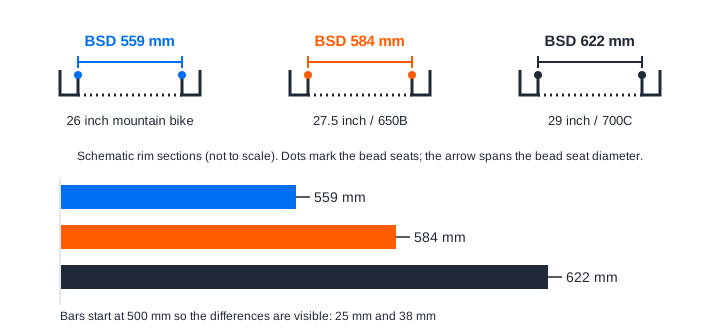
What each common name means
| Common name | Bead seat diameter | Notes |
|---|---|---|
| 26 inch (mountain bike) | 559 mm | Common mountain bike 26 inch size, e.g. 26 x 2.1 (ISO 559) |
| 27.5 inch / 650B | 584 mm | Two names for the same diameter |
| 29 inch | 622 mm | A marketing term for wide tires on a 622 mm rim |
| 700C | 622 mm | Same bead seat as 29 inch |
| 650C | 571 mm | Listed by Sheldon Brown for triathlon, time trial and small-rider road bikes |
| 27 inch (older road bikes) | 630 mm | Not the same as 700C |
Figures are from Sheldon Brown’s tire sizing page, which lists 27.5 under the same 584 mm size as 650B, and describes “29 inch” as a marketing term for wide 622 mm (700C) tires.
Where the inch names mislead
- “26 inch” is not one size. Sheldon Brown lists several incompatible bead seat diameters under that name, including 559, 571, 584 and 590 mm. Equal-looking fractional and decimal labels are also not interchangeable.
- 27 inch is not 700C. The older 27 inch road size is 630 mm, while 700C is 622 mm, so they are different clincher sizes.
- 650B is not 700C or 29 inch. The rims can look close, but 584 mm versus 622 mm is a 38 mm gap in bead seat diameter, 19 mm in radius. A tire with the wrong bead seat diameter will not seat on the rim.
- A 700C road tire and a 29-inch mountain bike tire fit the same 622 mm rim; the difference is width and tread.
Worked example: three “26 inch” tires
Suppose you find three tires all labeled 26 inch. Sheldon Brown’s table lists 26 x 2.1 style decimal sizes at 559 mm, 26 x 1 3/4 (S-7) at 571 mm, and 26 x 1 1/2 (650B) at 584 mm. Against a 559 mm rim, the 571 mm tire is 12 mm too large in diameter and the 584 mm tire is 25 mm too large (12.5 mm in radius). Neither will fit, even though all three say 26. Read the ISO number on the sidewall, not the inch name.
Diameter must match; width has a range
Diameter must match exactly. Width is a separate check: Schwalbe says the tire width must match the inner rim width, and publishes an ETRTO-based table of compatible tire and inner rim widths, with its own recommendations. A wider inner rim gives a flatter tire profile and a narrower one a taller, less wide profile. The tire also has to clear the frame, fork, brakes and fenders. Check the rim maker’s and tire maker’s published ranges for your parts.
How to read your own bike
- Look on the tire sidewall for a two-part number such as 47-622 or 50-584. The second number is the one that decides fit.
- If only inch sizes are printed, do not assume the diameter. Look for the ISO number, or check the rim and tire manufacturer’s spec page.
- When buying a replacement, match the second number exactly, then confirm the width fits your frame, fork, brakes and fenders.
For a tire that has gone flat, see Flat Tire? Here Is Exactly What to Do. To weigh which bike type suits you, read Road Bike, Hybrid or Mountain Bike. Before riding, the 5-minute pre-ride checklist includes a tire check, and preventing punctures covers choosing and maintaining tires.
Sources
Last reviewed: October 2026.