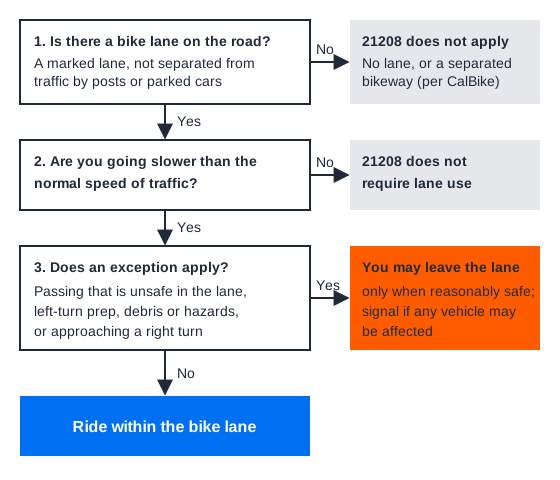
Sometimes. California Vehicle Code section 21208 tells a rider who is going slower than the normal speed of traffic to stay inside a bike lane whenever the road has one, with four listed exceptions. A rider keeping pace with traffic is outside the rule, and CalBike reads the law as leaving physically protected lanes out of it too. This page describes California law as of October 2026. The statute text on Public.Law, verified there on October 19, 2026, is marked as last updated on January 1, 1997.
What section 21208 requires
The duty switches on only when two conditions are both met:
- A bicycle lane has been established on the roadway. The statute ties this to lanes created under section 21207.
- You are riding slower than the “normal speed of traffic” moving the same direction at that moment.
When both are true, you ride within the lane. The section sets no number for “normal speed of traffic”, so there is no mph threshold to memorize. A rider grinding up a hill is plainly slower than the cars beside them; a rider keeping up in a crawling queue may not be. CalBike puts the other side of the rule simply: a rider moving as fast as traffic can ride wherever they like.
The four exceptions
The statute lists four situations in which you may move out of the lane. Each one is a permission, not an obligation.
| Exception in the statute | Condition attached | What it can look like |
|---|---|---|
| Overtaking and passing a bicycle, vehicle or pedestrian | Only if the pass cannot be done safely within the lane | Going around a slower rider, or someone walking in the lane |
| Preparing for a left turn | At an intersection, or into a private road or driveway | Moving left toward the turning position |
| Avoiding debris or other hazardous conditions | Leaving must be reasonably necessary | Broken glass, gravel or a pothole across the lane |
| Approaching a place where a right turn is authorized | None stated | An intersection where drivers may turn right across the lane |
The right-turn exception exists because paths cross there. California’s driver handbook tells motorists to enter a bike lane no more than about 61 m (200 feet) before starting a turn, so a driver turning right and a rider going straight reach the same spot together. The handbook also tells drivers to give riders enough room that they are not forced into parked vehicles or open car doors, which is a reminder that a lane beside parked cars can be a tight place to be.
Leaving the lane safely
Subsection (b) adds two conditions to every exception. You may leave the lane only when the move can be made with reasonable safety, and you must give an appropriate signal first if any vehicle may be affected. The form the signal takes is set out in Chapter 6, which starts at section 22100.
In practice, that means checking behind you and signaling before you drift out, not while you do it. The same habits appear in our guide to the basic rules of cycling on roads. Choosing a route with continuous lanes also reduces how often you have to leave them; mapping a safe cycling route to work covers how to scout a route on maps before you ride it.
Protected lanes are a different category
California sorts bikeways into classes in Streets and Highways Code section 890.4. Two of them matter here.
| Type | How section 890.4 describes it | Does 21208 apply? |
|---|---|---|
| Bike lane (Class II) | A restricted right-of-way for exclusive or semi-exclusive bicycle use. Vehicle parking is permitted, and pedestrians and motorists may cross it. | Yes, when you are slower than traffic |
| Separated bikeway or cycle track (Class IV) | A right-of-way for bicycles only, beside a roadway and separated from vehicle traffic by grade separation, flexible posts, inflexible barriers or on-street parking. | Not according to CalBike |
CalBike’s reading, citing section 890.4(d), is that once a lane is separated from moving traffic the law no longer calls it a “bike lane” but a “separated bikeway”. In that case section 21208 does not apply, and a rider may ride outside the separated bikeway for any reason. The text of section 21208 itself speaks only of a bicycle lane and never mentions separated bikeways.
The DMV handbook draws a similar line from the driver’s side. A buffered bike lane gets extra room from chevrons or diagonal markings, while a separated bikeway is physically separated from motor vehicle traffic. On that description, paint alone is not physical separation.
CalBike describes its page as a summary of the key sections of the law, which is not the same as a court ruling. If a street mixes paint, posts and parking so that you cannot tell which category it falls in, treating it as a bike lane and using the exceptions is the cautious choice.
Where the sources differ
- DMV summary versus the statute. The handbook’s list of bicyclist responsibilities says to use a bike lane whenever possible, or a through traffic lane. That is looser than section 21208, which is triggered by riding slower than traffic and comes with its exceptions. When precision matters, go by the statute text.
- What counts as a bike lane. The handbook lists the separated bikeway among its “types of bike lanes and markings”, while CalBike says the law stops calling a separated lane a bike lane. Section 890.4 keeps the two as separate classes.
When there is no bike lane
Where there is no bike lane, the rule for riders slower than traffic is section 21202. Such a rider must ride as close as practicable to the right-hand curb or edge of the roadway, with exceptions that include substandard width lanes, meaning lanes too narrow for a bicycle and a vehicle to travel safely side by side. CalBike describes the result as the ability to “take the lane” when it cannot be shared that way. Lane width is in the exceptions of section 21202; the four exceptions in section 21208 do not mention it.
E-bikes
CalBike says electric bicycles are generally allowed wherever regular bikes are, unless a sign prohibits them, and that regulations vary by e-bike class. Expect the same bike-lane question on an e-bike, then check posted signs and local rules on your route. Our guide to e-bike laws in the US, UK and EU covers the wider picture.
If lane use becomes a citation or a collision
Section 21208 states the duty and its exceptions but says nothing about a penalty, so the citation or court paperwork is where to find what a ticket involves. Whether an exception applied, such as whether a hazard was real or a move was safe, depends on the facts. If you are cited, or a collision turns on where you were riding, talk to a California attorney. CalBike lists bike-friendly lawyers on its Legal Resources page for riders with a legal problem over lane position. The official wording is on the California Legislative Information site: Vehicle Code section 21208.
Sources
- CalBike: California Bicycle Laws
- Public.Law: California Vehicle Code section 21208
- Public.Law: California Vehicle Code section 21202
- Public.Law: California Streets and Highways Code section 890.4
- California DMV: Section 6, Navigating the Roads
- California DMV: Section 7, Laws and Rules of the Road (Continued)
Last reviewed: October 2026.