A headset is the bearing assembly that connects the fork to the frame and lets the fork turn for steering. To buy the right one you need to know three things: whether the steerer is threaded, the steerer’s outside diameter, and how the bearings sit in the head tube. The size and standard codes printed on frames and parts describe exactly those facts.
What a headset is made of
A headset has four races plus associated parts. From top to bottom: the adjustable race attaches to the steerer, the upper head race is pressed into the top of the head tube, the lower head race is pressed into the bottom of the head tube, and the crown race is pressed onto the bottom of the steerer just above the fork crown. “Pressed” means an interference fit: the inside diameter of the outer part is very slightly smaller than the part that goes into it, so force is needed to assemble or remove it.
Threaded and threadless
A threaded headset fits a fork with a threaded steerer. The top race screws onto the steerer and a locknut screws on after it; a keyed washer normally sits between them for extra security. A threadless headset fits an unthreaded steerer and uses a clamp or collar to secure the top race. Usually the handlebar stem does that job. See Handlebar Setup: How to Adjust for Comfort and Control before altering anything at the steerer.
The most common threadless type is the “Aheadset” style. A threaded fastener such as a star fangled nut sits inside the steerer, the stem clamps the outside of the steerer, and a cap bolted to the star nut presses the stem down to take up play in the system. To adjust it, the stem binder is loosened, then the bolt through the cap is tightened. Two other threadless designs exist, including collar-based “Diatech” types, but the Aheadset style is the most common.
For a given frame you can usually switch between threaded and threadless by changing the fork, the headset and the stem together. The frame mostly does not care, as long as the headset is the correct size.
Safety: never clamp a stem on the threaded part of a threaded steerer. The threads are not made to resist the stress from the stem and could break off along with the stem and handlebars. Converting a bike between the two styles is a job for a shop unless you are very sure of the parts.
Steerer size: the number that names the headset
The nominal size of every headset is based on the outside diameter of the fork steerer. That causes confusion because the steerer is hidden inside the head tube. Do not measure the stem: on a bike with a quill stem, the stem shaft is 1/8 inch smaller than the steerer, so measuring it gives the wrong size.
| Nominal size | Steerer OD | Where it is used |
|---|---|---|
| 1 in | 25.4 mm | The vast majority of bikes with threaded headsets |
| 1-1/8 in | 28.6 mm | A sizable minority of threaded bikes; also the EC34 threadless size used on most newer mountain bikes with external cups |
| 1-1/4 in | 31.8 mm | Mainly tandems |
| 1.5 in | 38.1 mm | The OnePointFive standard for downhill and freeride |
Tapered steerers use two sizes on one fork: in the 38.1 to 28.6 mm (1-1/2 to 1-1/8 in) design, introduced from 2009, the lower bearing is 38.1 mm for stiffness and the upper is 28.6 mm for lower weight and to match existing stem interfaces. A reader tip on the same reference describes a frame using a tapered 1-1/8 in to 1.5 in steerer with a 40 mm lower crown race, and a straight 1-1/8 in fork that can be fitted only by swapping in a crown race reducer, with compatibility depending on the actual cup and bearing dimensions. Confirm the exact lower and upper sizes in the frame and fork documentation.
Where the bearings sit: EC, ZS and IS
- EC (external cup): the traditional pressed headset, which may be threaded or threadless.
- ZS (zero stack, semi-integrated): a bearing cup with a narrow rim rests on the end of the head tube and holds a cartridge bearing inside the tube. Recess depth varies, and a recess that is too shallow may not fit some headsets.
- IS (integrated): a cartridge bearing goes directly into a recess in the head tube with no cups. The recess is a slip fit and the tapered bottom of the recess aligns the bearing.
These are also the main bearing-style differences you will meet. Within an assembly the bearings may be cartridge or cup-and-cone. Even with the same SHIS code and similar appearance, there is no guarantee that internal parts will fit each other, so buying a complete matched assembly is the safer route than mixing parts. In every case the fork’s crown race is a press fit, even on integrated headsets.
Bearing types
Headset bearings are usually ball bearings: loose balls, caged balls, or balls presealed in a cartridge. Needle bearings are also available. Cartridge bearings are the type used in integrated and semi-integrated designs, and one trap is that cartridges for integrated 1-1/8 in headsets come in three angle standards that are not compatible with each other. The numbers describe the angle on the cartridge bearing.
| Cartridge standard | Angles | Head tube inner diameter |
|---|---|---|
| Campagnolo standard | 45/45 | 42.0 mm |
| Cane Creek standard | 36/45 | 41.1 mm |
| FSA standard | 36/36 | Used in FSA semi-integrated (internal cup) headsets; few fully integrated frames use it |
All these bearings look similar, so match the headset to the frame’s stated standard rather than judging by eye.
Reading a SHIS code
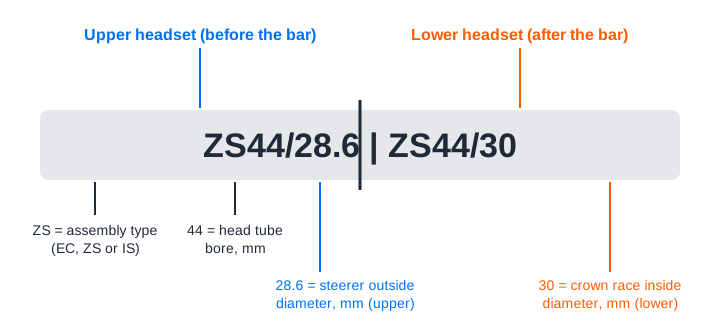
The Standardized Headset Identification System (SHIS) was developed by manufacturers to describe every dimension that affects how a headset fits the frame and fork in a compact code. An example: ZS44/28.6 | ZS44/30.
- The half before the vertical bar is the upper headset; the half after is the lower.
- The two letters give the assembly type (EC, ZS or IS) and can differ top and bottom.
- The number after the letters is the head tube inner diameter where the cup or cartridge goes, rounded down to a whole millimeter.
- The number after the slash is the steerer outside diameter for the upper headset, and the crown race or bearing cartridge inside diameter for the lower, rounded to a whole number.
- A thread other than the usual 24 TPI is appended there. A Nottingham Raleigh headset, for example, is EC30/25.4-26tpi | EC30/26.
- A stack height such as H16 may optionally be listed; it is usually unimportant for threadless headsets.
An upper or lower headset is usually interchangeable with another that has the same code, but the code does not say that parts can be mixed inside one bearing assembly. It also fails for a couple of older threaded standards whose dimensions differ by a fraction of a millimeter.
Common dimensions
| Standard | Cup or cartridge OD | Crown race ID |
|---|---|---|
| 1 in ISO (EC30) | 30.2 mm | 26.4 mm |
| 1 in J.I.S. (EC29) | 30.0 mm | 27.0 mm |
| 1-1/8 in EC34 | 34.0 mm | 30.0 mm |
| 1-1/8 in ZS44 | 44.0 mm | Varies by assembly; see SHIS code |
| 1-1/4 in EC37 | 37.0 mm | 33.0 mm |
| 1.5 in EC49 | 49.7 mm | 39.8 mm |
This is a subset. Many integrated and semi-integrated types (IS41, ZS41, IS42, IS47, IS52, ZS56 and others) exist, and 30.2 mm ISO cups are a very tight fit in the head tube, so a shop may mill the head tube. The 1 in J.I.S. cup is 30.0 mm and the head tube bore 29.9 mm, which is why its code is EC29.
Buying a replacement
- Find the steerer outside diameter from the fork or frame documentation, not by measuring the stem.
- Match the full SHIS code, upper and lower, or the cup outside diameter and crown race inside diameter.
- On threaded bikes, check stack height and thread pitch. A replacement that is too tall leaves parts extending past the top of the steerer, preventing proper assembly; a shorter one can be raised with spacer washers.
- If unsure, take the old headset, or the frame and fork, to the shop.
Pressing cups and crown races needs specialist tools, and sometimes a shop must mill the fork or head tube. Have a shop do it if you do not own those tools.
When to stop riding
The steering is not a place to gamble: if the front end is loose, rough or uneven when you turn the bars, or a part looks damaged, have a mechanic inspect it before you ride on. A common wear pattern is progressive notchiness in the steering. With the front wheel off the ground, a good headset lets the wheel and bars flop to one side by their own weight; with the wheel and bars off the bike, a light, even drag from bearing seals is normal, while roughness or uneven drag indicates problems. To check for looseness, apply the front brake and push the bars back and forth; a clunk usually means the headset is too loose. If the front end clicks or creaks instead, Why Your Bike Creaks and How to Fix It covers other causes, and the 5-Minute Pre-Ride Checklist is a good habit for catching play early.
Sources
Last reviewed: October 2026.