A bicycle stays upright mainly because it is steered, and it steers itself partly because of how the fork is angled. The rider’s hands, the geometry of the front end, and forward speed all contribute. Pedaling, meanwhile, is a simple lever-and-chain arrangement. This guide covers both halves: how a bike balances and turns, and how leg power reaches the road.
At a glance
- Balance: you keep a moving bike up by steering the front wheel under the direction you are falling, much as you would catch a falling broom on your palm.
- Trail: the distance between where the front tire touches the ground and where the steering axis meets the ground. More trail pulls the bike toward straight-ahead; less makes it more responsive.
- Speed matters: a bike can steer itself upright only within a limited range of speeds, so more speed is not always more stability.
- Power: pedals turn cranks and a front chainring; the chain carries that motion to a rear sprocket on the rear wheel. The ratio of the two sets how hard the pedals feel.
Balance: steering into the fall
A bicycle standing still falls over. A moving one does not, because when it starts to lean the front wheel steers toward the lean, which moves the tire contact patches back under the bike’s center of mass. Riders do this constantly with tiny handlebar movements they never notice.
Engineering research describes this in terms of “self-stability”: under certain conditions an uncontrolled bike can steer itself upright, and the range of speeds where that happens is limited. The contributing factors include geometry, mass distribution, gyroscopic effects and forward speed. Wikipedia’s article on bicycle dynamics explains that at low forward speeds the front wheel’s precession is too quick, which contributes to an uncontrolled bike oversteering and falling, while at high speeds it is usually too slow, which contributes to understeering and falling. That instability is slow, on the order of seconds, and easy for most riders to counteract, so a fast bike may feel stable even though it is not self-stable. Speed therefore does not make a bike steadily more stable, and a rider can steer to stay upright outside the self-stable range.
Gyroscopes are not the whole story
A popular explanation says spinning wheels keep a bike upright like a gyroscope. The research record is more nuanced. D. E. H. Jones reported in Physics Today in 1970 (“The stability of the bicycle”) that gyroscopic effects are not necessary for a person to balance a bicycle, and Kooijman and colleagues showed in Science in 2011 (“A bicycle can be self-stable without gyroscopic or caster effects”) that neither effect is necessary for self-stability, using a bicycle designed to be self-stable without them. Gyroscopic effects and trail can still shape how a bike handles, but the research shows they are not the single cause of balance.
Countersteering: why you first turn the wrong way
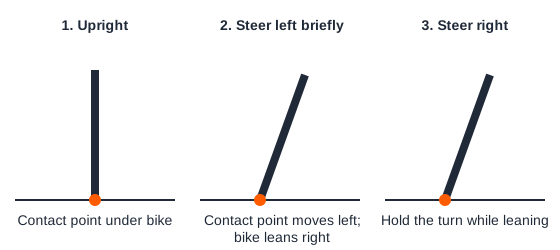
To start a turn, the bike must first lean toward the turn, and the way to do that is to steer momentarily the opposite way. The sideways tire force that results rolls the bike toward the intended direction. This is separate from the self-correction described above, which keeps an already-upright bike from falling. Once the lean is established, the steering angle needed to hold the turn is usually in the direction of the turn. Riders do this without thinking.
Steering geometry: head angle, offset and trail
Three terms describe the front end. The steering axis is the line the fork and handlebars pivot around, running through the head tube. The rake (also called offset) is, per Sheldon Brown’s glossary, the distance between the wheel axle and the extension of the steering axis; builders achieve it by bending the fork blades or setting the dropouts forward of them. The trail is the distance from the front tire’s contact point to where the steering axis meets the riding surface.
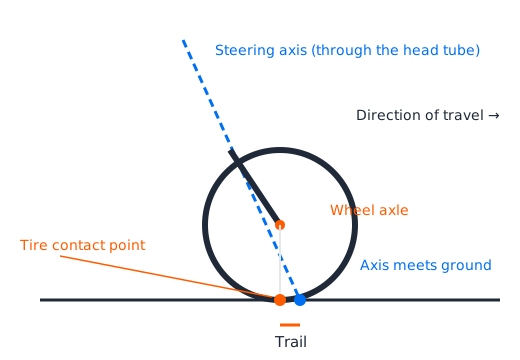
Sheldon Brown notes that trail is a function of three things: the head angle (the angle of the steering axis, usually measured from horizontal, so a bike with a steeper head angle has a more upright steering axis), the fork rake and the tire diameter. Changing any one changes the trail. He also describes the effect: larger trail increases the bicycle’s tendency to steer straight ahead, so a bike with a largish trail is very stable and easy to ride no-hands, while smaller trail makes it more maneuverable and responsive.
That is why geometry charts list head angle and fork offset or rake. Bike makers publish these figures per model and size, so check the manufacturer’s geometry table instead of relying on a general number. When you are comparing a relaxed commuter with a nimble road or mountain bike, handling character is partly written in those figures. For help matching bike type to riding, see our guide on road, hybrid and mountain bikes.
Why fitting matters for steering
Handlebar position changes how much of your weight rides on the front wheel and how far you reach to steer. Our pages on handlebar setup and bike fit explain how to set this up.
Power transfer: from your legs to the road
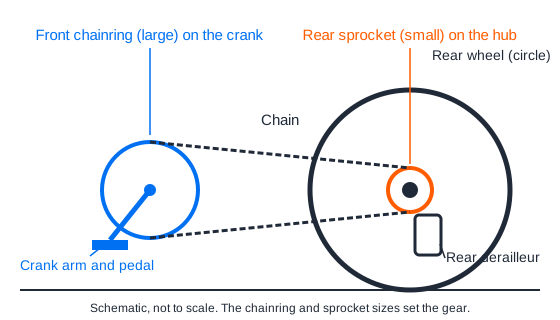
Your feet push pedals attached to cranks, and the cranks turn the front chainwheels (chainrings). A chain connects one front chainwheel to one rear sprocket at a time, and the rear sprocket is attached to the rear wheel hub. Each front and rear pairing is one gear. Sheldon Brown’s gearing overview gives the example that two front chainwheels and five rear sprockets yield ten theoretically possible combinations.
The hub and derailleurs
The rear sprockets are attached to the rear wheel hub, so turning them turns the wheel. On the 10-speed example above, Sheldon Brown explains that the setup needs two separate shifting mechanisms called derailers (derailleurs), one for the front chainwheels and one for the rear sprockets; a 27-speed bike with 3 chainwheels and 9 rear sprockets still has just two. Internal-gear hubs are the alternative: the gearing sits in the rear hub, which Brown notes can shift while you are stopped.
What a gear ratio does
The pairing sets how far the wheel turns for each pedal turn. A small front chainwheel with a large rear sprocket is a lower, easier gear; a large front with a small rear is a higher, harder gear that resists the pedals more and can force a slower cadence. Low gears are for hills and starting; high gears are for speed on flat or downhill ground.
Cyclists compare gears numerically. One long-standing measure is gear inches: the diameter of the drive wheel multiplied by the front sprocket size divided by the rear sprocket size. It is the equivalent diameter of the drive wheel on an old high-wheel bicycle. The arithmetic is simple: 26 inches × 28 teeth ÷ 32 teeth is about 22.8 gear inches, and 26 × 40 ÷ 20 is 52. The larger number moves the bike farther per pedal turn. For reference, Brown puts the lowest gear on most mountain bikes at around 22 to 26 inches. A related measure, the gain ratio, also accounts for crank length and has no units. Both are described in Sheldon Brown’s glossary. To put gearing to practical use, see understanding bike gearing and cadence.
Keeping the drivetrain working
Because the chain transmits all your power, a worn, dirty or poorly adjusted drivetrain wastes effort and shifts badly. Cycle99 covers chain maintenance and fixing poor shifting.
When to stop and get a professional
Understanding the mechanism does not make every repair a home job. If the steering feels loose, notchy or binds, the fork or frame is bent or cracked, or the handlebar or stem moves under load, do not ride the bike. Have a qualified mechanic inspect the headset, fork and frame.
What this guide does not settle
Bicycle dynamics is an active research area, and not every detail of why bikes balance is settled. This guide gives no numeric trail “ideal” values, since they differ by bike type and manufacturer.
Sources
- Sheldon Brown: Bicycle Glossary (Trail)
- Sheldon Brown: Bicycle Glossary (Rake)
- Sheldon Brown: Bicycle Glossary (Gain ratio, Gear inches)
- Sheldon Brown: Gears
- D. E. H. Jones, “The stability of the bicycle,” Physics Today 23(4), 34-40 (1970)
- J. D. G. Kooijman et al., “A bicycle can be self-stable without gyroscopic or caster effects,” Science 332, 339-342 (2011)
- Wikipedia: Bicycle and motorcycle dynamics
Last reviewed: October 2026.