In British Columbia, you may not ride two abreast on the roadway. Section 183(2)(d) of the Motor Vehicle Act bars a person operating a cycle from riding abreast of another cyclist there, and the province’s cycling page tells riders to go single file, “except to pass”. That exception is the catch: it appears on the page but not in the Act’s paragraph. For anyone who rides with a partner or a club, the difference between the two texts is the part worth understanding.
The Act and the province’s page, side by side
“Abreast” means side by side, level with each other instead of one behind the other. Both sources address it, in different words.
| Source | Wording | Passing exception | Version |
|---|---|---|---|
| Motor Vehicle Act, RSBC 1996, chapter 318 (BC Laws) | “must not ride abreast of another person operating a cycle on the roadway” | None in the paragraph | Act current to September 22, 2026 |
| Province of British Columbia, “Bike and e-bike rules and safety” | “Do not ride beside another person riding a bike, e-bike or other personal mobility device, except to pass.” | Yes: “except to pass” | Page last updated June 12, 2025 |
The province’s page lists section 183, headed “Rights and duties of operator of cycle”, among its legislation links, so the page and the Act point at the same section. In the Act, paragraph (d) stops after “on the roadway” and the next paragraph, (e), turns to keeping a hand on the handlebars. The clause itself carries no passing exception.
What “roadway” and “cycle” cover
Roadway. The clause applies “on the roadway”, and for this Part of the Act that word has a specific meaning: the strip of a highway that is improved for, designed for or normally used by vehicles, with the shoulder expressly left out. The province’s sentence says nothing about shoulders. Whether a particular shoulder, bike lane or path counts as roadway is a legal question, so if it matters to you, for a ticket or for a club’s route plan, ask local police or get legal advice instead of reasoning from a general article.
Cycle. The clause speaks of “another person operating a cycle”. The Act’s definition of cycle includes a “motor assisted cycle”, meaning a device prescribed as one for the purposes of section 182.1, so e-bikes that meet that prescription are covered. A human-powered device qualifies only if it is not a designated personal mobility device. The province’s sentence names a wider list (a bike, an e-bike “or other personal mobility device”), and its page adds that bikes and e-bikes are held to the general rules of the road that apply to drivers. In a mixed group, assume everyone is expected to hold the line. For how e-bike categories are drawn elsewhere, our e-bike laws guide covers the US, UK and EU.
Where the two texts part ways
Passing. The province allows side by side “to pass”; paragraph (d) does not mention overtaking at all. Section 183(1) puts a person on a cycle on the same footing as a driver, rights and duties alike, and the Act’s overtaking rule for drivers (section 157) is to pass on the left at a safe distance and not move back to the right until safely clear of the vehicle being overtaken. That is the general picture of a pass. The province’s page does not say how long a pass may last. The cautious reading treats the Act as the law and the page as plain-language guidance: go by, tuck back into line, and do not sit alongside someone to finish a conversation. This is an explainer, not legal advice.
Position on the road. The Act asks a person on a cycle to ride “as near as practicable to the right side of the highway”, and adds that this does not require riding on any stretch that is not paved. The province’s page frames it as keeping to the right as far as practicable on a paved roadway, unless a sign or traffic control device directs otherwise. Both hinge on “practicable”, a standard that depends on conditions.
What a single line changes for drivers passing you
A line of riders is narrower than a pair, so there is less for a passing driver to clear. Section 157.1 of the Act lets a driver pass a person on a cycle only when it can be done safely and with at least 1 m (about 3.3 ft) between vehicle and person, unless a prescribed distance applies. The Motor Vehicle Act Regulations, Division 48 (consolidation current to October 6, 2026), prescribe two: 1.5 m (about 5 ft) on a highway with a speed limit above 50 km/h, and 0.5 m (about 1.6 ft) when the person is on a sidewalk or inside a protected cycle lane. The regulation describes a protected lane as one kept apart from vehicle traffic by a physical feature such as a ditch, planter, wall or pole.
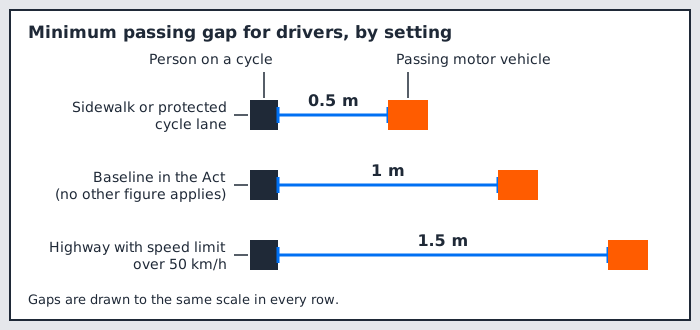
These are three separate settings, not a ladder: on a road posted above 50 km/h the driver must leave 1.5 m, not 1 m. None of it changes the rider’s own duty of care. The Act also prohibits operating a cycle on a highway “without due care and attention or without reasonable consideration for other persons”.
On a group ride
- Ride in a line on the roadway. Two riders chatting side by side is exactly what both texts address. Our guide to riding safely in a group covers spacing and communication within a line.
- Keep passes brief. When you move up the line or overtake a slower rider, go by and rejoin rather than holding the side-by-side position.
- Check local rules. The province’s page cautions that individual municipalities can have their own rules about where you may ride, including on shared paths, so check with yours and follow signs. When choosing where to ride, see our guide to finding and planning routes.
- Treat organized events separately. The page says stretches of provincial highway can host events involving cycles, from races and rallies to parades and triathlons, and it points to highway use permits for them. If you ride in one, follow the organizer’s briefing and any marshals instead of assuming the everyday rule is relaxed.
How Queensland compares
The rule is not universal. Queensland’s government page says a rider who is beside another rider must stay within 1.5 m (about 5 ft) of that rider, and that no more than two riders may ride side by side unless one is overtaking. Where Queensland’s wording plans for a pair, British Columbia’s does not. For everyday road habits that hold anywhere, see our basic rules of cycling on roads, and remember that local law always comes first.
Sources
- BC Laws: Motor Vehicle Act [RSBC 1996] chapter 318, Part 3
- BC Laws: Motor Vehicle Act [RSBC 1996] chapter 318, section 1 (definitions)
- BC Laws: Motor Vehicle Act Regulations, Division 48 (Minimum Passing Distances)
- Province of British Columbia: Bike and e-bike rules and safety
- Queensland Government: Bicycle road rules and safety
Last reviewed: October 2026.