It depends on the state and the city, and wherever sidewalk riding is allowed it comes with duties to pedestrians. In Virginia, Minnesota, Florida and Oregon, a rider on a sidewalk takes on a pedestrian’s rights and duties and has to give way to people on foot. Virginia and Minnesota also let local governments close sidewalks to bicycles, and Minnesota bars riding in business districts unless local authorities permit it. The Florida and Oregon sections compared here do not address local bans, though Florida separately gives local governments power over how bicycles are operated. Oregon is the outlier: its statute lists riding an electric-assisted bicycle on a sidewalk as an offense.
This page compares those four statutes. Other states and cities write their own rules, so treat it as a map of the pattern, not a ruling for your street and not legal advice.
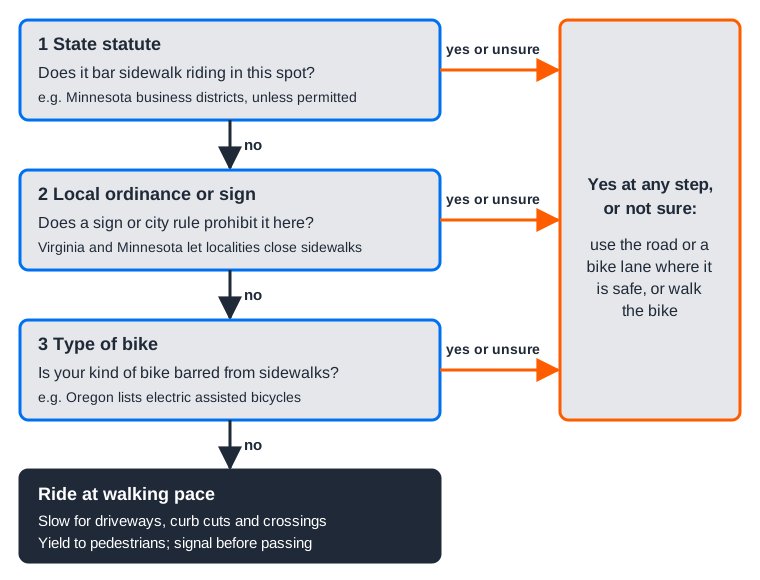
Three filters decide whether you can ride on a given sidewalk
- State statute: your status on a sidewalk and what you owe people walking there.
- Local rules and signs: in Virginia and Minnesota the statute itself lets local government narrow the baseline, so one block can differ from the next.
- Bike type: Oregon treats electric-assisted bicycles differently from other bicycles.
What you owe pedestrians on any sidewalk you may use
The four statutes share a core: pedestrian status plus two duties, yielding and making yourself heard. Minnesota words the status for a person lawfully operating a bicycle there, so it assumes the sidewalk is open to you in the first place.
| State and statute | Pedestrian rights and duties | Yield to pedestrians | Audible signal |
|---|---|---|---|
| Virginia, Code § 46.2-904 | Yes | To any pedestrian | Before overtaking and passing |
| Minnesota, Statutes § 169.222 | Yes, for a person lawfully operating a bicycle there | To any pedestrian | When necessary, before overtaking and passing |
| Florida, Statutes § 316.2065 | Yes, for a person propelling a vehicle by human power | To any pedestrian | Before overtaking and passing |
| Oregon, ORS 814.410 | Yes, unless other law provides otherwise | To all pedestrians on the sidewalk | Audible warning before overtaking and passing |
In Virginia, Minnesota and Florida the yield duty also covers crossing a roadway in a crosswalk.
The main difference is the signal. Virginia and Florida require it before you overtake and pass a pedestrian, while Minnesota says “when necessary.” Signal every time: a bell or a clear spoken word, early enough for the person to react. If there is no room to pass, slow down and wait.
Where cities and towns can say no
Virginia: by ordinance, with signs
The governing body of any Virginia county, city or town may prohibit riding bicycles, electric power-assisted bicycles included, on designated sidewalks or crosswalks, and signs indicating the prohibition must be posted in general areas where it applies. The riding rule points back to those signs: under § 46.2-904, no person may ride a bicycle on a sidewalk, or across a roadway on a crosswalk, where official traffic control devices prohibit that use. Obey posted signs, and check the local code where there are none.
Minnesota: a business-district default
A person must not ride a bicycle on a sidewalk within a business district unless local authorities permit it, and local authorities may also prohibit bicycles on any sidewalk or crosswalk under their jurisdiction.
The traffic chapter defines “business district” by frontage: roadside where 50 percent or more of the frontage over a distance of about 91 m (300 feet) or more is occupied by buildings in use for business. A main street lined with shops is the likely example. If you are unsure whether a block qualifies, or whether the city has permitted riding there, check with the city or county.
Florida and Oregon: not addressed in the sections compared
Neither Florida’s bicycle section nor Oregon’s sidewalk section mentions local sidewalk bans, which does not mean cities there cannot act. Florida’s 2025 statute on powers of local authorities says the traffic chapter does not prevent local authorities, on streets and highways under their jurisdiction, from regulating the operation of bicycles (§ 316.008(1)(h)). It also lets a county or municipality enact an ordinance to permit, control or regulate vehicles, electric bicycles and other listed devices on sidewalks, where federal law permits such use (§ 316.008(7)(a)). A Florida city may therefore have its own rules; Oregon’s section is silent, so check the city code in both states.
Driveways, crossings and speed
Of the four, only Oregon names a speed for these spots. Riding faster than an ordinary walk is part of the sidewalk offense when you approach or enter a crosswalk, approach or cross a driveway, or cross a curb cut or pedestrian ramp, and a motor vehicle is approaching that crosswalk, driveway, curb cut or pedestrian ramp. The paragraph is aimed at places where the path for pedestrians or bicycles approaches or crosses motor vehicle traffic.
Oregon also lists riding so as to suddenly leave a curb or other place of safety and move into the path of a vehicle so close that it is an immediate hazard, and riding in a careless manner that endangers or would be likely to endanger any person or property.
Walking pace at these spots is sensible anywhere, though only Oregon’s text requires it. A driver pulling out of a driveway is mostly watching the road, and a bicycle covers ground faster than a walker, so slowing down gives the driver more time to notice you and you more time to stop.
Oregon: electric-assisted bicycles are a separate case
One of the acts Oregon lists as unsafe operation of a bicycle on a sidewalk is operating an electric assisted bicycle there. Virginia is the contrast: its yield duty names electric power-assisted bicycles alongside bicycles, and its local ordinances can reach them too. The same bike can therefore be a sidewalk rider with a duty to yield in one state and an offender in another. Class-specific e-bike rules are outside this page; start with the e-bike laws guide.
The Oregon wording comes from the public.law copy of the statute, which cites the Oregon Legislature’s ORS page as accessed May 26, 2025. Laws change, so confirm the current text on the Oregon Legislature’s site.
What a violation can mean
- Virginia: a violation of the section or of a local ordinance under it is punishable by a civil penalty of not more than $50.
- Florida: a violation of the section is generally a noncriminal traffic infraction, punishable as a pedestrian violation under chapter 318.
- Oregon: unsafe operation of a bicycle on a sidewalk is a Class D traffic violation.
A routine that keeps you legal and welcome
- Look for signs at the start of a sidewalk, and read your city or county code for “bicycle” and “sidewalk.”
- If you are unsure, use the road or a bike lane where that is safe, or walk the bike. The basic rules of cycling on roads cover that choice, and mapping a safe route to work helps if the road feels stressful.
- Ride at walking pace near people, driveways, curb cuts and crossings, signal before you pass, and give way.
Riding with young children? Check local sidewalk rules first, and see cycling with kids for family setups.
Sources
- Virginia Law Library (Code of Virginia): § 46.2-904, sidewalks, shared-use paths and local ordinances
- Minnesota Office of the Revisor of Statutes: Sec. 169.222, Operation of bicycle
- Minnesota Office of the Revisor of Statutes: Sec. 169.011, Definitions
- Florida Senate: 2025 Florida Statutes, Chapter 316, Section 2065
- Florida Senate: 2025 Florida Statutes, Chapter 316, Section 008, Powers of local authorities
- Oregon Revised Statutes (public.law copy): ORS 814.410, Unsafe operation of bicycle on sidewalk
Last reviewed: October 2026.