Quick answer
Choose disc brakes if you ride in wet weather, on long or steep descents or with wide tires. Choose rim brakes if you want the lightest, simplest, cheapest system to maintain and your riding is mostly dry and flat to rolling. Which one you can buy is partly decided for you: a frame and fork are built for one system or the other, and you cannot add discs to a rim-brake frame without the right fittings.
| Factor | Rim brakes | Disc brakes |
|---|---|---|
| Braking surface | The wheel rim itself | A separate metal rotor on the hub |
| Wet weather | Reduced until the shoes wipe the rim dry; drastically worse with cheap steel rims, moderately worse with aluminum | Works better in the wet, though pads can howl |
| Weight | Lightest option | Heavier |
| Cost and upkeep | Simpler and cheaper | More complex and costly to maintain, especially hydraulic |
| Wear | Wears the rim sidewall | Wears pads quickly and rotors over time; rim is untouched |
| Bent or out-of-true wheel | Affects braking | Does not affect braking |
| Frame requirement | Brake bosses or a caliper mounting hole | Special frame, fork and hub fittings |
How each system stops the bike
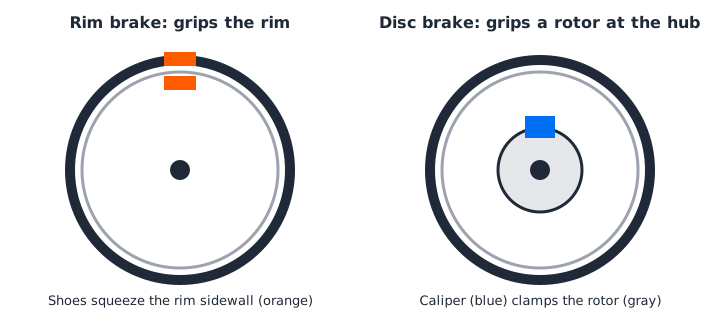
Every bicycle brake turns motion into heat by pressing friction material against something that rotates with the wheel. The difference is what that something is.
A rim brake squeezes rubber or composite shoes against the wheel rim. Sheldon Brown lists several designs: caliper brakes, which attach to the frame with a single bolt above the tire; cantilevers, with two separate arms on their own pivots; and U-brakes and roller-cam brakes. Cantilever, U and roller-cam brakes need brazed-on fittings called studs or bosses. Because the rim doubles as the braking surface, this is the lightest approach.
A disc brake uses a small metal rotor bolted to the hub and a caliper holding pads that clamp it. Braking force goes through the hub instead of the rim, so rim condition no longer matters. The calipers can be cable-operated (mechanical) or fluid-operated (hydraulic); hydraulic models avoid cable friction and some self-adjust for pad and rotor wear.
Where disc brakes win
- Wet conditions. Wet rims reduce rim-brake effectiveness; discs are little affected by wet and do not clog with mud or snow.
- Damaged or untrue wheels. A disc works regardless of rim damage or a wheel out of true. Rim brakes need a true wheel to work smoothly (see how to true a wheel).
- No rim wear. Rim brakes wear the rim; Sheldon Brown notes an aluminum rim may last only a couple of thousand miles in muddy or sandy conditions. Discs spare the rim, though pads wear quickly and rotors are replaceable parts.
- Tire clearance. The caliper does not arch over the tire, so wide tires need no design compromise.
- Lever effort. Large rotors give strong braking with low lever effort on better models.
Where rim brakes win
- Weight and simplicity. Fewer parts, lighter, and less costly to buy and maintain.
- Easy wheel changes. With discs, swapping a wheel means the caliper must be re-centered on the rotor, and a disc can interfere with racks and fender stays.
- Fork and hub loads. A front disc loads one fork blade heavily, which can call for a stronger fork. Under braking, a front caliper behind the fork blade can also pull the wheel toward the dropout. Sheldon Brown notes that a through-axle hub and a fork with a hole rather than a slot address this, which is why modern disc bikes commonly use through-axles. Check that your quick-release or through-axle is fully and correctly secured on any disc bike.
- No rotor noise or drag. Disc calipers can rub when not in use, and discs can howl when wet.
Limits of each system
Rim brakes and carbon rims are a poor combination because the braking surface wears faster, needs special shoes, and is costly to replace. Sheldon Brown also notes that rims wear thinner with grit, and a rim with thin sidewalls can split. Many modern rims have a small pit in each sidewall as a wear indicator; replace the rim when the pits disappear.
Heat. On long, steep descents both systems get hot. Sheldon Brown reports overheating tires blowing out on tandems with rim brakes, and notes that early disc brakes failed when pad glue melted or fluid boiled before heat-management features arrived. Shimano describes brake fade as what happens when stopping demand exceeds the brake’s ability to shed heat, typically on a long, steep descent with sustained braking. Brake manufacturers’ manuals give the proper technique and service limits for your model, so read yours before a big descent.
Compatibility: what you can actually choose
- Frames and forks. Discs can only be installed on frames and forks with disc fittings. Some frames have disc fittings but no rim-brake provisions, so check what your frame accepts before buying wheels.
- Caliper mount: post mount vs flat mount. These are two different caliper mounting standards, and the frame or fork must match the caliper (adapters exist for some combinations). Post mount is common on mountain bikes; flat mount is common on road and gravel bikes. SRAM publishes an explainer: flat mount vs post mount calipers.
- Rotor size. Rotor diameter must be supported by both the frame or fork and the caliper mount. Frames and forks carry a maximum rotor size, and changing size usually needs a different adapter. Confirm limits in the frame, fork and brake manufacturers’ documentation.
- Axle standard. Disc bikes are commonly built around thru-axles, though some use quick-release. Wheel axle type and spacing must match the frame or fork, and the axle must be secured as the manufacturer instructs.
- Hubs. Disc wheels need disc hubs. Rotors attach either with six bolts or with the Centerlock splined lockring, and the rotor must match the hub; adapters exist to fit 6-bolt rotors to Centerlock hubs but not the reverse. Sheldon Brown also lists older patterns such as Hope 3-bolt and Rohloff 4-bolt.
- Rotor and caliper. Rotor size and caliper position must match, and brands can be mixed, but Sheldon Brown recommends sticking with manufacturer-suggested combinations. Mounting standards and rotor sizes vary by model, so confirm in the frame, fork and brake manufacturers’ documentation.
- Levers. Cable-operated disc brakes use long-pull levers, while “road” cable discs work with ordinary levers. Hydraulic brakes come as matched lever-and-caliper systems.
Which should you pick?
- Commuting in all weather: discs are the usual choice, because Sheldon Brown notes wet rims reduce rim-brake effectiveness while discs are little affected. See our commuting guide and e-bike vs regular bike comparison; for an e-bike, follow the brake type and rating the manufacturer specifies.
- Dry-weather road or casual riding on a budget: rim brakes are perfectly capable and easier to service.
- Mountain biking: discs are popular off-road (Sheldon Brown). Our road, hybrid and mountain bike guide covers bike types.
- Buying used: inspect rim sidewalls (wear pits) or rotor condition and pad thickness. See commuter bike options for a sense of what comes with each.
Maintenance and when to stop riding
For adjustment steps, see how to service your own brakes and, for cable-operated systems, cable and housing maintenance. Rim-brake shoe height is the most critical setting: a shoe set too high rubs the tire, and one set too low can dive into the spokes and lock the wheel.
Replace a rotor if it is thinner than about 1.5 mm or seriously concave; Sheldon Brown cites 1.7 mm for Moment and 1.52 mm for Hayes, so check the minimum stamped on or specified for your rotor. A plain vernier caliper cannot read a concave rotor directly. Sheldon Brown suggests either a micrometer, or bending a spoke flat along each side of the rotor, measuring over it with a caliper, and subtracting twice the spoke thickness. The stamped minimum on your rotor always overrides these generic figures.
Your brake manual is the authority for wear limits. As a general precaution rather than a manufacturer limit, stop riding and see a qualified mechanic if the lever pulls to the bar, a hydraulic system leaks or feels spongy, pads or rotors are worn to their limits, a rotor is bent or cracked, a rim sidewall is cracked or bulging, or the brake does not release. Never mix brake fluids. Hydraulic brakes use either mineral oil or DOT fluid, and the two are not interchangeable. Which one applies depends on the brake model: SRAM DOT brakes call for DOT 4 or 5.1 (SRAM says DOT 5 silicone fluid damages them and other fluids void the warranty) and SRAM’s DB8 is a mineral-oil model. Check the label, manual or manufacturer page for your exact brake. Keep oil off pads and rotors.
A note on sources. Sheldon Brown’s pages are long-standing and widely respected but dated. He also wrote before road disc brakes were common and was skeptical of discs for road use, so treat his road-bike views as historical and rely on current manufacturer documentation for specifications.
Sources
- Sheldon Brown: Brake Choices
- Sheldon Brown: Disc Brakes
- Sheldon Brown: Rim Brakes
- SRAM Support: Flat mount vs post mount calipers
- SRAM Support: Can I use DOT 5 in my SRAM DOT brakes?
- SRAM Support: DB8 mineral oil brakes and other mineral oils
- Shimano: ICE Technology brake performance (brake fade)
Last reviewed: October 2026.