A disc brake rotor has two specifications that must both match your bike: its diameter (the sources below mention sizes from 140 mm up to 203 mm) and its hub mount (six bolts or Center Lock). A third item, the caliper mount on the frame or fork, decides which diameters the bike can physically take. This page explains each, so you can read a product listing and know what you are looking at.
Rotor diameter: what changes when it grows
Wikipedia notes that rotors come in many sizes, such as 160 mm (6.3 in), 185 mm (7.3 in) and 203 mm (8.0 in). A 140 mm rotor is also common: one component maker says most flat-mount forks are designed for it.
Diameter is a trade-off:
- Larger rotor: greater braking torque for a given pad pressure, and, in Sheldon Brown’s words, larger rotors are heavier but “dissipate heat more readily”. Heat matters on long descents, where he notes that disc brakes generate significant heat.
- Smaller rotor: less braking torque, but less weight and better protection from knocks, according to Wikipedia.
It is also common to run a larger rotor on the front wheel and a smaller one on the rear. Riders who spend time on steep descents may want to read how to descend a hill faster and more safely, since technique and brake size work together.
Hub mount: six-bolt or Center Lock
The hub mount is how the rotor attaches to the wheel. The two mainstream designs are not interchangeable without an adapter.
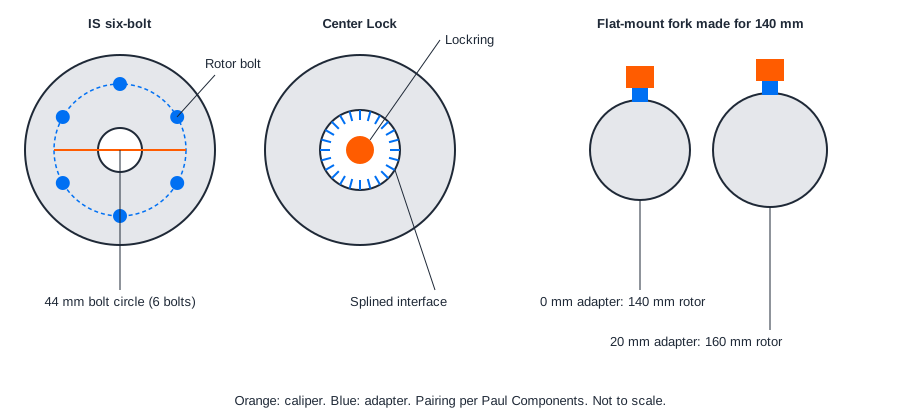
| Mount | How it attaches | Notes |
|---|---|---|
| International Standard (IS), six-bolt | Six bolts, 44 mm bolt circle diameter; usually M5×10 mm bolts | Described by Wikipedia as the industry standard |
| Center Lock | Splined interface plus a lockring | Patented by Shimano |
Adapters exist that let six-bolt rotors fit Center Lock hubs. Sheldon Brown lists other patterns, the Hope 3-bolt and Rohloff 4-bolt, and warns that some older patterns are no longer in production, so replacement rotors for an older hub can be hard to find.
Check the listing for what is in the box: Center Lock rotors use a lockring and six-bolt rotors use bolts, so confirm the correct parts are included before buying.
Caliper mount: why your frame limits the rotor
The caliper bolts to the frame or fork, and Wikipedia says most manufacturers today use either the IS or post-mount (PM) standard, which differ by disc size and axle type. It adds that in 2014 Shimano introduced a “Flat Mount” standard for high-end road bikes, which is why you will see flat-mount forks, post-mount calipers and adapters between them. Wikipedia also notes that on a post mount the bolt threads directly into the fork lower, so a stripped thread needs repair. Sheldon Brown is blunt about the consequence: the size of the rotor and the caliper position must match.
Moving to a larger rotor therefore means moving the caliper outward with an adapter. Paul Components, which makes adapters for flat-mount forks, sells them in 0 mm and 20 mm sizes. Its guidance for a fork designed for a 140 mm rotor is to use the 0 mm adapter for 140 mm and the 20 mm adapter to “bump up to a 160mm rotor”. For 180 mm rotors it says this might not work, depending on fork design. The practical rule: find the rotor size your frame or fork was designed for, and treat larger sizes as something the manufacturer must approve.
Always check a frame or fork’s stated maximum rotor size. Do not fit a larger rotor on a fork whose maker does not allow it: a front disc brake, Sheldon Brown notes, stresses one blade of the fork very heavily.
Rotor wear and when to replace
A rotor thins as it wears. Sheldon Brown says that with most brands a rotor under 1.5 mm thick, or seriously concave, should be replaced, while manufacturers differ: he lists 1.7 mm for Moment and 1.52 mm for Hayes. Wear limits vary by brand, so look up the manufacturer’s figure. Sheldon Brown notes that concavity means a conventional vernier caliper cannot measure rotor thickness directly; a micrometer caliper is needed.
Take the bike to a mechanic if a rotor is bent, cracked, concave, below its minimum thickness, or contaminated with oil, or if braking feels weak or inconsistent. Rotors get extremely hot in use and can burn skin, so never touch one straight after a descent.
For pad and caliper care, see how to service your own brakes, and make a quick brake check part of your pre-ride checklist.
Buying checklist
- Find the size your frame or fork was designed for (often in the maker’s specifications).
- Identify the hub mount: six bolts, or a splined Center Lock hub.
- Decide whether a different size is worthwhile for your riding, using the heat and torque trade-offs above, and whether an adapter is needed.
- Check the brake maker’s specifications for compatible rotors before ordering.
Sources
- Wikipedia: Bicycle brake
- Sheldon Brown: Disc Brakes
- Paul Components: Front Post Mount to Flat Mount Adapter
Last reviewed: October 2026.