A tire fits a rim when two numbers line up: the bead seat diameter must match exactly, and the tire width must sit inside the range the rim’s inner width supports. The first is a yes-or-no check; the second is a judgment about handling, pinch-flat risk and, on hookless rims, safety.
Reading the ETRTO/ISO marking
The marking molded into a sidewall, such as 37-622, is the tire’s ETRTO designation. It is defined by the international standard ISO 5775. The first number is the tire’s width in millimeters; the second is the bead seat diameter (BSD), the diameter in millimeters of the rim surface the tire bead sits on.
The second number is the critical one. If it matches the rim’s, the tire will generally fit; if it does not, the tire will not. Schwalbe’s example: a 37-622 tire fits a 622 x 19C rim, where 19 is the rim’s inner width in millimeters, and the tire width and inner rim width must also be matched.
Inch names are loose labels for a few bead seat diameters: “700C” and “29 inch” tires share 622 mm, traditional 26 inch mountain tires use 559 mm, and 650B or “27.5 inch” tires use 584 mm. Check the second number rather than the name.
Matching width: the rim’s inner width decides
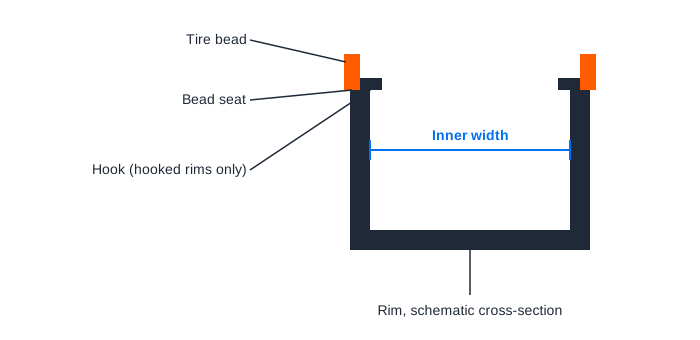
The inner width is the distance between the rim’s inside walls, not the outside width. Schwalbe states that the tire width and inner rim width must be matched, and publishes an ETRTO-based chart for it.
Schwalbe’s ETRTO chart, abridged
Schwalbe’s chart is labeled “ETRTO Standard 2024” and lists tire-width bands against inner-rim-width bands. The rows below are read from that chart for common road, gravel and commuter widths; the full chart also covers 20 to 24 mm and 58 mm and wider tires.
| Tire width | Inner rim widths marked as possible (mm) |
|---|---|
| 25 to 27 mm | 15, 16, 17, 18 to 20, 21 to 22 |
| 28 mm | 16, 17, 18 to 20, 21 to 22, 23 |
| 29 to 34 mm | 16, 17, 18 to 20, 21 to 22, 23, 24, 25 |
| 35 to 46 mm | 17, 18 to 20, 21 to 22, 23, 24, 25, 26 to 27 |
| 47 to 57 mm | 17, 18 to 20, 21 to 22, 23, 24, 25, 26 to 27, 28 to 30 |
Example: a 40 mm gravel tire falls in the 35 to 46 mm row, so rims from 17 to 27 mm inner width are marked possible. A 622 x 19C rim, as in Schwalbe’s own example, is inside that range. Schwalbe adds that its chart for hookless rims applies only to TLE/TLR tires, and that the rim maker’s pressure and tire-type limits must always be considered.
Sheldon Brown gives a simpler rule of thumb, a tire width between 1.45 and 2.0 times the inner rim width. Wikipedia reports other guidance: ideally 1.8 to 2 times the rim width, with 1.4 to 2.2 fitting. The sources differ, so use the maker’s chart for your own rim and tire when one exists.
What goes wrong at the extremes
- Tire too narrow for the rim: a higher risk of pinch flats and of rim damage from road hazards.
- Tire too wide for the rim: a higher risk of sidewall or rim failure.
Hooked versus hookless rims
Hooked rims have hooks on the inner-rim flange. Hookless rims have a straight sidewall on the inside and usually a wider rim width. ETRTO’s designation for tubeless hookless rims is TSS (Tubeless Straight Side).
- Tire type: Schwalbe states that hookless or straight side rims may only be combined with its TLE/TLR (Tubeless Easy/Tubeless Ready) tires, and that the tire widths specified by the rim maker must be taken into account. Follow the rim maker’s compatible-tire list.
- Pressure: Schwalbe, citing ETRTO, gives a maximum of 5 bar for hookless road rims, even when the tire sidewall allows more. If the rim’s own limit is lower, the rim’s limit applies.
- Minimum width: Schwalbe notes that many rim and wheel makers recommend a minimum tire width of 28 mm so the low pressure can be ridden without problems. The exact minimum for your inner width is in your rim maker’s documentation.
Stop and consult a bike shop or the wheel manufacturer if you cannot find the rim’s rated maximum pressure or compatible tire list, or if the tire looks uneven or deformed on the rim once inflated. Do not inflate beyond the lowest of the rim and tire limits.
A quick decision routine
- Read the rim’s bead seat diameter and inner width from the rim sticker or the maker’s page. It must match the tire’s second number.
- Check the tire’s width against the rim maker’s chart; if there is none, use the 1.45 to 2.0 guideline above only as a rough screen.
- If the rim is hookless, confirm the tire is approved for it, and set pressure at or below the rim’s maximum.
- Remember that real pressure needs depend on width and load; see tire pressure, and for sealant setups why tubeless tires are worth the switch.
For wider options on rough roads, see gravel tires explained, and if a fitting attempt ends in a puncture, how to fix a flat tire.
Sources
- Sheldon Brown: Tire Sizing
- Wikipedia: Bicycle tire
- Schwalbe: Bicycle Tire Dimensions
- Schwalbe: Possible combinations of tire widths and inner rim widths (ETRTO Standard 2024)
- Schwalbe: Hookless rims FAQ
- Schwalbe: Tubeless racing bike requirements
Last reviewed: October 2026.